Bush Hogging and Field Mowing: Cut the field before it needs a mulcher.
A field left alone goes to weeds, then briars, then saplings. We cut it back with our Massey Ferguson tractor and batwing cutter.
Quincy, Florida. Free estimates. Job minimum $2,000.

Is this what you need?
The pasture went to weeds
It was grass a few summers back, and now the dogfennel is over your head and the briars grab your legs.
I can still see across it, for now
Pine and privet seedlings are coming up through the grass, and this year they are whips a cutter can take.
The edges are closing in
The field gets a little smaller every year as briars and brush walk out from the fence row and the tree line.
The lot is waist high, and it is mine
A vacant lot, a road frontage, the parcel beside the shop. It needs cutting, and you do not own a tractor that can do it.
More on these
The pasture went to weeds
Bahiagrass is a persistent grass and may still be alive under all that, but it needs the light back.
I can still see across it, for now
Leave them and they grow into a mulching job, which starts at about 11 times the per acre rate.
The edges are closing in
The path you used to drive along the fence is gone.
The lanes grew shut before deer season
The food plots, the shooting lanes and the road to the back stand all grew up over the summer. You want them open before the season, not during it.
How I do it

Tractor ground or mulcher ground
I tell you which part the batwing takes and which part needs the mulching head.
Mark what the cutter cannot see
Well heads, old fence, stumps and the young trees you want kept get a flag.
The field is cleared of people and stock
A rotary cutter throws what it hits, so people and stock stay 300 feet back.
The tractor cuts
The batwing cuts three decks wide. The clippings stay where they fall.
Every step in detail
See a range before anyone calls you
Pick bush hogging in the instant quote and draw the field on the map.Time: About 2 minutes
I look at the field with you
I look at how tall and how woody the growth is. The visit is free.Time: One visit
Tractor ground or mulcher ground
I tell you which part the batwing takes and which part needs the mulching head.
Mark what the cutter cannot see
Well heads, old fence, stumps and the young trees you want kept get a flag.
The field is cleared of people and stock
A rotary cutter throws what it hits, so people and stock stay 300 feet back.
The tractor cuts
The batwing cuts three decks wide. The clippings stay where they fall.
A last look, and a date for the next cut
Look at the edges and corners with us. Then decide when it gets cut next.
What it costs
- Ten acres, overgrown
- $2,000 to $2,600
- Twenty acres, overgrown
- $2,500 to $3,900
- Forty acres, overgrown
- $4,550 to $7,000
- Ten acres with saplings in it
- $2,350 to $3,650
Estimates, not quotes. I confirm the price on site, and the visit is free. Job minimum $2,000.
What moves the price
Every figure here is an estimate, not a quote.
On flat, dry, open ground close to Quincy, ten acres of overgrown field runs about $2,000 to $2,600, which is the minimum at work, and twenty five acres of the same field about $3,050 to $4,700.
I confirm the price after I have seen the field, and the visit is free.
How many acres
A bush hog only job reaches our minimum at about 13 acres of overgrown field, or about 22 to 25 acres of field that has been kept up. Past 10 acres the per acre figure starts to come down.
How long since the last cut
I sort open ground into three kinds: a field cut within about a year starts around $75 to $120 an acre, a field that missed a season or more, waist high with briars, around $135 to $210, and a field with saplings in it around $235 to $365.
How thick the stems are
Up to about two inches, it is cutter work. Past that it is a mulching job, and mulching light brush starts around $1,530 to $2,250 an acre, so a field that is part one and part the other is priced as two lines.
What is hiding in the grass
Old fence wire, T posts, stumps, pipe or a junk pile each slow the tractor, and wire has to come out before the cutter goes in. If there is a lot of it, that is hauling and debris removal.
The shape of the ground
One big open field cuts fastest. Small paddocks, trees to go around, ditches and tight corners all add turning.
Wet ground
Soft ground can mean waiting for a dry spell or leaving the low end for later.
Distance from Quincy
We work up to 100 miles out from Quincy. Close to Quincy there is no delivery charge. Farther out, the estimate shows equipment delivery as its own line, so you can see it.
Other work on the same trip
The minimum covers the whole job, not each machine, so a few acres of field cut along with a mulching, clearing or demolition job is one more line on that estimate.
What stays protected
The sod stays, and so does the soil
A rotary cutter works above the ground.
What stays gets a flag before the tractor moves
In tall weeds a tree your own height is hard to see from a cab.
Posts, wire and trunks
A wide cutter is not a trimmer. Expect a narrow strip of standing grass along a fence and around a trunk.
More on what stays protected
The sod stays, and so does the soil
It leaves the grass roots and the topsoil where they are, and UF/IFAS calls bare ground the perfect place for weeds to get started.
What stays gets a flag before the tractor moves
So the young pecans, the planted pines and the shade tree are flagged on the walk, with you standing there.
The things hiding in the grass
Well heads, water risers, survey pins, guy wires, culvert ends, old T posts: a flag on each one protects your property and our blades. Old wire has to come out of the field before the cutter goes in.
Weed seed stays where it is
UF/IFAS warns that mowing after weeds have set seed loads the mower with seed and carries the problem to the next pasture. A cut before the seed is ripe carries none of it.
Firm ground only
A tractor on wet ground leaves ruts in a field you will be driving and mowing for years. We would rather come back for the low end in a dry spell.
Burrows in sandy ground
Florida protects gopher tortoises and their burrows. The state wildlife commission says agricultural work such as mowing does not need a tortoise permit. Show us the burrows you know anyway, and the tractor goes around them.
People, animals and glass
LSU AgCenter says a rotary cutter can throw a stone or a piece of limb more than 300 feet, and that chain guards like ours typically cut the number of thrown objects by half. So nobody stands close and the stock is moved.
A real job
Goldenrod and tall weeds had taken the open part of a home lot, up to the edge of the lawn. I cut it back with a tractor and left the tree line standing.


A home lot. Posted October 2020.
See the whole job: A home lot gone to goldenrod and weeds, cut back to open ground
Questions I get asked
How much does bush hogging cost per acre?
It depends on how long the field has gone: a field cut within about a year starts around $75 to $120 an acre, an overgrown field, waist high with briars, around $135 to $210, and a field with saplings around $235 to $365. The number that matters more is the minimum: no job is under $2,000. Ten acres of overgrown field runs about $2,000 to $2,600, and twenty five acres about $3,050 to $4,700. Those are estimates, and I confirm the price after I have seen the field.
I only have three acres. Will you cut it?
We will, but you should know what it costs first: our minimum is $2,000 on every job, so three acres of grass costs $2,000 with us. Contractors in Georgia who publish their prices list bush hogging minimums of $150 to $500 a visit, so for a small field and nothing else, a local man with a small tractor is the better deal. We make sense for a small field when other work is already bringing us out: if we are mulching, clearing or taking down a structure on the same land, the field is one more line on that estimate.
What is the difference between bush hogging and forestry mulching?
The machine, the stem size and the price. Bush hogging is a tractor pulling a rotary cutter that mows grass, weeds, briars and saplings up to about two inches thick, and it is cheap by the acre. Forestry mulching is a track loader with a grinding drum on the front, and John Deere rates our MK76 head for vegetation up to 8 inches thick. Mulching light brush starts at about 11 times the per acre rate of cutting an overgrown field, so you want the tractor wherever the tractor can do the job.
How big a sapling can the bush hog cut?
About two inches thick, and I set the real line when I see your field. One Georgia contractor network puts it at two to three inches. The limit is partly the tractor, which has to drive over a stem before the cutter reaches it, and a stiff young pine does not lie down the way a weed does. Past that line, the stem goes to the mulching head.
How often does a field need to be cut?
At least once a year. UF/IFAS says mowing prevents weeds from making seed if it is properly timed, so timing matters more than count. A field cut within about a year is the cheapest class to cut, a field with saplings in it costs about 3 times as much per acre, and past sapling size it is a mulching job.
More questions
When is the best time of year to bush hog?
It depends on what you are trying to stop. UF/IFAS says bahiagrass makes about 85 percent of its growth from April through September, so that is when a field gets away from you. For weeds, cut before they make seed: dogfennel, which UF/IFAS calls the most common pasture weed in Florida, blooms near Gainesville in September and October and seeds in November and December, and a mower run after seed set carries seed to the next pasture. If you manage the land for quail or turkey, ask a state wildlife biologist about nesting before you pick a date in spring or summer.
Will bush hogging get rid of my weeds and briars?
It will knock them down, but it will not kill most of them. UF/IFAS says mowing works better on broadleaf weeds than on grass weeds, better on annual weeds than on perennial ones, and that large weeds with extensive root systems are not controlled by mowing alone. Mowing still earns its place: it gives the grass its light back, keeps weeds from seeding when it is timed right, and holds woody sprouts at a size a mower can handle. To kill what keeps coming back, ask your county extension office about herbicide.
What does the field look like when you are done?
Like a mowed field, not a lawn: rough stubble with the clippings lying on it, and where the growth was tall and thick, rows of chopped stalks that take a while to settle. Cut saplings leave short stubs, and those are hard on thin tires and bare feet. Stumps, holes and anything else that was hiding in the weeds are still there, and now you can see them.
Can you bush hog wet ground?
Not well, and it is not worth what it does to the field: a tractor on soft ground cuts ruts. The low end waits for a dry spell, or the tractor cuts around it, and I make that call on the walk. If the low end holds water most of the year, it may be a wetland, and wetlands have their own rules. In the Florida Panhandle the Northwest Florida Water Management District is the office to ask.
Do you cut and bale hay?
No. A rotary cutter chops the grass and drops it, and hay needs a different mower, a rake and a baler, and grass cut before it gets old. If your field is worth baling, talk to a hay man early in the season. We cut the fields that are past that.
Do I have to move my cattle or horses?
Yes, out of the field we are cutting. A rotary cutter throws what it hits: LSU AgCenter says stones, cans and pieces of limb can fly more than 300 feet, and its rule is to run a cutter only when no person and no animal is within 300 feet. It says chain guards typically cut the number of thrown objects by half, but they do not stop all of them. The same goes for people: be there for the walk and the last look, and in between, stay well back.
Can you cut my food plots, lanes and firebreaks?
We cut food plots, shooting lanes and woods roads that a tractor and a wide cutter can get down, and narrow trails through timber are a job for the mulching head. For a burn, we cut the lanes your burn manager marks. Florida law asks for adequate firebreaks at an authorized burn, and whether a mowed lane counts is not ours to say. Ask me on the walk about disking and planting.
Do I need a permit to have a field bush hogged?
We can give you two facts we verified, not a legal answer. In Florida, the wildlife commission says its enforcement policy asks no gopher tortoise permit for agricultural work, and its list includes mowing, and in Georgia the erosion law exempts farm operations and names the preparation of pasture land. Neither one is a blanket pass: a lot inside city limits, land headed for development and anything wet have their own rules. If you are not sure, check with the county planning office before the tractor comes, and for wet ground in the Florida Panhandle, with the Northwest Florida Water Management District.
Do you bush hog in Georgia?
Yes. We work up to 100 miles out from Quincy, on both sides of the state line. On a long drive, a field has to be big enough to be worth bringing a tractor to. Draw it in the instant quote and you will see the delivery line before you talk to anyone.

The details
The longer answers, for when you want them.
What it is, in plain words
Bush hogging is mowing for ground a lawn mower cannot touch. A tractor pulls a heavy rotary cutter across the field. What was standing ends up on the ground as clippings.
Ours is a red Massey Ferguson cab tractor pulling a red batwing cutter. A batwing has a center deck and a wing on each side. The wings are hinged, so they follow the ground and fold up for the road. All three sections cut at once. That is why a batwing crosses a field in far fewer trips than a single deck.
The blades spin flat under the deck. They do not shave the ground and they do not dig. They knock down and chop grass, weeds, briars and saplings up to about two inches thick. The roots stay, the sod stays, and so does the soil.
What it cuts
- Pasture that got away. Bahiagrass gone tall, dogfennel, goldenrod and the rest of the tall weeds.
- Briars. Blackberry and the thorny tangles, as long as a tractor can still push through them.
- Saplings and sprouts. Woody stems up to about two inches thick.
- Fence rows, field edges and farm lanes that are still weeds and whips, not yet trees.
- Food plots and shooting lanes, before you plant or before the season opens.
- Vacant lots, road frontage and commercial parcels in tall weeds.
What it does not do
- It does not take out trees or stumps. That is land clearing.
- It does not cut stems much past two inches. That is forestry mulching.
- It does not pull roots. Briars, privet and tree sprouts come back, and they need cutting again.
- It does not leave a lawn. The cut is rough and the clippings stay where they fall.
- It does not make hay. A rotary cutter chops what it cuts.
- Job minimum
- $2,000On every job, bush hogging included.
- Tractor
- Massey Ferguson cab tractorClosed glass cab and a front loader with a bucket.
- Cutter
- Batwing rotary cutterCenter deck, two folding wings, chain guards.
- What it takes
- Grass, weeds, briars, saplings to about 2 inchesAbout where I draw the line. I set it for your field on the walk.
- Estimate visit
- Free, Monday to FridayA set start time, not a window.
- Where we work
- Up to 100 miles from Quincy, Florida
The minimum, up front
Every job we take has a $2,000 minimum. At my rates, bush hogging alone reaches that at about 13 acres of overgrown field. For a field that gets cut every year it takes about 22 to 25 acres. Under that size the minimum is the price.
Right call or wrong tool
The right call
A pasture or field that missed a year or two
This is the plain bush hog job. Weeds and briars over grass, with a few saplings getting started. The batwing takes all of it in one trip across. UF/IFAS says mowing gives forage a short lift, and that a cut at the right time keeps weeds from making seed.
Twenty acres or more that you want kept open, year after year
This is where a tractor is the right tool and our minimum stops mattering. On open ground the per acre figure is a small part of what mulching costs. It comes down again once a field is bigger than 10 acres.
Sprouts coming back after a mulching or clearing job
A mulching head cuts the top of the plant and leaves the roots alive. The sprouts that follow start out soft. That is batwing work. Tall Timbers, the research station at Tallahassee, says mowing favors grasses and sets back weeds and woody sprouts.
Fence rows, field edges and farm lanes
Where the growth is still weeds, briars and whips, the tractor opens the edge back up. Where privet and pines have taken the line, that stretch goes to the mulcher. Most fence rows are some of each, and I sort them on the walk.
Food plots, lanes and the road to the stand
We cut them down so you can get in to disk, plant or hunt. If a burn is planned, we cut the lanes your burn manager marks. Florida law asks for adequate firebreaks at an authorized burn. Whether a mowed lane is enough is for your burn manager and the Florida Forest Service to say.
A vacant lot, road frontage or commercial parcel
Tall weeds on open ground are tractor work. Know this first: with a $2,000 minimum, one small lot costs more with us than with a local man and a small tractor. Bigger tracts are where we make sense. See commercial.
Open ground on a job that already brings us out
We are mulching the back, or taking the old trailer down, and there are a few acres of weeds out front. The tractor comes too. The field is one more line on the same estimate.
The wrong tool
Thick privet, pines and anything much past two inches
Instead: A rotary cutter rides behind the tractor. The tractor has to drive over a stem before the blade ever reaches it. What the tractor cannot push down, the cutter cannot cut. That ground goes to the John Deere 335P and its MK76 mulching head. The head sits out front, and John Deere rates it for vegetation up to 8 inches thick. See forestry mulching.
Trees or stumps that have to come out
Instead: A bush hog cuts what stands above the ground. It takes out no tree and no stump. If they have to be gone for a pad, a pond or a plow, that is land clearing. The John Deere 60P excavator digs them out.
A yard, a lot or a few acres, and nothing else for us to do there
Instead: Our minimum is $2,000 on every job. Contractors in Georgia who publish their bush hogging prices list visit minimums of $150 to $500. For two or three acres of grass, a local man with a small tractor is the right call. We would rather say that here than waste your afternoon. We fit when the field is big, or when other work is already bringing our machines to your land.
You want it to look like a lawn
Instead: A batwing leaves a field cut: rough stubble, with the clippings where they fell. Tall growth leaves rows of chopped stalks that take a while to settle. For a finished yard you want a lawn service with a finish mower.
You want the hay
Instead: A rotary cutter chops what it cuts and throws it down. That is not hay. UF/IFAS notes that bahiagrass loses quality fast as it matures, most of all once seedheads show. If the grass is worth baling, call a hay man early. We cut the fields nobody is going to bale.
You want the weeds dead, not shorter
Instead: Mowing sets weeds back. UF/IFAS says large weeds with extensive root systems are not controlled by mowing alone. Dogfennel comes back from its rootstocks and privet from its runners. Killing them takes herbicide at the right size and season, and your county extension office can tell you what to use. One warning from the same source: some blackberry sprays work poorly on a patch that was mowed in the six months to a year before. Decide about spraying before you book the cutter.
Standing water and soft ground
Instead: A tractor on a soft field cuts ruts, and you bounce over them every time you cross it afterward. Extension guides say to run equipment when the soil is dry. The low field waits for a dry spell, or the tractor cuts around the wet end. I make that call on the walk. If the wet end may be a wetland, check with the water management district before anybody works in it.
A patch of cogongrass
Instead: Do not have it mowed through. UF/IFAS says mechanical control alone does not work once cogongrass is established. It also warns that equipment carrying seed or root pieces can take it to new ground. The Georgia Forestry Commission calls the southwest corner of Georgia the center of that state's cogongrass problem. Decatur County was the first county in Georgia to pass 500 detections. Show us the patch on the walk so the cutter can go around it. UF/IFAS says the only method that works on an existing patch is herbicide. Ask your county extension office about treatment.
Banks and dams too steep for a tractor
Instead: A tractor with a wide cutter behind it does not belong on a steep bank. I look at the slopes on the walk and tell you which ones the tractor will cut and which ones it will not.
How long it takes
Typical time on site. Estimates, not promises.
- A price range for your field
- About 2 minutes onlineBefore anyone calls you. The tool prices fields up to 40 acres.
- The estimate visit
- One visit, Monday to FridayBooked for a set start time, not a window.
- An open field that has been kept up
- I give you the hours or days on the walkA batwing cuts three decks wide in one trip. How long it takes depends on the acres, the growth and the shape of the field.
- An overgrown field with briars and saplings
- Slower than a kept field (I estimate it on the walk)Tall, woody growth means a lower gear. Thick spots can take a second pass.
- A pasture reclaim, mulcher first
- 1 to 8 machine hours an acre for the mulching part, by one published yardstickThe range Virginia Cooperative Extension gives for clearing an acre with a mulching machine. The batwing cut that follows is quick by comparison.
- After heavy rain
- Wait for the ground to firm upA tractor on a soft field cuts ruts. We would rather move the date.
- The next cut
- Within about a year keeps a field in the cheapest classNo extension source gives a number of cuts per year for this region. Timing matters more than count. See the section on when to cut.
Rules, permits and more to know
Where the batwing stops and the mulcher starts
Some fields people call about for bush hogging are really a young woods. And some ground gets mulched that a tractor could have mowed for a small part of the money. Here is how to tell which one you have.
| Compared on | Bush hogging | Forestry mulching |
|---|---|---|
| The machine | Massey Ferguson cab tractor pulling a batwing rotary cutter. | John Deere 335P track loader with the MK76 mulching head on the front. |
| How it cuts | Blades spin flat under a deck behind the tractor. The tractor drives over the growth first. | A toothed drum out front grinds the stem before the machine reaches it. |
| What it takes | Grass, weeds, briars, saplings to about two inches. | Privet, vines, brush and small trees. John Deere rates the head for up to 8 inches. |
| What it leaves | Rough stubble and clippings. Short stubs where saplings stood. | A layer of wood chips. The stumps and roots stay in the ground. |
| Roots | Stay alive. Sprouts come back. | Stay alive. Sprouts come back. |
| Our rate, per acre | From about $75 to $120 for a kept field to $235 to $365 with saplings (estimates). | From about $1,530 to $2,250 in light brush, more in heavier growth (estimates). |
| Best for | Open ground you want to keep open: pasture, fields, plots, lanes, big lots. | Ground that has already gone to brush, and the strip under trees you are keeping. |
Bottom lineWalk into it. If you can push through and the woody stems are thinner than about two inches, it is tractor work. If you have to go around it, or the stems are privet and pine as thick as your wrist, it is a mulching job. Many fields are both, and both carry the $2,000 job minimum.
Why the tractor cannot take it all
The cutter is behind the tractor, so the tractor meets everything first. Weeds lie down under the front axle. A stiff young pine does not. It rakes the belly of the tractor, and then it hits blades made to chop, not to grind wood. The mulching head is built the other way around: the teeth are out front and they reach the tree before the machine does.
Pasture reclaim: mulch it once, then keep it with the batwing
An old pasture that went to privet, briars and pines does not need to be bulldozed to be a pasture again. It needs the brush taken down once, and then it needs to be mowed on time. That is two machines, in order.
Walk it and flag what stays
The shade trees, the good pines, the line where the fence will go. I walk it with you and sort the ground: what the tractor can take now, and what needs the mulcher.
Mulch the brush, once
The 335P and the MK76 head grind the privet, the briar thickets and the small trees into chips where they stand. The soil is not scraped off. Virginia Cooperative Extension lists mulching as a way to get land ready to plant into pasture. It says mulching helps keep, and even build, the organic matter in the soil.
Let it sprout, then cut the sprouts
The roots are alive, so sprouts come. UF/IFAS says a cut mimosa can grow three feet or more in one season. The batwing mows them while they are still soft. Tall Timbers says mowing favors grasses and sets back woody sprouts.
Treat what mowing will not hold
For privet, UF/IFAS describes cutting the thicket down to get access and then treating the new sprouts with herbicide. Ask your county extension office what to use, what to plant and when.We mow. Ask me on the walk about spraying and planting.
Keep it on the calendar
From here on it is a field, and a field stays a field by being cut. A cut within about a year keeps it in the cheapest class. Skip a few years and you are back at step two.
What the two steps cost, straight
Mulching five acres of brush and small trees runs about $9,550 to $14,100. The cut that follows is cheap by the acre, but our $2,000 minimum applies to every job. A cut of those same five acres, with nothing else to do there, runs about $2,000 to $2,600. On a reclaim that small, it can make sense to have us do the heavy part. After that you keep it up with your own tractor, or with a local man. On a big one, the yearly cut is worth our trip. These are estimates, and I confirm them on site.
When to cut, and how often
There is no published rule that says to mow a North Florida field a set number of times a year. What the University of Florida does publish is enough to pick a date.
- The growing season is April through September. UF/IFAS calls bahiagrass the most common warm season perennial grass in Florida. It makes about 85 percent of its growth in those six months. A field that is going to get away from you does it then.
- Cut before the seed, not after. UF/IFAS says mowing prevents weeds from producing seed if it is properly timed. Mow after seed set, and the seed rides on the mower to the next pasture.
- Mowing sets back. It does not kill. It works better on broadleaf weeds than on grass weeds, and better on annuals than on perennials. Large weeds with big root systems come back.
- Low, flat weeds duck under the blades. UF/IFAS names crabgrass, spurges and matchweed.
- If you plan to spray blackberry, do not mow it first. Labels in the UF/IFAS weed guide say not to mow for six months to a year before treatment. If you do, control drops.
- Mowing favors grass. Tall Timbers says mowing stimulates grasses and reduces weeds and woody sprouts. That is the reason a mowed field stays a field.
Dogfennel, as an example of timing
UF/IFAS calls dogfennel the most common pasture weed in Florida. A single stalk can grow past 8 feet. It spreads two ways: by seed on the wind, and by underground rootstocks that build a whole colony in about three years. Here is its year.
The dogfennel year near Gainesville, Florida, from UF/IFAS.
| Months | What the plant is doing | What a cut does |
|---|---|---|
| January to March | Dormant, low to the ground | Little to cut. |
| April to June | Shooting up | Knocks it down while it is small. It grows back from the root. |
| July and August | Between shooting up and bloom | Takes the stalks off before they can flower. |
| September and October | Flowering | The last chance to cut before seed. |
| November and December | Seed ripe and blowing | Too late for this year. The mower spreads the seed. |
January to March
Dormant, low to the ground
Little to cut.
April to June
Shooting up
Knocks it down while it is small. It grows back from the root.
July and August
Between shooting up and bloom
Takes the stalks off before they can flower.
September and October
Flowering
The last chance to cut before seed.
November and December
Seed ripe and blowing
Too late for this year. The mower spreads the seed.
UF/IFAS lists the stages for January to June and for September to December. It drew them near Gainesville and notes they run earlier in South Florida. July and August sit between its stages. The last column is our reading. Treat the table as a guide for our end of the state, not as a schedule.
The same source has a number worth knowing if you run cattle. Take a pasture more than half covered in dogfennel. With the weed removed in May, it still made 42 to 74 percent less bahiagrass than a clean pasture. Left until August, the loss was more than 75 percent. UF/IFAS says a significant loss shows up when dogfennel is not removed before July 1. Herbicide works best on it under 20 inches tall. A mower helps the grass. It does not replace the sprayer.
Hunting land
Quail and turkeys nest on the ground, and a man on a tractor does not see a nest. We clear land. We are not wildlife biologists, so this page gives no nesting dates. Before you set a spring or summer date for fallow fields and plot edges, ask a state biologist. Call the Florida Fish and Wildlife Conservation Commission or the Georgia Department of Natural Resources.
What a field runs, and where our minimum bites
Bush hogging is cheap by the acre, and our minimum is not small. Contractors in Georgia who publish their bush hogging prices list visit minimums of $150 to $500. Here is what ours does to the math.
Estimates for bush hogging alone. I confirm every price on site.
| The field | Estimated range |
|---|---|
| 10 acres, overgrown: waist high weeds and briars | $2,000 to $2,600 |
| 20 acres, overgrown | $2,500 to $3,900 |
| 40 acres, overgrown | $4,550 to $7,000 |
| 10 acres with saplings in it | $2,350 to $3,650 |
| 20 acres with saplings in it | $4,400 to $6,800 |
| 25 acres, kept up: cut within about a year | $2,000 to $2,650 |
| 40 acres, kept up | $2,550 to $3,950 |
Flat, dry, open ground, close enough to Quincy that there is no delivery line. The online tool prices fields up to 40 acres. It has no question about the last cut, so it prices open ground as overgrown. I set the kept up rate on the walk.
- Where it evens out. Bush hogging alone reaches the minimum at about 13 acres of overgrown field. A kept field takes about 22 to 25 acres. A field with saplings takes about 7 acres.
- Under that size, with nothing else to do: hire a local man with a small tractor. You will pay a small part of our minimum.
- Under that size, with other work on the land: put the field on the same job. The minimum covers the whole job, not each machine.
- Over that size: this is our kind of field. Draw it and see the range.
Show us on the walk
Tall weeds hide things. The walk is where you tell us what the man in the cab cannot see.
- Old fence: wire, T posts and the corner braces that fell over.
- Well heads, water risers, pipe and anything else that sticks up a foot.
- Stumps, rocks, holes and washouts.
- Culverts, ditches and the soft end of the field.
- The young trees and the planted rows you want kept.
- Any burrow in sandy ground, and any patch of cogongrass.
- Your narrowest gate, and where the stock will be while we cut.
Stay back 300 feet
A rotary cutter throws what it hits. LSU AgCenter says stones, cans, bottles and pieces of limb can travel more than 300 feet. It tells operators to shut the cutter off when anyone comes closer than that. It says chain guards typically cut the number of thrown objects by half, not to none. Keep people, pets and stock well away until the tractor has stopped.
Gopher tortoise burrows in Florida
Florida protects gopher tortoises and their burrows. The Florida Fish and Wildlife Conservation Commission says permits are not required for agricultural activities, and its list includes mowing. Clearing for development is different: there, any work within 25 feet of a burrow counts as a disturbance and takes a permit first. If your field is headed for a house or a building site, read the commission's permit page before anything is cut.
The equipment and the sources
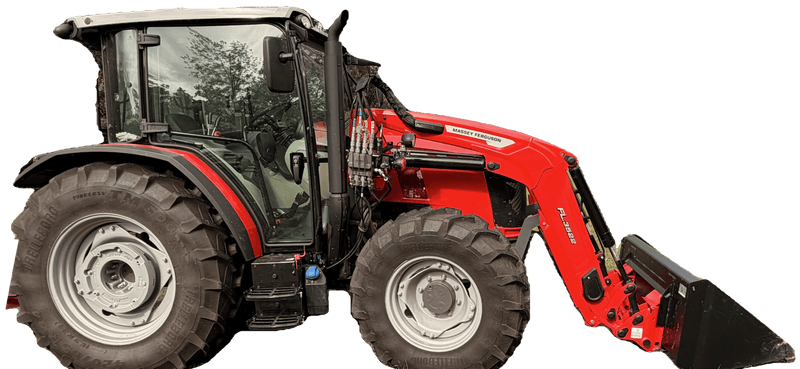
Massey Ferguson cab tractor with front loader
Farm tractor with a closed glass cab and a front loader. It pulls and powers the batwing cutter.
Pulls the cutter and turns its blades. A red Massey Ferguson with a closed glass cab and a front loader.
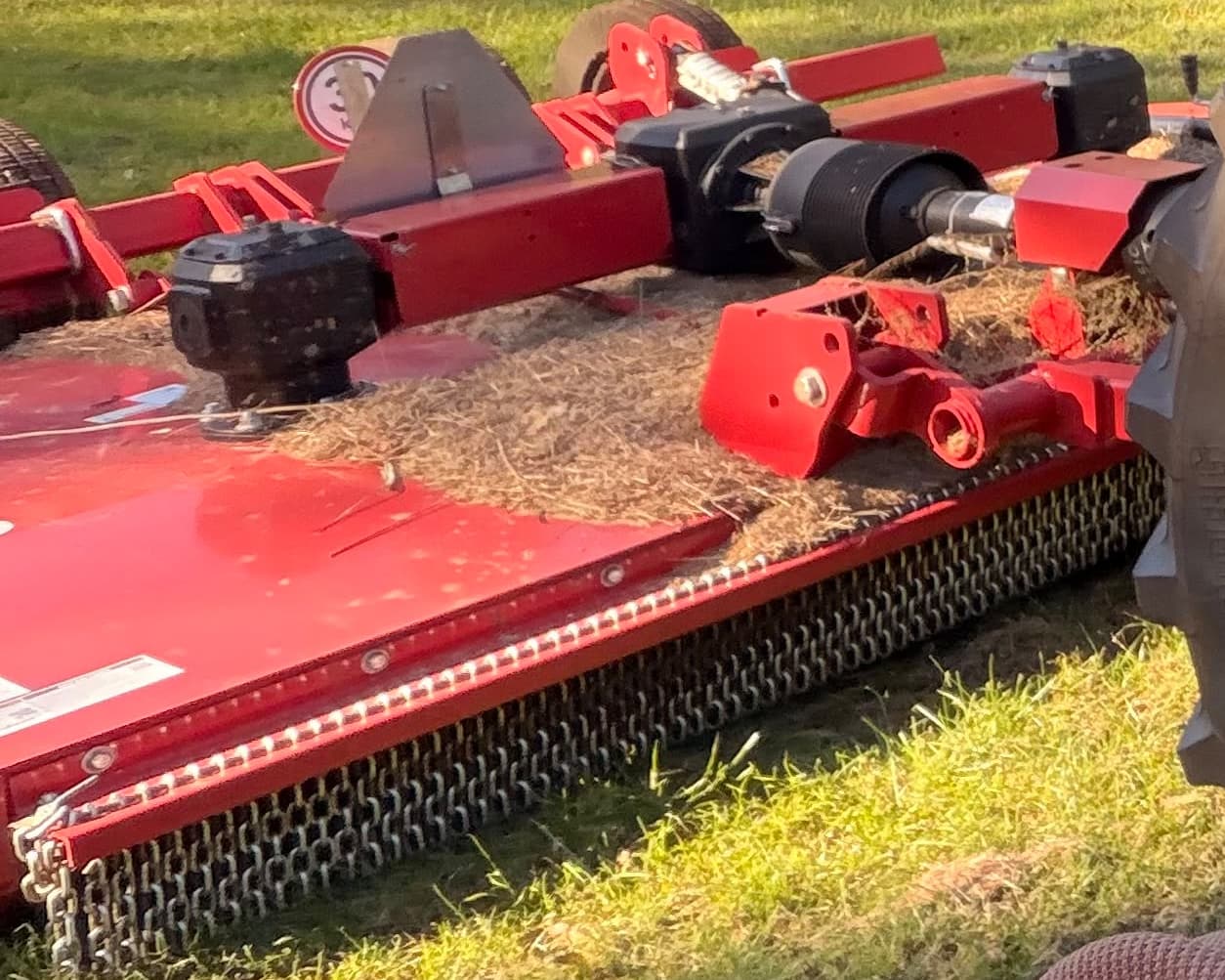
Batwing rotary cutter
Pull behind rotary mower with a center deck and folding wings. Also called a bush hog.
Does the cutting. A center deck and two hinged wings cut in one trip, and take grass, weeds, briars and saplings up to about two inches thick.
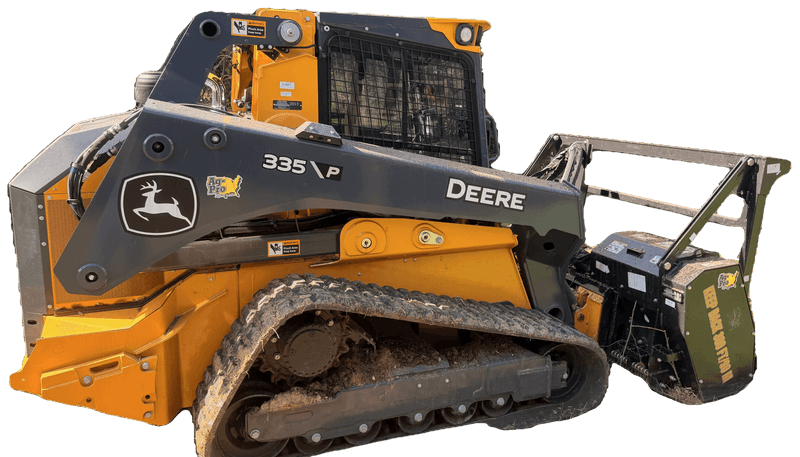
John Deere 335P
Compact track loader. A tracked carrier that swaps tools on its front.
Not a mowing machine. It carries the mulching head into the privet and the pines when part of the field is too thick for the tractor.
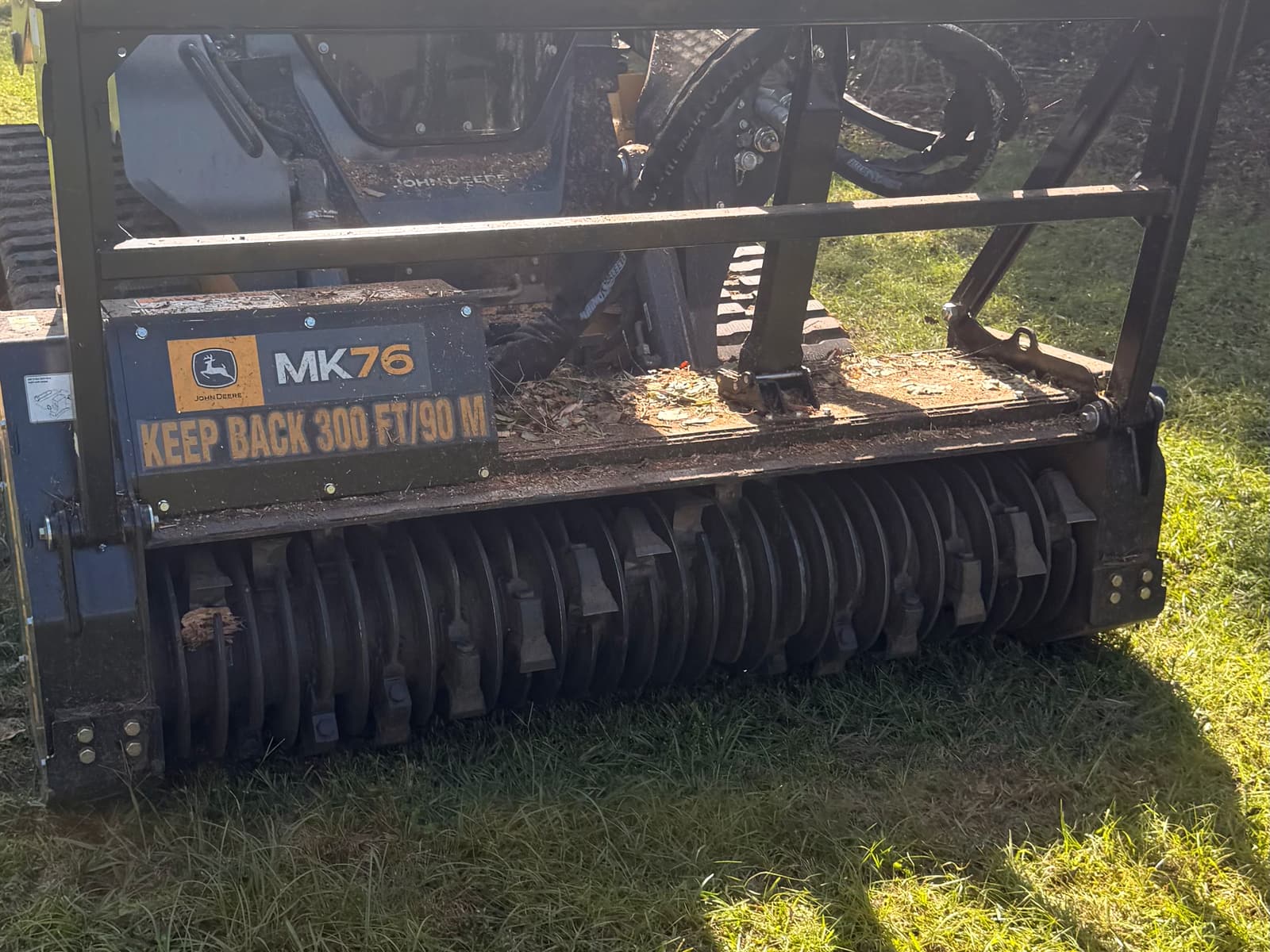
John Deere MK76 mulching head
Forestry mulching head. A steel drum of cutting teeth that mounts on the front of the 335P.
Takes over where the batwing stops. On a pasture reclaim it goes first, once. See forestry mulching.


Sources (19)
Rules change. Every link below was read between November 11 and November 12, 2026. Check with the office named before you act on it.
Weed Management in Pastures and Rangeland, 2025 edition (WG006) (opens in a new tab). University of Florida, IFAS Extension. Checked .
Dogfennel (Eupatorium capillifolium): Biology and Control (AG233) (opens in a new tab). University of Florida, IFAS Extension. Checked .
Bahiagrass (Paspalum notatum): Overview and Pasture Management (AG342) (opens in a new tab). University of Florida, IFAS Extension. Checked .
Controlling Invasive Plants in North Florida Forests (FR133) (opens in a new tab). University of Florida, IFAS Extension. Checked .
Biology and Control of Cogongrass (Imperata cylindrica) in Southern Forests (FR411) (opens in a new tab). University of Florida, IFAS Extension. Checked .
Thrown Objects Safety With Rotary Cutters (opens in a new tab). LSU AgCenter (Louisiana State University Agricultural Center). Checked .
MK76 Mulching Head, Compact Equipment Attachment (opens in a new tab). John Deere. Checked .
Land Management: Managing Forest Resources (opens in a new tab). Tall Timbers. Checked .
Options for Clearing Land to Establish Pasture (publication 465-341) (opens in a new tab). Virginia Cooperative Extension. Checked .
Reducing Hazardous Fuels on Woodland Property: Mechanical Treatments (EC 1575) (opens in a new tab). Oregon State University Extension Service. Checked .
2026 Cogongrass Winter Update (opens in a new tab). Georgia Forestry Commission. Checked .
Gopher Tortoise: Frequently Asked Questions (opens in a new tab). Florida Fish and Wildlife Conservation Commission. Checked .
Gopher Tortoise Permits (opens in a new tab). Florida Fish and Wildlife Conservation Commission. Checked .
Florida Statutes, Section 590.125: Open burning authorized by the Florida Forest Service (opens in a new tab). The Florida Legislature. Checked .
Environmental Resource Permits (opens in a new tab). Northwest Florida Water Management District. Checked .
Official Code of Georgia, Section 12-7-17: Exemptions (Erosion and Sedimentation Act) (opens in a new tab). State of Georgia, public copy linked from the Georgia Secretary of State rules site. Checked .
Bush Hogging Cost Per Acre in Georgia (opens in a new tab). SG Land Management, Cartersville, Georgia. Checked .
Brush Hogging Cost Per Acre in Georgia (opens in a new tab). Cut Brush. Checked .
Bush Hogging Cost Per Acre in Georgia (opens in a new tab). Augusta Land Works, Augusta, Georgia. Checked .