Grading: Give the water somewhere to go.
The drive ruts out after every storm, or the yard holds water for days. We shape the ground so rain runs where it should.
Quincy, Florida. Free estimates. Job minimum $2,000.

Is this what you need?
The driveway washes out every summer
You drag it smooth and the next hard rain cuts the same ruts, because the drive is the lowest path the water can find. Smoothing it again changes nothing.
Water stands in the yard for days
The low spot by the house holds a puddle long after the storm has passed, or the rain runs toward the slab and not away from it.
The lot got cleared and left rough
Stump holes, ruts, root wads and piles of loose dirt. Clearing took the trees off, and nobody shaped what was left.
The fill is still sitting in piles
You had dirt brought in for the low side and it is right where the truck dumped it.
More on these
Water stands in the yard for days
Somebody left the ground flat, and flat does not drain.
The fill is still sitting in piles
Spread the wrong way, it blocks the water and makes a new pond.
The builder needs a pad and a way in
The house, shop or barn has its spot picked out. Before concrete or posts go in, the ground has to be cleaned, shaped and left so water runs off it and not under it.
How I do it

Mark what stays and what is buried
Keeper trees, septic, well and corners get marked. We request utility locates before we dig.
Clean the ground first
Roots, stumps, old wire and trash come out before any dirt gets shaped.
Cut the high, fill the low
High spots are cut and low ones filled. A drive gets its crown.
Give the water a way out
A swale or a ditch carries the water to the low side of your land.
Every step in detail
Draw the area and see a range
Outline the drive, yard or lot on the instant quote map.Time: About two minutes
I walk it and read the water
Where the rain comes from, where it sits, where it goes. Free, Monday to Friday.
Mark what stays and what is buried
Keeper trees, septic, well and corners get marked. We request utility locates before we dig.Time: Locates: at least 2 full business days in Florida, at least 3 business days in Georgia
Clean the ground first
Roots, stumps, old wire and trash come out before any dirt gets shaped.
Cut the high, fill the low
High spots are cut and low ones filled. A drive gets its crown.
Give the water a way out
A swale or a ditch carries the water to the low side of your land.
Walk it, then cover it
Walk the grade with me. Bare dirt washes, so decide on gravel, seed or sod.
What it costs
- One acre of open ground, rough graded
- $2,100 to $4,500
- Two acres
- $3,950 to $8,550
- A pad for a house or shop, up to 2,500 square feet
- $2,625 to $4,900
Estimates, not quotes. I confirm the price on site, and the visit is free. Job minimum $2,000.
What moves the price
These are starting estimates, not a price list: rough grading of open ground runs about $2,100 to $4,500 for one acre on flat, dry ground with no fill brought in.
The instant quote gives a range for up to 5 acres, and past that, or for any job with fill, a pipe or a pad built to a plan, the price comes from the visit.
Most grading jobs are priced after I see how the water moves, and the estimate is free.
How much ground
Open ground is priced by the acre, and the per acre figure comes down as the area goes up. As a starting estimate, rough grading runs about $2,100 to $4,500 for one acre and about $3,950 to $8,550 for two.
How much dirt has to move
Dressing ruts is quick, and cutting a rise down to fill a hollow is not. The per acre range assumes fairly flat ground, and slope pushes it up.
Fill brought in
The ranges use the dirt already on your land. Fill that has to be trucked in is priced on site, once I know how much it takes.
Wet ground
Soft ground slows the machine and can mean waiting for it to dry. Tell the quote tool, and the range goes up and gets wider.
What is in the dirt
Stumps, roots, old slabs and junk have to come out before the ground is shaped. Stumps and brush are land clearing, slabs and old buildings are demolition, and loads that leave the property are hauling.
A pad
A pad for a house or shop up to 2,500 square feet, shaped on native soil, is estimated at about $2,625 to $4,900. It is its own line, added to the grading or clearing around it.
Getting in
A tight gate or a long way back from the road slows every trip the machine makes.
Distance from Quincy
Close to Quincy the quote carries no delivery charge. Farther out it adds an equipment delivery line that grows with the miles.
What stays protected
No cut and no fill under the trees you keep
I shape the drainage around the root zone of a tree you keep, not through it.
One way in, one way out
I pick one route across your land and stay on it, and I keep machines off ground that is too wet to carry them.
Topsoil goes back on top
The dark top layer is the part that grows grass. Where a job has to strip it, tell us you want it kept.
More on what stays protected
No cut and no fill under the trees you keep
University of Florida extension warns that raising or lowering the grade around a tree by even a few centimeters can kill it. Gadsden County writes the same idea into its code: no extra soil or fill inside the barrier around a protected tree.
One way in, one way out
Soil packs fast: the same University of Florida publication puts over 90 percent of the compaction in the first three tire passes.
Topsoil goes back on top
It can be pushed to one side and spread back over the finished grade.
Your water stays on its own path
We grade so runoff follows the way it already wants to go: the swale, the road ditch, the low side of your land. A grade that points a new stream at the house, the well or the fence next door is not finished.
Burrows, wet ground and buried lines
In Florida, gopher tortoise burrows are protected. The state wildlife commission treats any work within 25 feet of one, grading and ground leveling included, as a disturbance that takes a permit first. We keep 25 feet back, or we stop and tell you. Wet areas are left alone until the right office has looked. Septic tanks, drainfields and wells get marked before a machine moves.
Questions I get asked
How much does grading cost?
As a starting estimate, rough grading of open ground runs about $2,100 to $4,500 for one acre and about $3,950 to $8,550 for two, on flat, dry ground with no fill brought in. No job is under our $2,000 minimum. Most grading jobs get their real price after I have walked the ground and seen how the water moves, so draw yours on the map to see a range first.
Why does my driveway keep washing out?
Because water is running down it and not off it. The Federal Highway Administration's gravel road guide says a road with no crown collects water, the surface softens and ruts form, and it recommends about half an inch of crown per foot, a shoulder that slopes away and a ditch. Dragging the drive flat brings back the smooth look for a few weeks. Putting back the crown and the ditch goes after the cause.
Does it matter whether my land is red clay or sand?
Yes. Around Quincy a common upland soil is Orangeburg, loamy sand over the yellowish red sandy clay loam people here call clay: it can pack into a firm drive when it has a crown, but left flat it puddles, and it ruts under a machine when wet. Other ground in our area is deep sand, and Lakeland sand alone is mapped on close to 14,000 acres of Gadsden County. Rain soaks in quickly there, but sand has little clay to hold it together, so the answer is gentler slopes and cover on the bare dirt soon after.
Can you grade right after it rains?
Usually not, and you would not want us to: wet ground ruts under a machine and packs hard, and a grade shaped in mud does not hold. Oregon State University Extension gives the same advice for machine work in the woods: operate equipment when soils are dry. The National Weather Service office in Tallahassee says June normally starts the summer rainy season here, so grading still gets done in summer, but the dates move more.
Can you bring in fill dirt?
Sometimes the high spots on your land hold enough dirt to fill the low ones, and that is the cheapest fill there is. When they do not, fill has to be trucked in, and I price that part on site after I have seen how much the low ground will take. The instant quote puts no number on fill.
More questions
Can you just fill in the low wet spot?
If it is a dip that holds rain for a day or two, usually yes: fill it and give the water a path out. If it stays wet most of the year, stop, because Florida regulates filling in wetlands and other surface waters through Environmental Resource Permits, and in the Panhandle that reaches isolated wetlands too. Whether your spot counts is a question for the Northwest Florida Water Management District (opens in a new tab) or the state, not for us. I will tell you what I see on the walk.
Do I need a permit to grade my land?
It depends on where the land is, how much ground is disturbed and what it is for. In Florida, a project that disturbs one acre or more and drains to surface waters or a city storm sewer needs coverage under the state construction stormwater permit, and in Georgia grading counts as land disturbing activity. Leon County and the City of Tallahassee have environmental permits of their own. We are not the permit office: I tell you what I see on the walk and which office to call, and the rules are listed further down this page.
I am cutting in a new driveway. Is there a permit where it meets the road?
Often, yes. On a state highway, Florida Statutes section 335.1825 says a connection may not be built or substantially altered without an access permit from the Florida Department of Transportation first. County roads and city streets have their own rules for the permit, the fee and the size of the pipe, so check with the county or city before the pipe goes in. In Gadsden County, start with the Planning Division at (850) 875-8663.
Will the pad be ready to build on?
It will be cleaned out, shaped and drained, on the soil that is already there, but we do not certify it. If your builder, your engineer or your lender needs a compaction test or a pad built to stamped elevations, say so before the estimate so the job gets planned for it. For how far the ground should fall away from a house, check with your builder or the county building department.
Will it be smooth enough to plant grass?
A rough grade leaves the shape right and the ruts and holes gone, and a raked, lawn smooth finish for sod is finer work. Ask at the estimate whether we take that last pass or whether your landscaper should. Either way, do not leave it bare for long: bare dirt washes in the first hard rain.
Can you grade near my big oaks?
Near them, yes, and under them, no. University of Florida extension says tree protection should reach all the way out to the drip line, the outer edge of the canopy, and that raising or lowering the grade around a tree by even a few centimeters can kill it. So the cut, the fill and the machines stay out from under the trees you are keeping, and we shape the drainage around them. We cannot promise that any tree lives, but we can tell you exactly what we did to protect it.
How far do you travel for a grading job?
Up to 100 miles from Quincy, across North Florida and South Georgia. Tallahassee and Bainbridge are both under 30 miles by road. Farther out, the quote adds an equipment delivery line.

The details
The longer answers, for when you want them.
What it is, in plain words
Grading is moving dirt until water does what you want. We cut the high spots, fill the low ones and leave a slope the rain can follow.
The grading we do is rough grading. The shape is right, the ruts and holes are gone, and the water has a way out. It is the pass that comes after clearing and before the builder, the gravel truck or the landscaper.
- Driveways and farm roads: the crown put back, the washouts filled, the edges opened so water can leave.
- Pads for a house, shop or barn, shaped on the soil that is already there.
- Yards and lots: low spots filled, humps cut, the fall turned away from the house.
- Rough grading after clearing: stump holes filled, ruts dressed, the lot left so you can drive it.
- Fill that is already on your land, spread, shaped and tied into the ground around it.
| Compared on | Grading | Site preparation | Excavation |
|---|---|---|---|
| What it is | Shaping ground that is already open, so water runs where it should | The whole run from woods to a pad: clearing, stumps out, rough grade, pad | Digging: a ditch, a trench, a pond, a stump |
| Starts with | A drive, a yard, open dirt or a lot somebody already cleared | Trees or brush standing where a building will go | A spot that needs a hole or a cut |
Bottom lineNot sure which one you have? Pick the closest one in the instant quote. I sort it out on the walk, and one visit covers all three.
Why the water comes first: the Federal Highway Administration's guide for gravel roads repeats an old line from road crews. The three most important things in building a road are drainage, drainage and drainage. The same holds for a yard, a pad or a farm drive.
More on what it is
Take photos the next time it rains hard: where the water comes in, where it sits, where it leaves. Bring them to the estimate. A dry yard hides most of that.
Right call or wrong tool
The right call
The same ruts come back in the drive after every hard rain
Smoothing does not last when the shape is wrong. The Federal Highway Administration recommends about half an inch of crown per foot on a gravel road, so water sheds to the sides before it can soften the surface and rut it. A drive needs that crown, plus a shoulder and a ditch that let the water leave.
Water sits in the yard or runs toward the house
Standing water means the ground has no fall, or falls the wrong way. We cut and fill until it runs away from the building and toward a spot that can take it.
The lot was just cleared
Clearing with the stumps out leaves holes and loose dirt. When we clear a lot that way, the price range you see already counts a rough grade. See land clearing and lot clearing. If somebody else cleared it and left it rough, we can dress it.
You are putting in a house, a shop or a barn
A pad on native soil gets cleaned of roots and soft dirt, shaped, and left so water runs off it. For the whole job, from trees to pad, see site preparation.
A washout or a gully keeps getting bigger
Moving water takes more dirt with every storm. The fix has two parts: fill the cut, then give the water a wider, flatter path so it does not cut the same place again.
You have fill on site that needs spreading
We spread it into the low ground, shape it to drain and blend it into the grade around it. Dirt you already own is the cheapest fill there is.
The wrong tool
The low spot stays wet most of the year
Instead: Do not fill it until someone has ruled out a wetland. Florida regulates filling in wetlands and other surface waters, and in the Panhandle that reaches isolated wetlands too. That call belongs to the Northwest Florida Water Management District (opens in a new tab) or the state. It is never a call for a contractor to make.
Your plans show surveyed elevations that must be held to a tight tolerance
Instead: Bring the plans to the estimate. Our work is rough grading: the shape and the drainage. A parking lot, a slab on engineered fill or a pad that needs a compaction test is a different kind of job, and I will tell you at the walk whether it is one for us.
You want it smooth enough to lay sod tomorrow
Instead: Rough grading gets the shape and the drainage right. The fine raking a lawn needs is a separate, lighter pass. Ask at the estimate whether we take it or whether your landscaper should finish it.
The ground is soaked right now
Instead: Wait for it to dry. Wet ground ruts under a machine and packs hard, and a grade shaped in mud does not hold. The National Weather Service office in Tallahassee says June normally starts the summer rainy season, so summer dates move with the weather.
The fix means cutting or filling under a tree you want to keep
Instead: Change the plan, not the grade. University of Florida extension warns that raising or lowering the soil around a tree by even a few centimeters can kill it. We send the water around the root zone and leave that ground alone.
The real problem is brush and trees, not dirt
Instead: Forestry mulching or land clearing comes first. Nobody can grade ground they cannot reach.
You need a pond dug, a trench cut or dirt carried away
Instead: That is excavation and hauling. Grading moves dirt around your land. It does not dig the hole or make the pile leave.
How long it takes
Typical time on site. Estimates, not promises.
- One washout, or a short drive reshaped
- Set at the estimateA small job like this starts at our $2,000 minimum. I tell you how long it takes once I have seen it.
- Open ground, rough graded
- Planning figure: about 1 to 3 machine days per acreThat is the figure our price range is built on. It is not a promise. The low end is flat, dry ground that only needs dressing. The high end is real cut and fill. I give you my number at the walk.
- A house or shop pad on native soil
- Set at the estimateIt depends on how much has to be cleaned out and whether fill comes in.
- Utility locates before any digging
- Florida: at least 2 full business days. Georgia: at least 3 business days.Set by Florida law and by Georgia 811, not by us.
- After a hard rain
- We wait for the groundHow long depends on the soil. Deep sand drains fast. Slow draining soil in the hills can pond for a day or two after an intense rain.
Rules, permits and more to know
The ground here: red clay hills, deep sand, wet summers
The right grade depends on the dirt. Two kinds of upland ground show up again and again on the soil maps of our area, and they behave in opposite ways. A third is a slow draining soil of the Tallahassee Hills.
Three kinds of ground in our area
| Ground | What the federal soil survey says | What it means for grading |
|---|---|---|
| Red clay hills (Orangeburg soils) | About 7 inches of loamy sand on top. Yellowish red sandy clay loam from about a foot down to past four feet. Well drained, with medium runoff. | Can pack firm and shed water when it has a slope. Left flat it puddles, and it ruts under a machine when wet. |
| Deep sand (Lakeland soils) | Sand more than 80 inches thick on uplands. Excessively drained. Water moves down through it fast. | Soaks up rain quickly. Little in it binds, so slopes stay gentle and bare sand gets covered soon. |
| Slow draining soil in the hills (Miccosukee soils, described from a site north of Monticello) | Deep, slowly permeable soils on the uplands of the Tallahassee Hills. Brief ponding for a day or two can follow intense rains. | Needs an outlet, not only fill. If it stays wet, rule out a wetland first. |
Red clay hills (Orangeburg soils)
What the federal soil survey says
About 7 inches of loamy sand on top. Yellowish red sandy clay loam from about a foot down to past four feet. Well drained, with medium runoff.
What it means for grading
Can pack firm and shed water when it has a slope. Left flat it puddles, and it ruts under a machine when wet.
Deep sand (Lakeland soils)
What the federal soil survey says
Sand more than 80 inches thick on uplands. Excessively drained. Water moves down through it fast.
What it means for grading
Soaks up rain quickly. Little in it binds, so slopes stay gentle and bare sand gets covered soon.
Slow draining soil in the hills (Miccosukee soils, described from a site north of Monticello)
What the federal soil survey says
Deep, slowly permeable soils on the uplands of the Tallahassee Hills. Brief ponding for a day or two can follow intense rains.
What it means for grading
Needs an outlet, not only fill. If it stays wet, rule out a wetland first.
Soil descriptions are from the USDA Natural Resources Conservation Service. The soil mapped at downtown Quincy is Orangeburg loamy sand, 2 to 5 percent slopes. The right hand column is our reading for grading work. A soil map is a starting point, and I look at the dirt itself on the walk.
Timing matters as much as the machine. The National Weather Service office in Tallahassee says June normally kicks off the summer rainy season. Jefferson County, two counties east of us, counts about 57 inches of rain a year. A grade cut in a dry week and covered before the afternoon storms come back has a better chance than one cut in mud.
Where the soil and weather facts come from
The soil descriptions are the official series descriptions of the USDA Natural Resources Conservation Service. The Quincy map unit and the acres of Lakeland sand come from its Soil Data Access service for Gadsden County. The rainy season line is from the National Weather Service office in Tallahassee. The rainfall figure is the one Jefferson County publishes.
Why wet ground waits
Oregon State University Extension, writing about machine work in the woods, is plain: operate equipment when soils are dry, and keep the passes few. University of Florida extension puts over 90 percent of soil compaction in the first three tire passes. On wet ground those passes also leave ruts, and every rut is a new place for water to sit.
What a drive needs so it stops washing out
A dirt or gravel drive is a short road, and it fails the way roads fail. The Federal Highway Administration guide for gravel roads names three parts every one of them needs: a crowned driving surface, a shoulder that slopes away from it, and a ditch.
- Crown
- About half an inch per footAround 4 percent, in a straight line from the edge up to the middle. The guide says not to go past 6 percent.
- Shoulder
- No higher than the edge of the driveA ridge along the edge holds water on the surface. On flat ground it soaks in and softens the whole drive. On a hill it runs down the edge and takes the gravel with it.
- Ditch
- Kept openThe guide calls the roadside ditch the most important drainage feature on a rural road.
- Surface
- Some clay in the mixFine clay particles bind the stone and sand, so the surface forms a crust and sheds water.
A guide, not a law
These figures come from the federal guide for gravel roads. It was written for the local agencies that keep up gravel roads, and it says of itself that it is not a national standard or a regulation. A farm drive is shorter and narrower, but water treats it the same way.
Rock goes on last. If the shape under it is wrong, new gravel ruts the same way the old dirt did. So we put the shape back first: crown, edges, ditch, and an outlet at the low end.
Grading around the trees you keep
Our name says land clearing and preservation, and grading is a quiet way to lose a tree you meant to keep. Nothing gets cut down. The dirt around it just ends up a little higher or a little lower.
Do not bury or cut the roots of a tree you want
University of Florida extension warns that raising or lowering the soil grade around a tree by even a few centimeters can kill it. Lowering removes roots. Raising smothers them. Its advice for building sites is to protect the ground all the way out to the drip line, the outer edge of the leafy canopy. Gadsden County code allows no extra soil, fill or heavy machinery inside the barrier around a protected tree.
So the trees get marked on the walk, before a machine is unloaded. The fill stops short of them. The swale bends around them. If the only way to drain the yard runs through the roots of an oak you love, you hear that from me before any dirt moves, and you choose.
Rules that grading can trigger
Moving dirt is regulated county by county and state by state, and most of the rules follow the water. These are the main ones. This is not legal advice. The office named in each one is the office that decides.
Florida: one acre and up
Construction that disturbs one acre or more, and drains to surface waters or a city storm sewer system, needs coverage under the state construction stormwater permit. The notice goes to the Department of Environmental Protection at least 2 calendar days before work starts. On covered sites, steps to stabilize bare ground must start within 7 calendar days after work stops on that part of the site.
Florida: wet ground and changed water flow
Environmental Resource Permits cover work that alters the flow of surface water, including filling in wetlands and other surface waters. In the Panhandle they also cover isolated wetlands. Ask the water management district before anyone fills low, wet ground.
Leon County and the City of Tallahassee
Leon County says an environmental permit is required for drainage improvements in most cases. Inside the city, the Environmental Management Permit covers site grading along with protected trees, stormwater and erosion control, and one of its forms is a Land Disturbance Only permit.
Where the drive meets the road
On the State Highway System in Florida, a connection may not be built or substantially altered without an access permit from the Department of Transportation first. County roads and city streets have their own driveway rules. Check with the county or city that keeps the road. In Gadsden County, start with the Planning Division at (850) 875-8663.
Georgia: grading is land disturbing activity
The Georgia erosion rules name grading. Projects under one acre are exempt from the state act, but not inside a larger development plan and not within 200 feet of the bank of state waters, and a city or county can still regulate them. A 25 foot undisturbed buffer runs along state waters. From one acre up, the state construction stormwater permit applies. Inside Valdosta, grading needs a city land disturbance permit unless the work is exempt.
Both states: buried lines. Florida: tortoise burrows
Florida law requires notice to the one call system at least 2 full business days before excavation starts. Georgia 811 says to submit a ticket at least 3 business days before digging. In Florida, a permit from the wildlife commission is needed before a gopher tortoise burrow is disturbed, and any work within 25 feet of a burrow counts, grading included.
The equipment and the sources
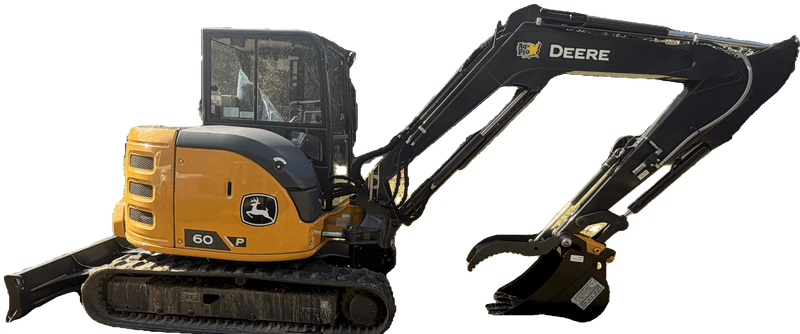
John Deere 60P
Compact excavator with a hydraulic thumb, a tooth bucket and a backfill blade.
Opens ditches and swales, digs out stumps and soft pockets, and reaches where the loader cannot.
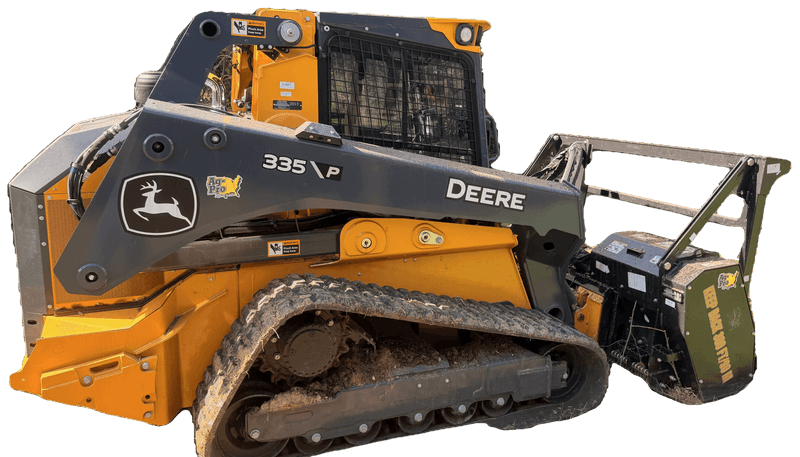
John Deere 335P
Compact track loader. A tracked carrier that swaps tools on its front.
Does most of the dirt work: cutting the high spots, carrying fill, spreading it and dressing the surface.
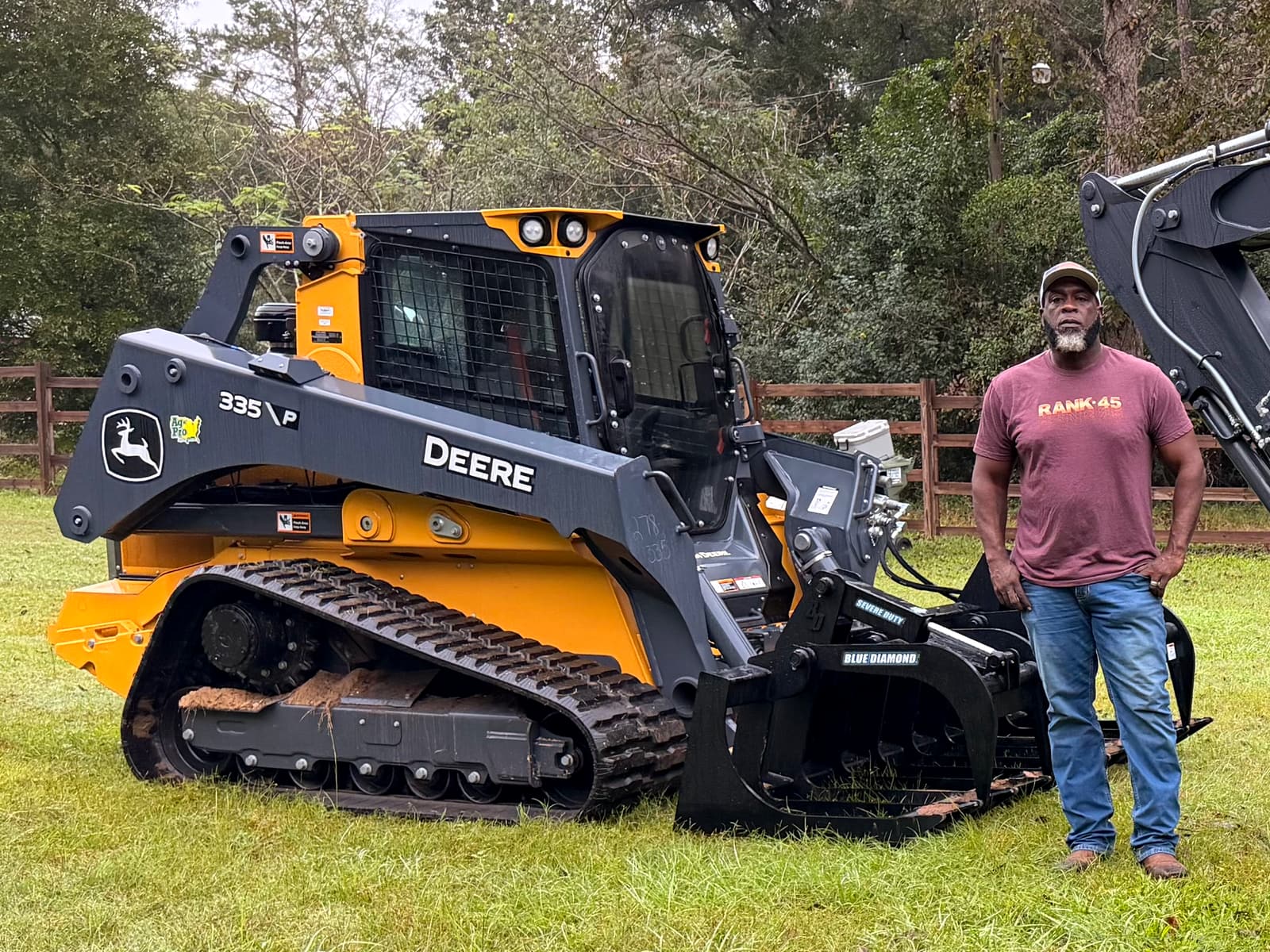
Blue Diamond root grapple
Root grapple. A steel rake with a hydraulic clamp, mounted on the 335P.
Goes on the 335P first. It rakes roots, limbs and trash out of the dirt so none of it ends up buried under your pad or your drive.

Massey Ferguson cab tractor with front loader
Farm tractor with a closed glass cab and a front loader. It pulls and powers the batwing cutter.
Carries a front loader and bucket. On open, firm ground it can move and spread material while the tracked machines do the shaping.


Sources (26)
Rules change. Every link below was read on November 11, 2026. Check with the office named before you act on it.
Gravel Roads Construction and Maintenance Guide (FHWA OTS 15 0002), sections 1.9 to 1.11, 2.1, 2.2 and the surface gravel section (opens in a new tab). Federal Highway Administration. Checked .
Official Series Description: Orangeburg series (opens in a new tab). USDA Natural Resources Conservation Service. Checked .
Official Series Description: Lakeland series (opens in a new tab). USDA Natural Resources Conservation Service. Checked .
Official Series Description: Miccosukee series (opens in a new tab). USDA Natural Resources Conservation Service. Checked .
Soil Data Access: soil survey of Gadsden County, Florida (survey area FL039), map units and acres (opens in a new tab). USDA Natural Resources Conservation Service. Checked .
June 2025 Climate Summaries, Tri State Area (opens in a new tab). National Weather Service Tallahassee. Checked .
About Jefferson County (opens in a new tab). Jefferson County, Florida. Checked .
Conservation Subdivision: Construction Phase, Protecting Trees and Conserved Natural Areas (WEC278/UW323) (opens in a new tab). University of Florida IFAS Extension. Checked .
Protecting Trees During Construction (opens in a new tab). University of Florida IFAS Gardening Solutions. Checked .
Reducing Hazardous Fuels on Woodland Property: Mechanical Treatments (EC 1575) (opens in a new tab). Oregon State University Extension Service. Checked .
Gadsden County Land Development Code, Chapter 5, Subsection 5404 (tree protection) (opens in a new tab). Gadsden County, Florida. Checked .
Florida Statutes, section 335.1825: Access permit required (opens in a new tab). The Florida Legislature, Online Sunshine. Checked .
Florida Statutes, section 556.105: Procedures (notice before excavation) (opens in a new tab). The Florida Legislature, Online Sunshine. Checked .
Construction Activity: NPDES Stormwater Construction Generic Permit (opens in a new tab). Florida Department of Environmental Protection. Checked .
Generic Permit for Stormwater Discharge from Large and Small Construction Activities, Part 5.4 (opens in a new tab). Florida Department of Environmental Protection. Checked .
Environmental Resource Permitting (opens in a new tab). Florida Department of Environmental Protection. Checked .
Environmental Resource Permits (opens in a new tab). Northwest Florida Water Management District. Checked .
Environmental Services: Frequently Asked Questions (opens in a new tab). Leon County Development Support and Environmental Management. Checked .
Environmental Management Permit (opens in a new tab). City of Tallahassee Growth Management. Checked .
Gopher Tortoise Permits (opens in a new tab). Florida Fish and Wildlife Conservation Commission. Checked .
The 811 Process (opens in a new tab). Georgia 811. Checked .
Rule 391-3-7-.01: Definitions (Erosion and Sedimentation Control) (opens in a new tab). Rules and Regulations of the State of Georgia, Georgia Secretary of State. Checked .
Official Code of Georgia, section 12-7-17: Exemptions (Erosion and Sedimentation Act) (opens in a new tab). State of Georgia, public copy linked from the Secretary of State rules site. Checked .
General Permit GAR100001: stormwater discharges from stand alone construction activity (opens in a new tab). Georgia Environmental Protection Division. Checked .
Land Development Regulations, Chapter 302, Article 5: Development Permits (Section 302-44) (opens in a new tab). City of Valdosta. Checked .
Land Disturbance Permit application (opens in a new tab). City of Valdosta Engineering Department. Checked .