Land Clearing: Trees down. Stumps and roots dug out.
Dozer land clearing with my own John Deere 650P, stumps and roots dug out. We walk it first and flag what stays, then the woods come off.
Quincy, Florida. Free estimates. Job minimum $2,000.

Is this what you need?
The house site is under trees
The plans are drawn and the builder is waiting, but a pad, a septic field and a driveway cannot go in over stumps and roots.
The pasture went back to woods
It was grass once, and now it is pine, sweetgum and privet.
The pond or the road has woods in the way
A pond and a road bed start the same way: the trees come off, then the stumps, then the roots. Only then does the digging or the shaping begin.
It was mulched once, and now you want to build there
The brush is gone, but the stumps are still there, cut off at the dirt, with their roots under them. That was fine for a view, not under a slab.
More on these
The house site is under trees
The ground has to be open all the way down, not cut off at the dirt.
The pasture went back to woods
You cannot pull a disk or run a fence through it, and you want it back as ground you can work.
You have heard three prices and three methods
One outfit wants to push it all into a pile and burn it, one wants to mulch it, and one wants to haul every stick away. You want somebody to say which one your ground needs and what each one costs.
How I do it

You get a price for the whole job
I price it after the walk, and say which machine does which part.
Permits and locates come before machines
I name the office to call. We request utility locates before stumps come out.
Brush first, then the trees
The mulching head grinds the brush and small trees. Then the bigger trees come down.
Stumps and roots come out
The 60P digs each stump out, and the grapple carries it to the pile.
Every step in detail
See a range, then book the walk
Draw the area in the instant quote, then pick a time for the free walk.Time: About two minutes online
I walk it with you and set the line
We set the line, flag what stays and look for burrows and wet ground.Time: One visit
You get a price for the whole job
I price it after the walk, and say which machine does which part.
Permits and locates come before machines
I name the office to call. We request utility locates before stumps come out.Time: Locates: at least 2 full business days in Florida, 3 business days in Georgia
Brush first, then the trees
The mulching head grinds the brush and small trees. Then the bigger trees come down.
Stumps and roots come out
The 60P digs each stump out, and the grapple carries it to the pile.
Debris handled, ground rough graded, last walk
Piles go as agreed and stump holes are filled. Walk it against the flags.
What it costs
- One acre of light brush
- $3,200 to $5,200
- One acre of brush and small trees
- $4,400 to $7,150
- One acre of heavy mixed growth
- $6,000 to $9,750
- Five acres of heavy mixed growth
- $21,000 to $34,150
Estimates, not quotes. I confirm the price on site, and the visit is free. Job minimum $2,000.
What moves the price
Full clearing brings two machines, so the instant quote starts this service at $2,500.
These are planning ranges, not bids.
I give you the exact price after I walk the ground, and that visit is free.
Above 10 acres the tool shows no number for full clearing: I price those on site.
How thick the growth is
Thicker growth costs more per acre, and nothing moves the price more. On flat, dry ground the instant quote figures a first acre at $3,200 to $5,200 in light brush, $4,400 to $7,150 in brush and small trees, $6,000 to $9,750 in heavy mixed growth and $8,000 to $13,000 in mature trees.
How many acres
The price per acre drops as the job grows: five acres of heavy mixed growth figures at $21,000 to $34,150 for the whole job. Under an acre it runs the other way, because two machines still have to come out: half an acre of brush and small trees figures at $2,850 to $4,650.
What happens to the debris
Whatever the mulching head grinds never has to be piled, and piling the rest on your land is in the base price. Haul off adds the most: about $400 to $750 a load.
Big timber and the dozer
Mature pines and hardwoods take more machine time. That is work for my John Deere 650P dozer, and I settle which machine does what on the walk.
Wet ground and slope
Soft ground slows the machines and ruts: mark it in the instant quote and the range moves up and gets wider. For hills, banks and ravines it adds about 15 percent.
Distance from Quincy
Inside about 30 road miles of Quincy there is no delivery line. Past that, the range shows equipment delivery as its own line, and it is larger than on a mulching job because full clearing moves more than one machine.
What you keep inside the line
Ground you mark to keep comes off the price, though not all of it, because working around what stays takes time.
What stays protected
The line is set before the first tree goes down
On a mulching job a mistake costs you a bush. On a clearing job it costs you a hundred year oak.
Trees at the edge keep their roots
Tracks, blades, piles and fill stay outside the drip line of every tree you keep.
A stump next to a keeper gets a second look
Digging a stump out tears up whatever roots run through that ground. Some of them belong to the tree you wanted.
More on what stays protected
The line is set before the first tree goes down
So nothing starts until the line is flagged and you have walked it. The Gadsden County code asks the same order of development sites: an approved clearing plan and tree barricades come before the clearing.
Trees at the edge keep their roots
UF/IFAS says tree roots often reach as far from the trunk as the tree is tall, and one pass with heavy equipment can do real damage. Our guide on protecting trees has the distances.
A stump next to a keeper gets a second look
Beside a keeper, a stump can be better cut low and left to rot. We point those out on the walk so you can decide.
Carry it, do not push it
Pushing brush into a pile with a blade drags topsoil along. The root grapple picks debris up and carries it, and the dirt falls back through the tines. Less of your topsoil ends up in the pile.
Wet ground and water get room
Machines stay out of wetlands. Soft ground is better left until it dries: working dry soil is the standard advice for keeping ruts and compaction down. Where clearing runs near a wetland or a creek, UF/IFAS calls for well maintained silt fence at a minimum. In Georgia, the state construction stormwater permit calls for a 25 foot undisturbed buffer along state waters that require one.
Bare dirt needs a plan
Cleared ground here does not stay bare. UF/IFAS warns that soil torn up by heavy equipment invites invasive plants. It also says cogongrass can spread when its roots are broken up. Plan to build, seed or mow soon after we leave. If you know you have cogongrass, show us on the walk so it is not dragged across the place.
Questions I get asked
How much does land clearing cost per acre?
It depends on how thick the growth is, how many acres there are and what happens to the debris. On flat, dry ground, with stumps out and debris piled on site, a first acre figures at $3,200 to $5,200 in light brush, $4,400 to $7,150 in brush and small trees, $6,000 to $9,750 in heavy mixed growth and $8,000 to $13,000 in mature trees. These are planning ranges: I give you the exact price after I walk it. Draw your land and see a range.
What is the difference between land clearing and forestry mulching?
Stumps and soil. Forestry mulching grinds brush and small trees into mulch where they stand, so the stumps and roots stay and the soil is not dug up. Land clearing digs the stumps and roots out and leaves open dirt. If you plan to build, dig or plow, you need the stumps out, and if you want the place open, walkable and mowable, mulching does it for less and is easier on the ground.
What happens to the trees, stumps and brush you take off?
One of four things, and a job can mix them: brush and small trees mulched in place, trunks, stumps and roots piled on your land and left, the piles burned where the setbacks fit and the state authorizes it, or all of it loaded and hauled off at about $400 to $750 a load. We settle that plan with you at the estimate. Haul off is the choice that adds the most to the price.
Can the piles be burned on my land?
Sometimes. In Florida every land clearing pile burn needs an authorization from the Florida Forest Service, and a home site pile must sit at least 300 feet from any occupied building that is not yours. In Georgia, machine piled clearing debris needs a burn permit from the Georgia Forestry Commission. Where burning will not fit, the debris is mulched, left in a pile or hauled.
Do I need a permit for full clearing?
It depends on the county, the city and what the land will be used for. I tell you which office to call, and the page for your town lists it. Some permits are yours to pull as the owner, and nobody can promise how a permit office will decide. The permit guide covers both states.
More questions
What if there are gopher tortoise burrows on the property?
In Florida the tortoises and their burrows are protected by state law, and any work within 25 feet of a burrow counts as a disturbance. If the whole job can stay 25 feet away, you may not need a permit. If it cannot, a relocation permit from the Florida Fish and Wildlife Conservation Commission comes first. We do not relocate tortoises.
Do you own a dozer?
Yes. I own a John Deere 650P dozer and use it for dozer land clearing: heavy timber, stumps and brush across open acres. It works next to my 60P excavator and my 335P track loader. Which machine does which part of your job, I settle on the walk, before I give you a price.
Should I cut the trees down myself first to save money?
Usually not, if the stumps are coming out. Virginia Cooperative Extension notes it can be faster to take out whole trees and high stumps. Low cut stumps give a machine nothing to push against. Cut them low and you may make our job slower, not cheaper, so ask me on the walk before you start a saw.
Is the ground ready to build on when you leave?
It is open and rough graded: stumps out, holes filled, ground shaped enough to drive and work on. It is not a finished pad. Shaping and compacting a pad is site preparation, and finer shaping of a yard or drive is grading. I can price those on the same estimate.
Will it grow back after full clearing?
A stump that has been dug out cannot sprout, but seeds, runners and bare dirt are another matter in North Florida and South Georgia. UF/IFAS warns that ground disturbed by heavy equipment invites invasive plants and should be watched. Build on it, seed it or mow it: ground that goes to grass and weeds can be kept open with bush hogging.
Can you clear most of it and still keep some trees?
Yes, that is the point of the walk: I flag the trees and the patches that stay, and machines, piles and fill stay outside their drip lines. We cannot promise that any tree survives nearby clearing, and no one honestly can, but we can tell you what we do to protect it. If keeping trees is the main goal, read selective clearing.
Can you clear when the ground is wet?
We would rather not. Wet ground ruts, packs down and slows every machine, which costs you money and soil, and extension guidance is to run equipment when soils are dry. If your land has a soft end, say so in the instant quote: the range gets wider, and I look at how it drains before I give you a number.
How far do you travel, and is there a minimum?
We work up to 100 miles out from Quincy, across North Florida and South Georgia. Past about 30 road miles the price range shows equipment delivery as its own line. Our job minimum is $2,000. Full clearing starts at $2,500 in the instant quote, because two machines come out. The estimate visit is free.

The details
The longer answers, for when you want them.
What it is, in plain words
Land clearing is the full job. The trees come down. The stumps and roots come out of the ground, which the trade calls grubbing. The brush goes. What is left is open dirt, rough graded, ready for the next crew or the next crop.
It takes more than one machine. Our John Deere 60P excavator digs the stumps and lifts them with its hydraulic thumb. Our John Deere 335P track loader carries the debris with the Blue Diamond root grapple. With the MK76 mulching head on, it grinds the small growth. For heavy timber and open acres, my John Deere 650P dozer pushes it clear.
What a full clearing job covers
- Trees and brush down, inside a line I set with you on the ground.
- Stumps and roots dug out, not cut off and left.
- Roots raked out of the top of the soil.
- Debris mulched, piled on your land or hauled off, as agreed at the estimate.
- Stump holes filled and the ground left rough graded.
The honest part: this is the hardest method on your soil
Virginia Cooperative Extension puts it plainly: clearing with dozers and loaders is quick, and it nearly always destroys the topsoil. When roots are ripped out, good topsoil is often lost with them. That is why we grub only the ground that needs it and mulch or leave the rest. If nothing is being built, dug or plowed there, you probably do not need this service.
How it differs from forestry mulching and selective clearing
| Compared on | Land clearing | Forestry mulching | Selective clearing |
|---|---|---|---|
| What comes off | Everything inside the line: trees, brush, stumps and roots. | Brush and small trees, ground into mulch where they stand. | Only what you point at. The trees you flag stay. |
| Stumps and roots | Dug out with the excavator. | Stay in the ground. The head works at ground level and does not pull roots. | Stay in the ground, same as mulching. |
| The soil | Dug up and turned over. The most disturbance of the three. | Stays in place under a layer of mulch. | Stays in place. Root zones of the kept trees are off limits to machines. |
| Right for | House pads, septic fields, driveways, ponds, roads, pasture you will plow. | Overgrown lots, fence lines, trails, views, underbrush. | Wooded land where the good oaks and pines are the point. |
| Machines | My 650P dozer, the 60P excavator and the 335P with the grapple. | The 335P with the MK76 head. | The 335P with the MK76 head. |
| Price | The highest of the three. More machines, stumps to dig, and debris to deal with. | Lower. One machine, and nothing is piled or hauled. | Priced like forestry mulching. Protecting trees is not an extra line. |
Bottom lineIf you need to build, dig or plow, this page is your service. If you want the land open and walkable with the soil left alone, read forestry mulching. If you want the good trees standing in clean ground, read selective clearing. One property can get all three: the house site grubbed, the back acres mulched, the oaks by the road left alone.
Right call or wrong tool
The right call
A house, a shop or a barn is going there
A pad cannot sit on stumps and roots, so they come out with the excavator before any dirt work. If you want the pad shaped too, that is site preparation, and it starts with this.
A septic field or a driveway has to cross the woods
Same reason. Ground that gets dug, trenched or driven on for years usually needs the stumps and roots out first. Cut flush and covered will not do.
You are digging a pond
The pond site is cleared and grubbed before the first bucket of the pond itself. Trees, stumps and roots all come off the footprint. The digging is on the excavation page.
Old woods are going back to pasture you will plow or plant
Mulching leaves the stumps in the ground. Virginia Cooperative Extension says most pine stumps rot away in three to five years. Hardwood stumps can take anywhere from a few years to decades. That is fine if cattle will graze around them. It is not fine if a disk or a planter has to go through that soil this year.
A road or a wide lane has to go through timber
The stumps and roots come out of the road bed before it is shaped. Shaping it is grading.
The lot was mulched before and now it will be built on
Stumps cut off at the dirt still have their roots. We dig them, fill the holes and rough grade it.
The wrong tool
You only want to see it, walk it or mow it
Instead: Then the stumps can stay, and you should not pay to dig them. Forestry mulching grinds the brush where it stands, leaves your soil alone and costs less.
There are good oaks and pines in there you would hate to lose
Instead: Do not clear to bare dirt and hope. Selective clearing takes the brush and the cull trees and leaves the ones you flagged. You can still have just the house site grubbed.
It is weeds, briars and saplings, not woods
Instead: That is tractor work. Bush hogging with the batwing cutter costs far less per acre than bringing an excavator.
The low end of the property holds water
Instead: It may be a wetland, and that is not our call or yours. In the Florida Panhandle even isolated wetlands are regulated. Have the water management district look before anything is cleared there. We clear the high ground and stay out of the wet.
The land is a development site and is not approved yet
Instead: Before development, the Gadsden County code allows only underbrushing of growth under 4 inches across, to help the survey. Clearing ahead of approval takes a letter of permission from the county Planning Department. Have it underbrushed now and cleared once that is in hand. Other counties have their own order of steps, so ask the planning office first.
It is two or three trees in a yard
Instead: Our job minimum is $2,000. For a handful of trees or a single stump, a tree service is usually the better fit. We will tell you so.
How long it takes
Typical time on site. Estimates, not promises.
- The free estimate visit
- A booked start time, Monday to FridayYou pick the time online. It is a solid start time, not a window.
- Utility locates before stumps come out
- At least 2 full business days in Florida, at least 3 business days in GeorgiaSet by law and by the 811 centers, not by us.
- The clearing itself
- A day count from me, after the walkIt depends on the acres, the size of the stems, wet ground and whether debris is hauled.
- A burn day
- Authorized one day at a timeIn Florida the authorization is requested the day of the burn. A Georgia permit is good only for the day it is issued.
Rules, permits and more to know
What happens to everything that comes off the land
An acre of woods is a lot of wood. Where it goes changes the price, and it decides what your soil looks like afterward. There are four choices, and a job can use more than one.
The four ways debris leaves a clearing job
| Choice | What it means | What it does to the price | What it does to the soil |
|---|---|---|---|
| Mulch it | The MK76 head grinds brush and small trees where they stand. Nothing is piled. | Nothing added. No pile, no fire, no truck. | The soil stays put under a layer of mulch. Virginia Cooperative Extension says mulching helps reduce erosion and can add organic matter. |
| Pile it and leave it | Trunks, stumps and roots are stacked where you choose and left to rot. | In the base price. | The pile takes up ground, and stumps are slow to rot. Virginia Cooperative Extension gives most pine stumps three to five years. Hardwood can take much longer. |
| Pile it and burn it | The piles are burned on site, where the setbacks fit and the state authorizes it that day. | Not in the instant quote. It takes room, a dry pile and someone who stays with the fire. Settled at the estimate. | Nothing is trucked away. Do not bury what is left: Virginia Cooperative Extension warns that a hole back filled after a burn can sink later. |
| Haul it off | Everything is loaded and trucked to a disposal site. | Adds the most. About $400 to $750 a load, with the load count confirmed on site. | Nothing is left on the ground. On tight lots where burning is ruled out, it may be the only way to get the stumps gone. |
Mulch itThe MK76 head grinds brush and small trees where they stand. Nothing is piled.
What it does to the price
Nothing added. No pile, no fire, no truck.
What it does to the soil
The soil stays put under a layer of mulch. Virginia Cooperative Extension says mulching helps reduce erosion and can add organic matter.
Pile it and leave itTrunks, stumps and roots are stacked where you choose and left to rot.
What it does to the price
In the base price.
What it does to the soil
The pile takes up ground, and stumps are slow to rot. Virginia Cooperative Extension gives most pine stumps three to five years. Hardwood can take much longer.
Pile it and burn itThe piles are burned on site, where the setbacks fit and the state authorizes it that day.
What it does to the price
Not in the instant quote. It takes room, a dry pile and someone who stays with the fire. Settled at the estimate.
What it does to the soil
Nothing is trucked away. Do not bury what is left: Virginia Cooperative Extension warns that a hole back filled after a burn can sink later.
Haul it offEverything is loaded and trucked to a disposal site.
What it does to the price
Adds the most. About $400 to $750 a load, with the load count confirmed on site.
What it does to the soil
Nothing is left on the ground. On tight lots where burning is ruled out, it may be the only way to get the stumps gone.
One way to mix them: mulch the brush, then pile or haul only the trunks and stumps. That keeps the pile small and the load count down. More on trucking is on the hauling and debris removal page.
Florida: every land clearing pile burn needs an authorization
The Florida Forest Service must authorize every land clearing pile burn. For a home site (existing or planned, up to two family units) the pile must be 300 feet from any occupied building other than your own. It must be 100 feet from a paved public road and 50 feet from wildlands or brush. For other development the distance from occupied buildings is 1,000 feet. The piles must be dry and attended at all times. You ask the local Florida Forest Service office for the authorization on the day of the burn, and the first time they may inspect the site. Start at the Florida Forest Service burn authorization page (opens in a new tab).
Georgia: machine piled debris still needs a burn permit
Georgia dropped the permit for hand piled leaves and limbs in July 2021. That change does not cover clearing debris. Debris piled by a machine counts as land clearing. It needs a burn permit from the Georgia Forestry Commission, and the permit is good only for the day it is issued. State rules put the burn at least 1,000 feet from any occupied structure unless the Environmental Protection Division approves less, and they allow plant growth only. Depending on the county, an air curtain destructor may be required. The summer burn ban, May 1 to September 30, covers 54 counties. Decatur, Dougherty and Lowndes counties are not on that list. Permits: Georgia Forestry Commission (opens in a new tab), (800) 428-7337.
Only what grew there can burn
Burning tires, plastic, treated lumber or household trash is illegal in both states. If the clearing turns up an old dump, a fallen shed or a pile of tires, that goes on a truck, never on the burn pile.
Rules to check before a machine starts
Rules change by county and by what the land will be used for. These are the ones to check before clearing in our area. This is not legal advice. The office named in each box has the last word, and the page for each town lists who to call.
Florida: gopher tortoise burrows get 25 feet
Gopher tortoises and their burrows are protected by Florida law. Any work within 25 feet of a burrow counts as a disturbance: clearing, grading, even staging heavy equipment. If all of the work stays 25 feet away, you may not need a permit. If it cannot, a relocation permit from the Florida Fish and Wildlife Conservation Commission is needed before the burrows are disturbed. A burrow just over the property line matters too: you can still be held responsible if clearing within 25 feet of it collapses the burrow or harms the tortoise. Farming and forestry work is treated differently from clearing to build, so tell us what the land is for.
Wetlands: not our call, and not yours
In Florida, Environmental Resource Permits cover dredging and filling in wetlands. In the Panhandle that includes isolated wetlands that connect to nothing. The federal permit is separate and runs through the U.S. Army Corps of Engineers. Around Quincy and Tallahassee the state side is the Northwest Florida Water Management District (opens in a new tab), which offers a meeting before you apply (850-951-4660). In Georgia, the state construction stormwater permit calls for a 25 foot undisturbed buffer along state waters that require one. If a low spot holds water, have it looked at before it is cleared.
One acre is the stormwater line in both states
Florida: the state construction stormwater permit covers work that disturbs one acre or more and drains to state surface waters or a municipal storm sewer system. Smaller sites count when they are part of a larger plan. The notice is due at least 2 calendar days before work starts. The fee is $250 for one to five acres and $400 for five acres or more. Georgia: clearing is a land disturbing activity. The state stormwater permits apply at one acre or more. A site under one acre is exempt from the state erosion law on two conditions: it is not part of a larger plan, and it is not within 200 feet of the bank of state waters. A city or county can still regulate it. The same Georgia law exempts farm operations, including preparing and planting pasture land.
Sources
- NPDES Stormwater Program (opens in a new tab)
- Generic Permit for Stormwater Discharge from Large and Small Construction Activities (opens in a new tab)
- Rules and Regulations of the State of Georgia, Rule 391-3-7-.01 (opens in a new tab)
- Official Code of Georgia, Section 12-7-17 (opens in a new tab)
- General Permit GAR100001 (opens in a new tab)
Local tree and clearing permits differ town by town
Gadsden County, outside the cities, has a Tree Removal and Clearing Permit with a $100 application fee. Its form asks for a drawing of the clearing limits and counts trees 20 inches across at chest height or larger as protected. The county code exempts placing one detached house on a lot from its tree protection section, so ask the Planning Division how that applies to you. Leon County, outside Tallahassee, requires an environmental management permit for tree removal projects. On developed lots some trees may come out without one, depending on the site. The City of Tallahassee protects trees by species and size and allows no more than 10 trees on one tree permit. The City of Valdosta requires a land disturbance permit for land disturbing work, and its application names clearing and grubbing. Local detail and the office to call are on each town page: Quincy, Tallahassee, Marianna, Monticello, Bainbridge, Valdosta.
Sources
- Tree Removal and Clearing Permit Application (opens in a new tab)
- Land Development Code, Chapter 5, Subsection 5404 (opens in a new tab)
- Environmental Permits (opens in a new tab)
- Environmental Services (opens in a new tab)
- Tree Permit (opens in a new tab)
- Land Development Regulations, Chapter 302, Article 5 (opens in a new tab)
- Land Disturbance Permit application (opens in a new tab)
Buried lines are located before stumps come out
Florida law requires notice through Sunshine 811 at least 2 full business days before excavation. Georgia 811 asks for a ticket at least 3 business days before digging. We treat pulling stumps with an excavator as digging, so we request the locates first.
Dozer land clearing with my 650P
Heavy timber is dozer work, and I own the dozer: a John Deere 650P. It pushes over pines, hardwoods, stumps and brush into piles and opens ground across open acres. It can level the ground after.
The excavator still digs stumps out with its thumb, and the mulching head still grinds what does not need a pile. Which machine does which part is settled on the walk, before I give you a price.
The equipment and the sources
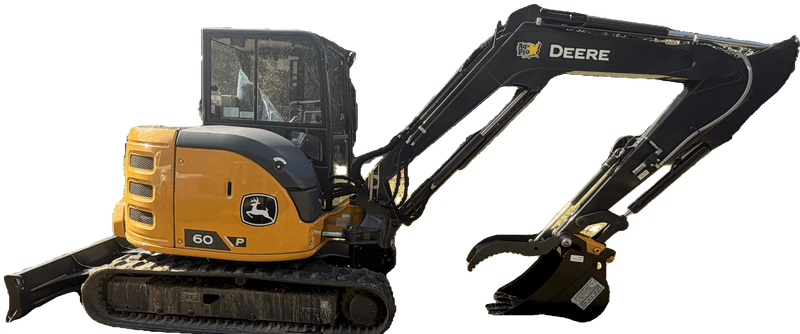
John Deere 60P
Compact excavator with a hydraulic thumb, a tooth bucket and a backfill blade.
The stump machine. It digs around a stump, clamps it with the hydraulic thumb and lifts it out. Its blade pushes the dirt back into the hole.
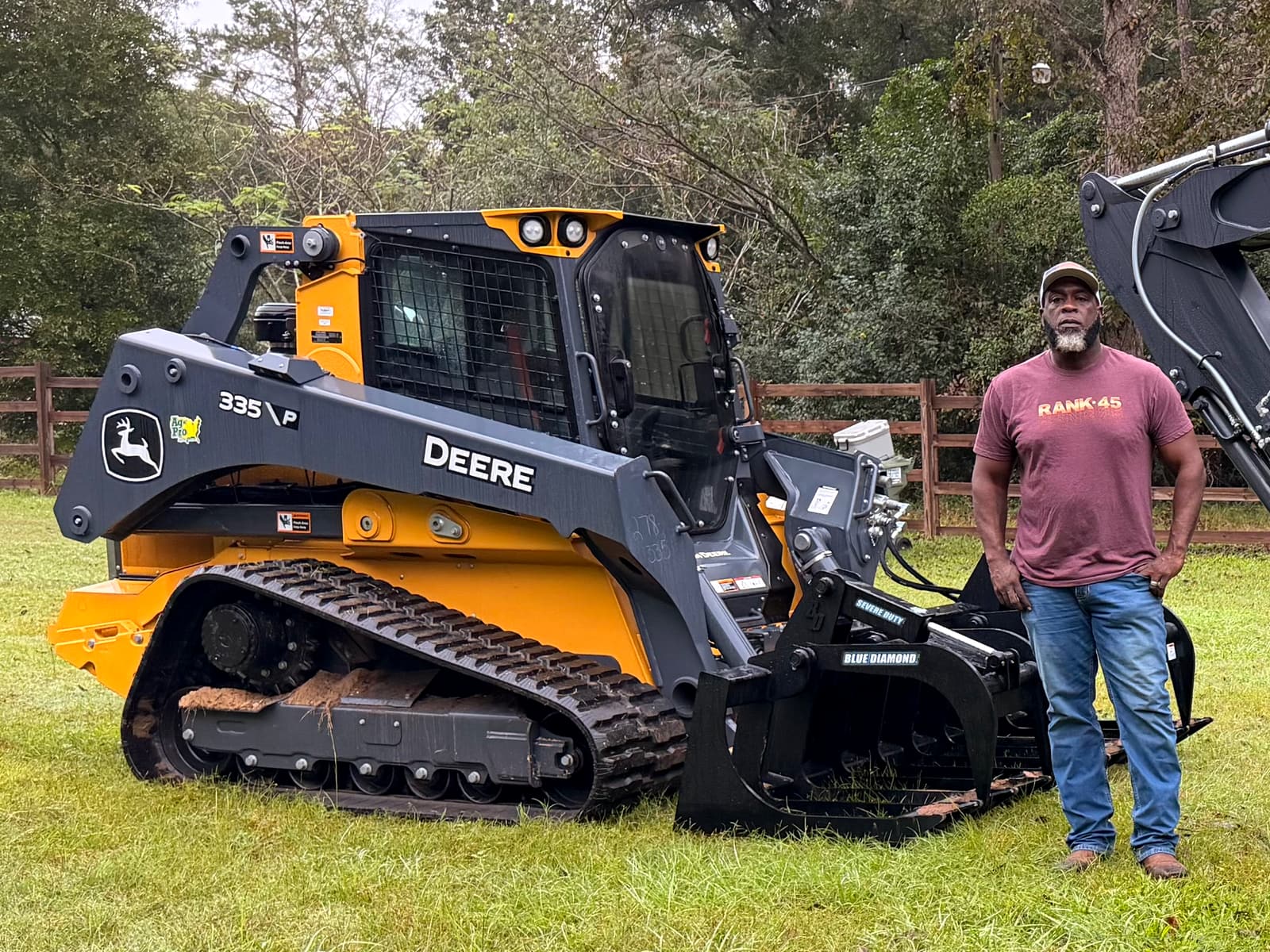
Blue Diamond root grapple
Root grapple. A steel rake with a hydraulic clamp, mounted on the 335P.
Rides on the front of the 335P. It picks up tops, logs, stumps and roots and carries them to the pile or the truck.
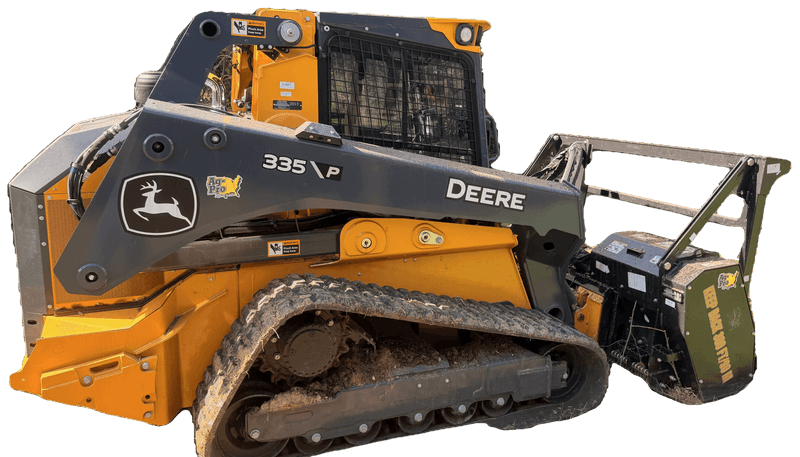
John Deere 335P
Compact track loader. A tracked carrier that swaps tools on its front.
The carrier. It runs the grapple or the mulching head, on rubber tracks.
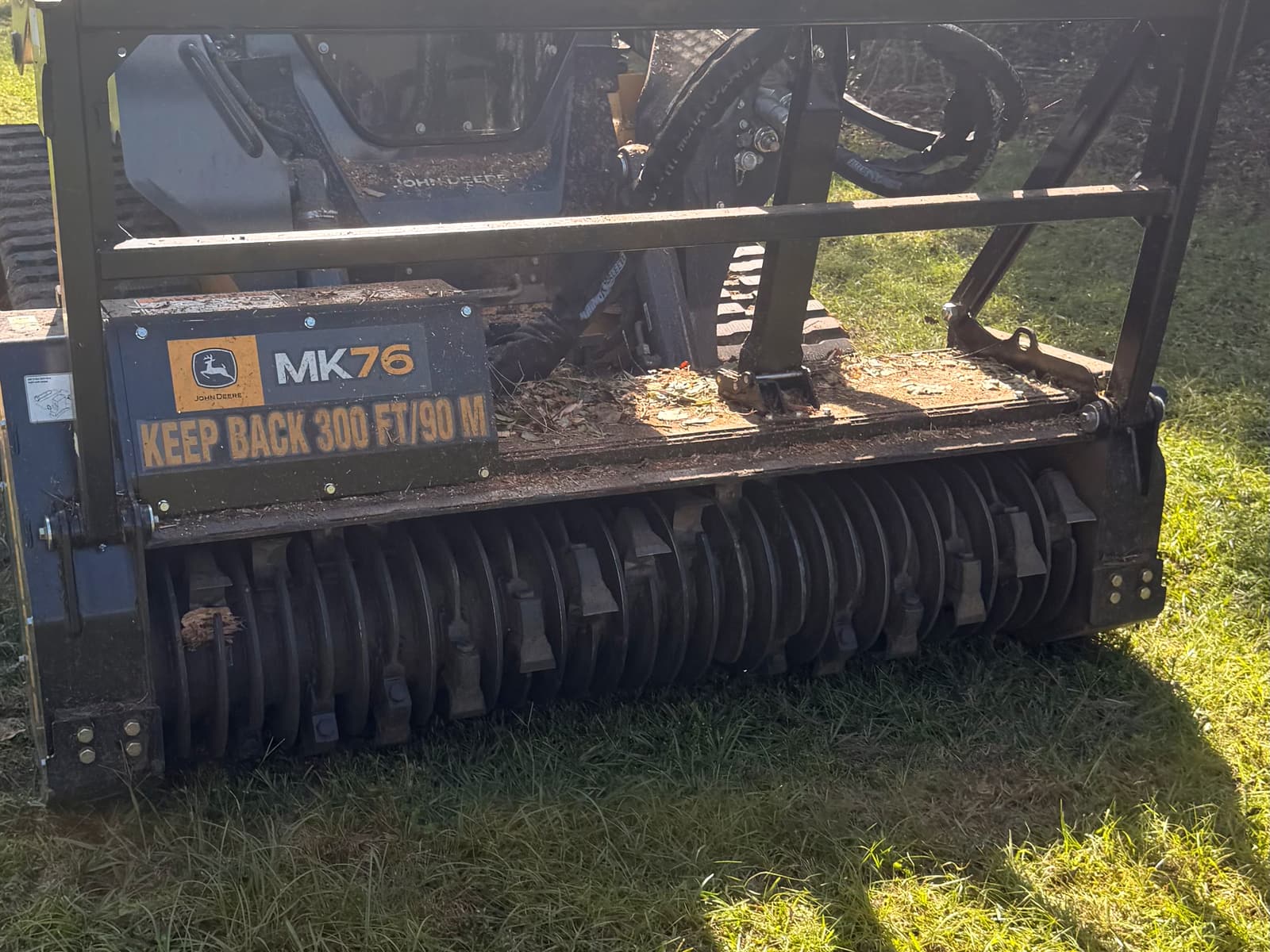
John Deere MK76 mulching head
Forestry mulching head. A steel drum of cutting teeth that mounts on the front of the 335P.
Grinds the brush and small trees that do not need to be piled at all.
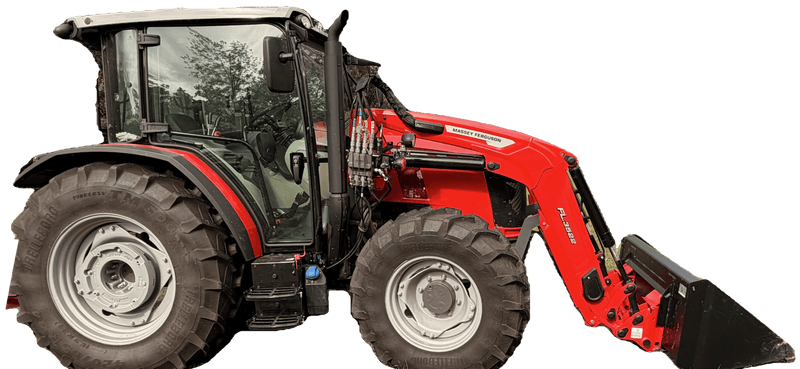
Massey Ferguson cab tractor with front loader
Farm tractor with a closed glass cab and a front loader. It pulls and powers the batwing cutter.
With its batwing cutter it keeps cleared ground open afterward, once grass and weeds come back. That is bush hogging.


Sources (33)
Rules change. Every link below was read on November 11, 2026. Check with the office named before you act on it.
Options for Clearing Land to Establish Pasture (publication 465-341) (opens in a new tab). Virginia Cooperative Extension. Checked .
Conservation Subdivision: Construction Phase, Protecting Trees and Conserved Natural Areas (WEC278/UW323) (opens in a new tab). University of Florida IFAS Extension. Checked .
Dispelling Misperceptions About Trees (SS-ORH-03/MG089) (opens in a new tab). University of Florida IFAS Extension. Checked .
Protecting Trees During Construction (opens in a new tab). University of Florida IFAS Gardening Solutions. Checked .
Controlling Invasive Plants in North Florida Forests (SS-FOR-19/FR133) (opens in a new tab). University of Florida IFAS Extension. Checked .
Reducing Hazardous Fuels on Woodland Property: Mechanical Treatments (EC 1575) (opens in a new tab). Oregon State University Extension Service. Checked .
Know the Law, Land Clearing Debris Burns with ACI (brochure) (opens in a new tab). Florida Department of Agriculture and Consumer Services, Florida Forest Service. Checked .
Florida Statutes, Section 590.125: open burning authorized by the Florida Forest Service (opens in a new tab). The Florida Legislature. Checked .
Burn Permits and Notifications (opens in a new tab). Georgia Forestry Commission. Checked .
Open Burning Rules for Georgia (opens in a new tab). Georgia Environmental Protection Division, Air Protection Branch. Checked .
Open Burning Rules for Georgia: Burn Types (opens in a new tab). Georgia Environmental Protection Division, Air Protection Branch. Checked .
Summer Open Burning Ban (opens in a new tab). Georgia Environmental Protection Division, Air Protection Branch. Checked .
Summer open burning ban: list of the 54 counties (opens in a new tab). Georgia Environmental Protection Division, Air Protection Branch. Checked .
Gopher Tortoise Permits (opens in a new tab). Florida Fish and Wildlife Conservation Commission. Checked .
Gopher Tortoise FAQs (opens in a new tab). Florida Fish and Wildlife Conservation Commission. Checked .
Environmental Resource Permits (opens in a new tab). Northwest Florida Water Management District. Checked .
Environmental Resource Permitting (opens in a new tab). Florida Department of Environmental Protection. Checked .
NPDES Stormwater Program: Construction Activity (opens in a new tab). Florida Department of Environmental Protection. Checked .
Generic Permit for Stormwater Discharge from Large and Small Construction Activities (effective February 2015) (opens in a new tab). Florida Department of Environmental Protection. Checked .
Rules and Regulations of the State of Georgia, Rule 391-3-7-.01 (definition of land disturbing activity) (opens in a new tab). Georgia Secretary of State. Checked .
Official Code of Georgia, Section 12-7-17: exemptions from the Erosion and Sedimentation Act (opens in a new tab). State of Georgia, public code hosted by Fastcase. Checked .
General Permit GAR100001: stormwater discharges from stand alone construction projects (opens in a new tab). Georgia Environmental Protection Division. Checked .
Land Development Regulations, Chapter 302, Article 5: Development Permits (Section 302-44) (opens in a new tab). City of Valdosta, Georgia. Checked .
Land Disturbance Permit application (February 2024) (opens in a new tab). City of Valdosta, Georgia, Engineering Department. Checked .
Tree Removal and Clearing Permit Application (form revised 10/20/2020) (opens in a new tab). Gadsden County, Florida, Planning Division. Checked .
Land Development Code, Chapter 5, Subsection 5404 (version dated 12/19/2023) (opens in a new tab). Gadsden County, Florida. Checked .
Environmental Permits (opens in a new tab). Leon County, Florida, Development Support and Environmental Management. Checked .
Environmental Services: Frequently Asked Questions (opens in a new tab). Leon County, Florida, Development Support and Environmental Management. Checked .
Tree Permit (opens in a new tab). City of Tallahassee, Growth Management. Checked .
Florida Statutes, Section 556.105: notice before excavation or demolition (opens in a new tab). The Florida Legislature. Checked .
The 811 Process (opens in a new tab). Georgia 811. Checked .