Site Preparation: Clearing, grubbing and a rough pad, by one crew.
Your builder says call when the lot is ready. We dig the stumps out, rough grade the pad and open a way in for the trucks.
Quincy, Florida. Free estimates. Job minimum $2,000.

Is this what you need?
Call me when the lot is ready
Ready means the trees and stumps are out of the footprint, the pad is rough graded, a truck can get in, and somebody has marked where the house goes.
Three outfits for one lot
One crew drops the trees, another digs the stumps, a third pushes dirt, and each waits on the one before it.
There is no way in
A concrete truck will not follow a deer trail.
It holds water where the house goes
It may be a low spot grading can fix, a wet area the state regulates, or bottom land that should never get a house.
More on these
Call me when the lot is ready
We do the first three and tell you who does the fourth.
Three outfits for one lot
My crew and I clear, grub and rough grade with the same machines: one scope and one start date.
There is no way in
We open a drive with the roots out and the low spots dealt with, best where the permanent driveway will go, so that ground only gets packed once.
It holds water where the house goes
Frequently flooded bottom land is the biggest soil unit on the NRCS map of Gadsden County, about 13 percent of the county. I look at the low end at the walk, before a pad is promised anywhere.
I want the house in the trees
A lot of site work starts by pushing everything flat, and then the oaks you bought the lot for are in the burn pile. We mark the trees that stay before the footprint is cleared, and we keep machines and fill dirt out from under them.
How I do it

Paperwork and locates first
I tell you which office to call. We request utility locates before we dig.
Clear the footprint and grub it
The 60P digs the stumps out, and the root grapple rakes out the roots.
Mulch what stays natural
Brush outside the footprint is mulched and left as cover on the ground.
Deal with the debris
Piled on your land, hauled away, or on some sites burned. You pick.
Every step in detail
See a range, then book the walk
Draw the site on the map, see a price range, then pick a time.Time: About two minutes online, then one visit
Walk it and mark it
We mark the limits of clearing, the trees that stay and the way in.
Paperwork and locates first
I tell you which office to call. We request utility locates before we dig.Time: Locates need 2 to 3 business days of notice
Clear the footprint and grub it
The 60P digs the stumps out, and the root grapple rakes out the roots.
Mulch what stays natural
Brush outside the footprint is mulched and left as cover on the ground.
Deal with the debris
Piled on your land, hauled away, or on some sites burned. You pick.
Strip, shape and hand it off
The pad, the drive and the swales are rough graded so water runs off.
What it costs
- Half an acre of brush and small trees, cleared and rough graded
- $2,850 to $4,650
- One acre of brush and small trees, the same work
- $4,400 to $7,150
- The same acre with a pad up to about 2,500 square feet
- $7,000 to $12,050
- A pad alone, on the soil already there
- $2,625 to $4,900
Estimates, not quotes. I confirm the price on site, and the visit is free. Job minimum $2,000.
What moves the price
Every number here is an estimate: I confirm the real price after I have walked your ground, the walk is free, and our job minimum is $2,000.
A one acre home site in brush and small trees, cleared, grubbed, piled and rough graded, with a pad up to about 2,500 square feet, is an estimated $7,000 to $12,050, with fill dirt, hauling, culverts and anything your engineer specifies priced on site.
What is growing on it
Clearing with the stumps out is priced by the acre and by how heavy the growth is: an estimated $3,200 to $5,200 for one acre of light brush, and $4,400 to $7,150 for one acre of brush and small trees. Heavy mixed woods and mature timber cost more.
How big the cleared area is
The price per acre drops as the job grows, because two machines have to be moved either way. Half an acre of brush and small trees is an estimated $2,850 to $4,650, and five acres of heavy mixed woods, cleared and piled, an estimated $21,000 to $34,150.
The pad
A building pad up to about 2,500 square feet, shaped on the soil that is already there, adds an estimated $2,625 to $4,900. Bigger pads cost more by the added square foot, and dirt that has to be brought in is priced on site.
Where the debris goes
Piled on your land costs the least and hauled away costs the most: about $400 to $750 for each load of about 12 to 16 cubic yards. More on the hauling page.
Wet ground and slope
Soft, wet ground or a real slope slows every machine and can push a job past the top of its range. The gentle roll of the ground around Quincy counts as flat in our pricing.
How far back the pad sits
A pad just off the road is one job. A pad far back in the woods needs a drive cleared, grubbed and shaped first, and the length of that drive is part of the price.
Distance from Quincy
Inside about 30 road miles of Quincy, which takes in Tallahassee and Bainbridge, there is no delivery charge. Farther out, equipment delivery shows as its own line.
What stays protected
The keep trees are picked before the footprint is
Where the house sits decides which trees live. So the keepers are marked at the walk, before anything is staked or cleared.
A marked circle, not a ribbon on the trunk
Each keeper gets a marked circle on the ground: no machines, no parked trucks and no dirt piles inside it.
No cut and no fill under a tree you are keeping
I keep cut and fill out from under every tree you are keeping.
More on what stays protected
A marked circle, not a ribbon on the trunk
UF/IFAS says protection should reach the drip line, the outer edge of the canopy, and that flagging around the trunk alone is not enough.
No cut and no fill under a tree you are keeping
UF/IFAS warns that raising or lowering the grade around a tree by even a few centimeters can kill it. If the pad grade and a keeper oak cannot both work, I say so at the walk, and you choose.
One way in, used every time
The machines keep to one route in and out, best along the line of the future driveway. UF/IFAS reports that over 90 percent of soil compaction happens within the first three passes of a tire.
Topsoil stays on your land
The dark top layer is the part your yard will want back. Where topsoil is stripped, it is stockpiled where you say, out from under the keep trees, for whoever does the final grade to spread.
Dirt stays on the site
We open what the build needs and leave the rest covered. Florida's construction stormwater permit lists mulching, protection of trees and preservation of mature vegetation among its ways to stabilize a site. Where a site needs silt fence, EPA says it has to follow the contours of the ground.
Burrows and stream banks get their distance
In Florida, any work within 25 feet of a gopher tortoise burrow counts as a disturbance and takes a permit from the Florida Fish and Wildlife Conservation Commission. In Georgia, state waters carry a 25 foot undisturbed buffer. We look for both at the walk and keep the machines back.
Questions I get asked
Is the ground ready to build on when you are done?
It is ready for the next trade: the trees, stumps and roots are out of the footprint, the pad is rough graded on the soil that was there, and a truck can get in. Whether it is ready for concrete is your builder's call. Engineered fill, a compaction test or a laser finished pad belong to an engineer, a testing lab and a finish grader, so tell me what your builder expects and we stop our work in the right place.
How much does site preparation cost?
It turns on four things: how big the cleared area is, how heavy the growth is, whether you want a pad built, and where the debris goes. One acre of brush and small trees, cleared with the stumps out, piled and rough graded, is an estimated $4,400 to $7,150, and a pad up to about 2,500 square feet adds an estimated $2,625 to $4,900. Those are ranges, not quotes: I confirm the price after I walk the ground, and the job minimum is $2,000. Draw your lot and see your own range.
Do I need a permit to clear and grade a home site?
It depends on the county, the city and what you are building. Gadsden County's code exempts placing one detached single family home from its tree protection section, while Leon County, the City of Tallahassee and Valdosta each have a permit step of their own. So call the planning office for your parcel before any clearing. We tell you which office that is, and our permits guide has the offices, rules and phone numbers.
My lot is under one acre. Does that mean no permit?
No. One acre is where the state construction stormwater permits start in Florida and in Georgia, not a line under which every other rule switches off. A smaller lot still counts if it is part of a larger plan of development that adds up to an acre or more, and in Georgia the under one acre exemption also falls away within 200 feet of the bank of state waters. City and county tree and land disturbance rules can apply at any size.
Who calls 811 on a site prep job?
We request utility locates before we dig, as the law requires in both states: Florida requires at least 2 full business days of notice, and Georgia 811 says at least 3 business days. The locators mark utility owned lines only. Sunshine 811 says private utilities belong to the property owner and are not located when you contact 811, so show me at the walk anything you or a past owner put in the ground: a line from the well, a septic system, yard lighting, irrigation.
More questions
What happens to the trees, stumps and roots?
You choose at the walk: piled on your land, loaded and hauled away, or on some sites burned. In Florida every land clearing pile burn needs an authorization from the Florida Forest Service, and the piles must sit 300 feet from any occupied building other than the owner's on a home site and 1,000 feet on a construction or land development site. In Georgia, machine piled clearing debris needs a permit or notification through the Georgia Forestry Commission, and the state rule is 1,000 feet from any occupied structure unless the state approves less. On a small lot with neighbors close by, those distances often rule burning out, and then hauling is what is left.
Can you keep the big trees close to the house site?
Often, and it is the part of the job we care most about. The tree needs its root zone left alone: no machines, no fill and no grade change under the canopy, and UF/IFAS says protection should reach the drip line at least. Sometimes the pad and the tree cannot both work, and I tell you that at the walk, before the footprint is cleared, so you can shift the house or let the tree go. Nobody can promise that a tree will live through construction, and I will not.
Do you bring in fill dirt?
The online range prices a pad shaped from the soil already on the site. If your pad needs dirt brought in, I look at the grade on site and price it there. Engineered fill placed and tested in layers is not our work: your engineer writes that spec and a testing lab checks it.
Do you install septic systems, culverts or driveways?
Septic, no: the design, the permit and the installation belong to a septic contractor, and we clear and grub the area they point to. A driveway culvert or a new driveway cut is priced as excavation with the John Deere 60P. Rock, asphalt and concrete for the finished driveway come from others.
Can you work when the ground is wet?
Sometimes, and sometimes we should not: wet ground ruts, and ruts on a pad have to be fixed later. Extension foresters give the same advice: run equipment when soils are dry and keep the number of passes down. If a week of rain turns the site soft, I make the call with you, because waiting a few days usually costs less than repairing a rutted pad.
How long does site preparation take?
The paperwork often takes longer than the machines: utility locates need 2 to 3 business days of notice, a Florida site of one acre or more needs its stormwater notice filed at least 2 calendar days before work starts, and city and county permits take as long as that office takes. The work itself is counted in machine days and turns on the trees, the stumps, the weather and whether debris is hauled. As a planning figure, rough grading on open ground is an estimated 1 to 3 machine days per acre. Ask me for a day count at the walk.
We are a builder. Can you work to our site plan and our schedule?
Yes. Send the site plan before the walk if you can: we work from your limits of clearing and your staked corners, and the start date is agreed with you before a machine moves. We are licensed and insured, we work residential and commercial sites, and the machines and the crew are our own. The parts that are not ours are listed on this page, so you can line up those trades the same week.
Is there a minimum for site prep?
Yes. Our job minimum is $2,000, and a site prep job with clearing, grubbing and a pad lands above it.
How far from Quincy do you take site prep jobs?
Up to about 100 miles from Quincy, across North Florida and South Georgia. Two machines travel to a site prep job. Inside about 30 road miles, which takes in Tallahassee and Bainbridge, there is no delivery charge. Farther out, delivery shows as its own line on the estimate.

The details
The longer answers, for when you want them.
What it is, in plain words
Site preparation is the work between raw land and the day your builder starts. Trees, stumps and roots come out of the places that get built on. Then the ground is shaped so the house sits high, the drive holds a truck and the water has somewhere to go.
Builders call the first part clearing and grubbing. Clearing is the trees and brush. Grubbing is what is under them: stumps, root balls and the big roots. A mulching head works at ground level and leaves the root ball in the ground. That is fine for a view or a pasture. Under a slab or a driveway, we dig the stumps and roots out with the excavator.
Then comes the dirt. Where the plans call for it, topsoil is stripped off the pad and saved. The pad, the drive and the drainage are rough graded. Rough graded means shaped and sloped by machine to the lines you and your builder set, close enough for the next trade to take over. It does not mean laser finished, and it does not mean tested.
What we do on a site prep job
- Walk the site with you and your builder, and mark the limits of clearing and the trees that stay.
- Clear trees and brush from the footprint, the drive and the other areas you point out.
- Grub the stumps and roots out of everything that gets built on or driven on.
- Pile the debris on site, or load it and haul it off.
- Strip topsoil where the pad goes and stockpile it where you want it.
- Rough grade the building pad, the drive and the swales, the shallow ditches that carry water away.
- Open a way in for the trucks that come after us.
What belongs to other trades
We say this up front so your schedule has no holes in it. Plan on someone else for these:
- Surveying and staking. Property corners, setbacks and house corners come from your surveyor.
- Engineered fill and compaction testing. If your plans or your building department call for fill placed in tested layers, an engineer writes that spec and a testing lab checks it.
- Final or laser grading for the slab and the finished yard.
- Utilities: power, water, a well, gas and communication lines.
- Septic: the design, the permit, the tank and the drain field.
- Storm pipe, curb, paving and concrete.
Tell me what your builder expects on day one
Every builder draws the line in a different place. Some want a rough pad and nothing more. Some want topsoil stripped and stacked. Bring that list to the walk and I price to it.
Right call or wrong tool
The right call
You have house plans and a wooded lot
The footprint, the drive and the septic area all have to be opened and grubbed before anyone can stake, dig or pour. That is one job for us, not three.
You are a builder with a start date
You need the lot opened, the stumps gone and the pad roughed in before your form crew shows up. You get a scope that says what we clear, grub and grade and what we leave for your other subs. The start date is agreed before we move a machine.
A manufactured home is on order
The home needs a graded pad to sit on and room for the delivery truck to swing in. We clear the way in, grub the pad area and rough grade it. Ask your dealer or installer what they need the pad to be before I walk it.
You are putting up a shop, a barn or a pole building
The building is simpler than a house. The pad is not. It still has to sit above the ground around it, with no stumps or roots left under it.
You are splitting a tract into lots
Each lot needs a way in and a place to build. The rules also change when several lots are one plan. In Florida and in Georgia, a lot under one acre still counts toward the one acre stormwater threshold when it is part of a larger common plan.
An old house or trailer has to go before you rebuild
The old structure comes down first, then the pad area is cleaned up and reshaped for the new one. We do demolition too, so the same crew can take the lot from the old house to the new pad.
The wrong tool
You only want to see and use the land, with nothing to build yet
Instead: Do not pay to dig stumps you will never build on. Forestry mulching cuts the brush where it stands and leaves the soil covered. An acre of brush and small trees is an estimated $2,100 to $3,150 mulched. The same acre cleared with the stumps out is an estimated $4,400 to $7,150.
Your plans call for engineered fill, tested compaction or a laser finished pad
Instead: That part belongs to the engineer, the testing lab and the finish grader your builder uses. We clear, grub and rough grade ahead of them. Tell me where our work stops so nothing gets done twice.
The spot you picked is wet most of the year
Instead: Stop before anyone clears it. Wetland calls belong to the water management district, Florida DEP and the Army Corps of Engineers. In the Panhandle even isolated wetlands are regulated. For a parcel in Gadsden, Leon or Jackson County, call the Northwest Florida Water Management District at (850) 951-4660 and ask for a pre application meeting. Farther east, ask which water management district covers your parcel. At the walk, I can look at higher ground on the same tract with you.
The ground is already open and only needs shaping
Instead: That is grading. It costs less because nothing has to be cleared or grubbed first. An acre of open ground, rough graded, is an estimated $2,100 to $4,500.
You need one thing dug: a pond, a driveway culvert or a new driveway cut
Instead: That is excavation with the John Deere 60P. It is priced by the job or by the machine day, not by the acre.
There is still a house, a barn or a trailer on the site
Instead: That comes down first, and it has its own rules. Florida law requires a permit from the building department to demolish a building. Start with the demolition page.
It is one stump or one load of dirt
Instead: Our job minimum is $2,000. For a job that small, a smaller operator near you is the better call, and we will say so.
How long it takes
Typical time on site. Estimates, not promises.
- Estimate visit
- A solid start time, Monday to FridayFree. You pick the time after you see your range.
- Utility locates before any digging
- At least 2 full business days in Florida. At least 3 business days in Georgia.Set by Florida law and by Georgia 811, not by us. A Florida ticket is good for 30 calendar days.
- Florida stormwater notice, sites of one acre or more
- Filed at least 2 calendar days before work startsFiled by the operator of the site with Florida DEP. The fee is $250 for 1 to 5 acres and $400 for 5 acres or more.
- Clearing and grubbing a wooded home site
- Counted in machine days. Ask me for the day count at the walk.It turns on tree size, stump count, how wet the ground is and whether debris is piled or hauled.
- Rough grading on open ground
- Estimate: 1 to 3 machine days per acreA planning figure, not a promise. Wet clay, long pushes and dirt brought in add days.
- Bare ground on a permitted Florida site
- Stabilizing starts within 7 calendar days after work stops on that part of the siteA term of the Florida construction stormwater permit. Seed, sod and mulch all count.
Rules, permits and more to know
Who does what on a building site
A lot gets ready in a set order, and each trade waits on the one before it. This is where our work starts and stops.
The work on a home site, and whose it is
| Work | Whose it is | Note |
|---|---|---|
| Limits of clearing and keep trees marked | Ours | At the walk, with you and your builder. |
| Property corners, setbacks and house corners staked | Your surveyor | We clear to the marks we are given. |
| Utility locates for our digging | Ours | Lines you own are not marked by 811. Show us where they are. |
| Trees and brush cleared | Ours | Footprint, drive and the areas you point out. |
| Stumps and roots grubbed | Ours | In everything that gets built on or driven on. |
| Debris piled or hauled | Ours | Your choice at the walk. It is in the price. |
| Topsoil stripped and stockpiled | Ours | Where the plans call for it. |
| Rough grading of the pad, the drive and the swales | Ours | On the soil that is already there. |
| Silt fence and other erosion controls | Settled at the estimate | Agree who puts it up and who keeps it up. |
| Permits and the stormwater notice | The owner or the site operator | We tell you which office to call. |
| Engineered fill and compaction testing | Your engineer and a testing lab | Only if your plans call for it. |
| Final or laser grading | Your finish grader or builder | Comes after our rough grade. |
| Septic system | A septic contractor | We clear and grub the area they point to. |
| Power, water, well, gas | The utilities and their contractors | Not our work. |
| Storm pipe, curb, paving, concrete | Your site and concrete contractors | Not our work. |
Limits of clearing and keep trees markedOurs
Note
At the walk, with you and your builder.
Property corners, setbacks and house corners stakedYour surveyor
Note
We clear to the marks we are given.
Utility locates for our diggingOurs
Note
Lines you own are not marked by 811. Show us where they are.
Trees and brush clearedOurs
Note
Footprint, drive and the areas you point out.
Stumps and roots grubbedOurs
Note
In everything that gets built on or driven on.
Debris piled or hauledOurs
Note
Your choice at the walk. It is in the price.
Topsoil stripped and stockpiledOurs
Note
Where the plans call for it.
Rough grading of the pad, the drive and the swalesOurs
Note
On the soil that is already there.
Silt fence and other erosion controlsSettled at the estimate
Note
Agree who puts it up and who keeps it up.
Permits and the stormwater noticeThe owner or the site operator
Note
We tell you which office to call.
Engineered fill and compaction testingYour engineer and a testing lab
Note
Only if your plans call for it.
Final or laser gradingYour finish grader or builder
Note
Comes after our rough grade.
Septic systemA septic contractor
Note
We clear and grub the area they point to.
Power, water, well, gasThe utilities and their contractors
Note
Not our work.
Storm pipe, curb, paving, concreteYour site and concrete contractors
Note
Not our work.
If your builder wants the line drawn somewhere else, say so at the walk. I price the scope we agree on.
What it runs
These are estimated ranges for flat, dry ground with open access. They show how the parts of a site prep job add up.
Estimated ranges, debris piled on site
| Job | Estimated range |
|---|---|
| Half an acre of brush and small trees: cleared, grubbed, piled, rough graded | $2,850 to $4,650 |
| One acre of light brush, same scope | $3,200 to $5,200 |
| One acre of brush and small trees, same scope | $4,400 to $7,150 |
| One acre of brush and small trees, plus a pad up to about 2,500 square feet | $7,000 to $12,050 |
| A pad alone, up to about 2,500 square feet, on the soil already there | $2,625 to $4,900 |
| Five acres of heavy mixed woods, cleared and piled | $21,000 to $34,150, confirmed on site |
Estimates, not quotes. Hauling, fill dirt, culverts and equipment delivery past about 30 road miles are extra. I confirm every price after the walk. Job minimum: $2,000.
The rules that touch site work
Clearing a lot to build on is treated differently from clearing a pasture. Dirt is being opened, so stormwater, erosion and tree rules come into play. Here are the rules, each with its source. Rules change by county and by what the land will be used for. The office has the last word.
One acre: the stormwater line in both states
In Florida, a construction site that disturbs one acre or more, or less than an acre as part of a larger common plan, needs coverage under the state construction stormwater permit when its runoff reaches surface waters or a city storm sewer. The operator files a Notice of Intent at least 2 calendar days before work starts and develops a stormwater pollution prevention plan. The fee is $250 for 1 to 5 acres and $400 for 5 acres or more. Georgia has its own construction stormwater permits for land disturbance of one acre or more.
Georgia: clearing and grading are land disturbing activities
Georgia counts clearing, grading and excavating as land disturbing activity. Projects under one acre are exempt from the state erosion act, with two catches: the exemption does not apply inside a larger common plan of an acre or more, or within 200 feet of the bank of state waters. State waters also carry a 25 foot undisturbed vegetated buffer. A city or county can still regulate a small project. Valdosta, for one, requires a land disturbance permit for clearing and grubbing and for grading.
Florida: wet ground has its own permit
Environmental Resource Permits cover dredging and filling in wetlands and stormwater from new development. In the Panhandle they reach isolated wetlands too, and they are separate from the federal permit handled by the Army Corps of Engineers. Small projects with less than 2 acres of impervious surface, less than 10 acres in all and no wetland impacts may go ahead under a general permit. Whether a low spot is a wetland is not our call or yours. It belongs to the agencies.
Gadsden County: what a developer may clear, and when
Before a development is approved, the only clearing the county code allows is underbrush less than 4 inches across, to let the surveyor work. Clearing ahead of development takes a letter of permission from the Planning Department, an approved plan, tree barricades and erosion control. Trees over 20 inches in diameter must be preserved or replaced. Protected trees removed without approval have to be replaced, or paid for at $125 per diameter inch. Placing one detached single family home on a lot is exempt from that section.
Where the new drive meets the road
On a Florida state highway, a driveway connection may not be built or substantially altered without an access permit from the Florida Department of Transportation first. County and city roads have their own rules, so ask the road or planning office before a culvert goes in. The grading page has more on driveways.
Locates come before the first bucket of dirt
Florida law requires notice through the 811 system at least 2 full business days before any excavation, and the ticket is good for 30 calendar days. Georgia 811 says to submit a ticket at least 3 business days before digging. Private utilities are not located when you contact 811. The property owner or the excavator has to have those found.
Bare dirt does not get to sit
On a Florida site covered by the construction stormwater permit, stabilization has to start within 7 calendar days after work stops on any part of the site, for a while or for good. The permit lists seeding, sod, mulching, protection of trees and preservation of mature vegetation among the measures.
Piles: burning takes permission in both states
In Florida, every land clearing pile burn needs an authorization from the Florida Forest Service. Piles on a home site must be 300 feet from any occupied building other than the owner's. Piles on a construction or land development site must be 1,000 feet away. In Georgia, burning machine piled clearing debris takes a permit or notification through the Georgia Forestry Commission.
Silt fence only works if it is put in right
EPA says a silt fence that does not pond water will not work well. It is placed by the contours of the site, the bottom of the fabric is buried in the ground, and the area draining to any one run should usually stay under a quarter acre. Agree before the first day who puts the fence up and who keeps it up.
Who to ask before you clear a building site
| Where | What the office says | Call |
|---|---|---|
| Gadsden County, outside city limits | Tree Removal and Clearing Permit application with a $100 fee. One detached single family home is exempt from the tree protection section. | Planning Division, (850) 875-8663 |
| Leon County, outside Tallahassee | An environmental management permit is required for tree removal, tree protection, stormwater, floodplain and landscaping projects. | Development Support and Environmental Management, (850) 606-1300 |
| City of Tallahassee | An Environmental Management Permit or a waiver must be in hand before building permits are issued. One permit type covers land disturbance only. | Growth Management, (850) 891-7001 |
| Jefferson County | A Development Permit from Planning comes before any building permit. The land development rules cover driveways too. | Planning Department, (850) 342-0223 |
| City of Valdosta | No land disturbing activity without a land disturbance permit from the City Engineering Department. | Engineering Department, (229) 242-2600 |
| Decatur County and Bainbridge | The county sends land disturbance questions to Georgia EPD. Building permits go through the joint city and county office. | Building and Planning, (229) 248-2000 |
Gadsden County, outside city limits
What the office says
Tree Removal and Clearing Permit application with a $100 fee. One detached single family home is exempt from the tree protection section.
Call
Planning Division, (850) 875-8663
Leon County, outside Tallahassee
What the office says
An environmental management permit is required for tree removal, tree protection, stormwater, floodplain and landscaping projects.
Call
Development Support and Environmental Management, (850) 606-1300
City of Tallahassee
What the office says
An Environmental Management Permit or a waiver must be in hand before building permits are issued. One permit type covers land disturbance only.
Call
Growth Management, (850) 891-7001
Jefferson County
What the office says
A Development Permit from Planning comes before any building permit. The land development rules cover driveways too.
Call
Planning Department, (850) 342-0223
City of Valdosta
What the office says
No land disturbing activity without a land disturbance permit from the City Engineering Department.
Call
Engineering Department, (229) 242-2600
Decatur County and Bainbridge
What the office says
The county sends land disturbance questions to Georgia EPD. Building permits go through the joint city and county office.
Call
Building and Planning, (229) 248-2000
For the city codes of Quincy, Marianna or Monticello, call City Hall there before clearing inside city limits. This is a place to start, not legal advice.
When a site calls for a dozer
My compact excavator and track loader are the right size for home sites, tight lots and work around trees you are keeping. A big pad, a long drive or heavy timber is dozer work, and I own the dozer: a John Deere 650P. Which machine does which part, I settle at the walk.

For builders and developers
You need three things from a site sub: a scope you can hold us to, a start date and one crew that does not hand your lot to somebody else. This is how we answer each.
- A clear scope. What we clear, what we grub, what we rough grade, where the debris goes and where our work stops. The table above is the starting point.
- A start date. I walk the site at a solid start time, Monday to Friday. The start date for the work is agreed before a machine moves.
- One crew. Our own John Deere 650P dozer, 60P and 335P, our own people.
- Licensed and insured. Residential and commercial. Ask for our insurance certificate when you ask for the estimate.
- Several lots at once. Send the plat or the site plan. I look at the lots together, because the stormwater rules count them together.
The equipment and the sources
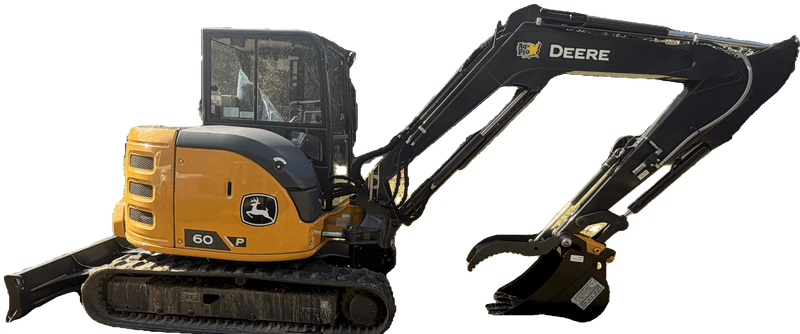
John Deere 60P
Compact excavator with a hydraulic thumb, a tooth bucket and a backfill blade.
Does the grubbing and the digging. The bucket cuts around a stump and the hydraulic thumb pulls the root ball. The same machine cuts swales and ditches, and its blade closes the holes the stumps leave.
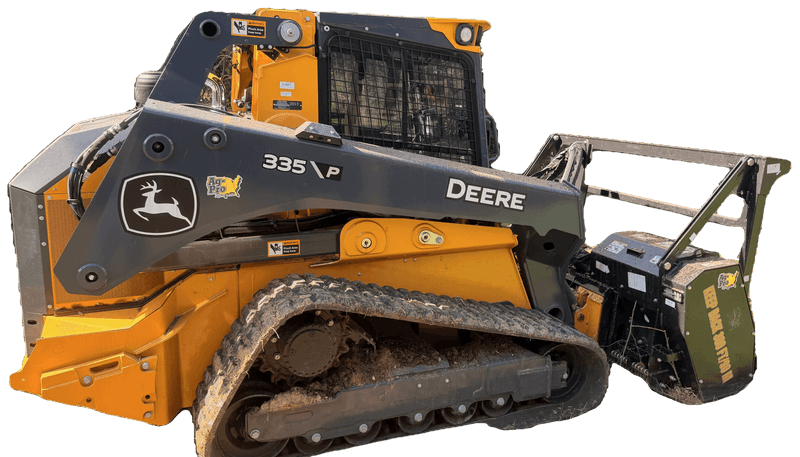
John Deere 335P
Compact track loader. A tracked carrier that swaps tools on its front.
The carrier and the shaper. It moves debris and dirt across the site on rubber tracks and does the rough shaping on pads and drives.
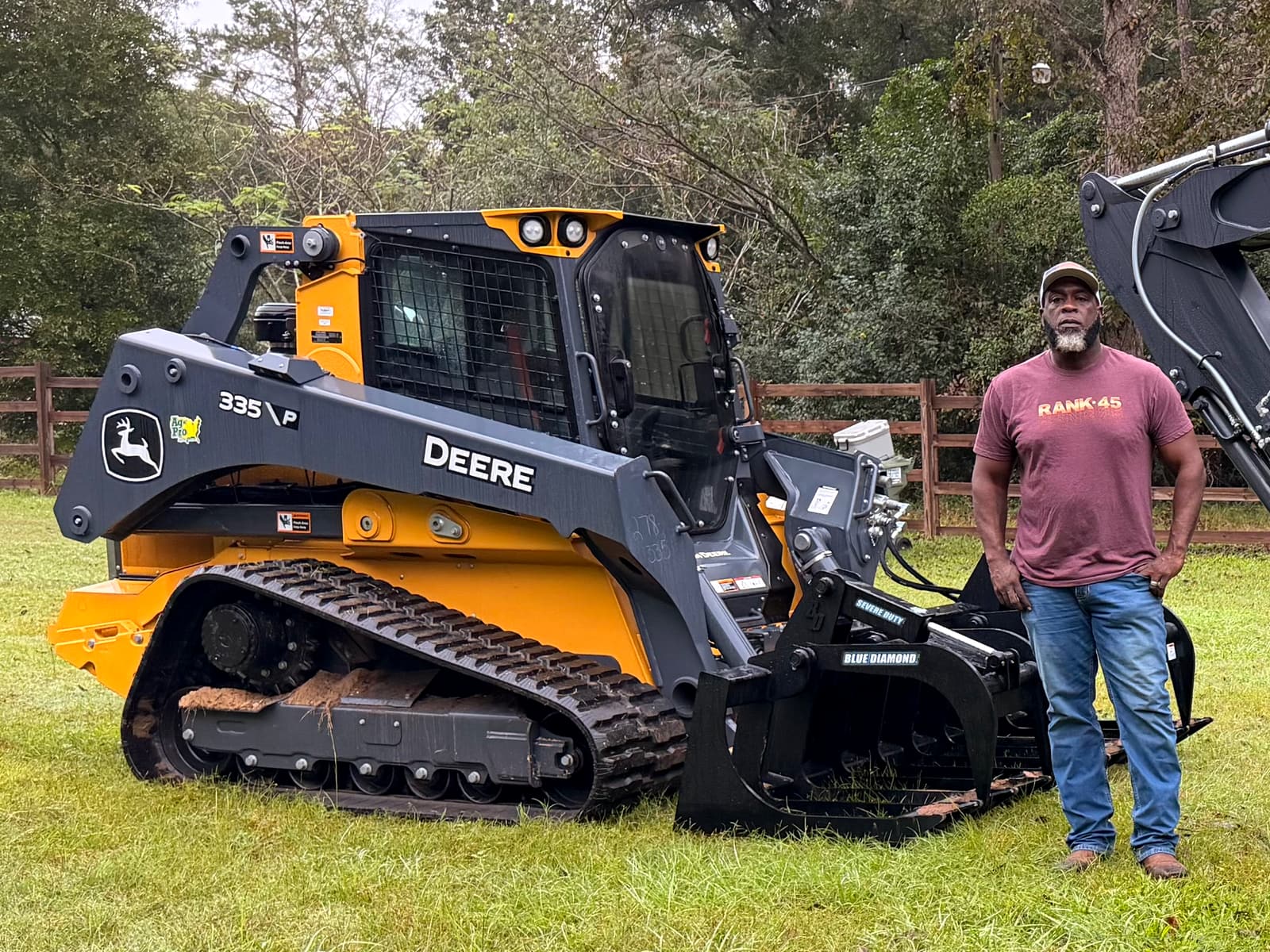
Blue Diamond root grapple
Root grapple. A steel rake with a hydraulic clamp, mounted on the 335P.
Goes on the 335P for the root work. The tines rake roots and limbs out of loosened ground and carry them to the pile.
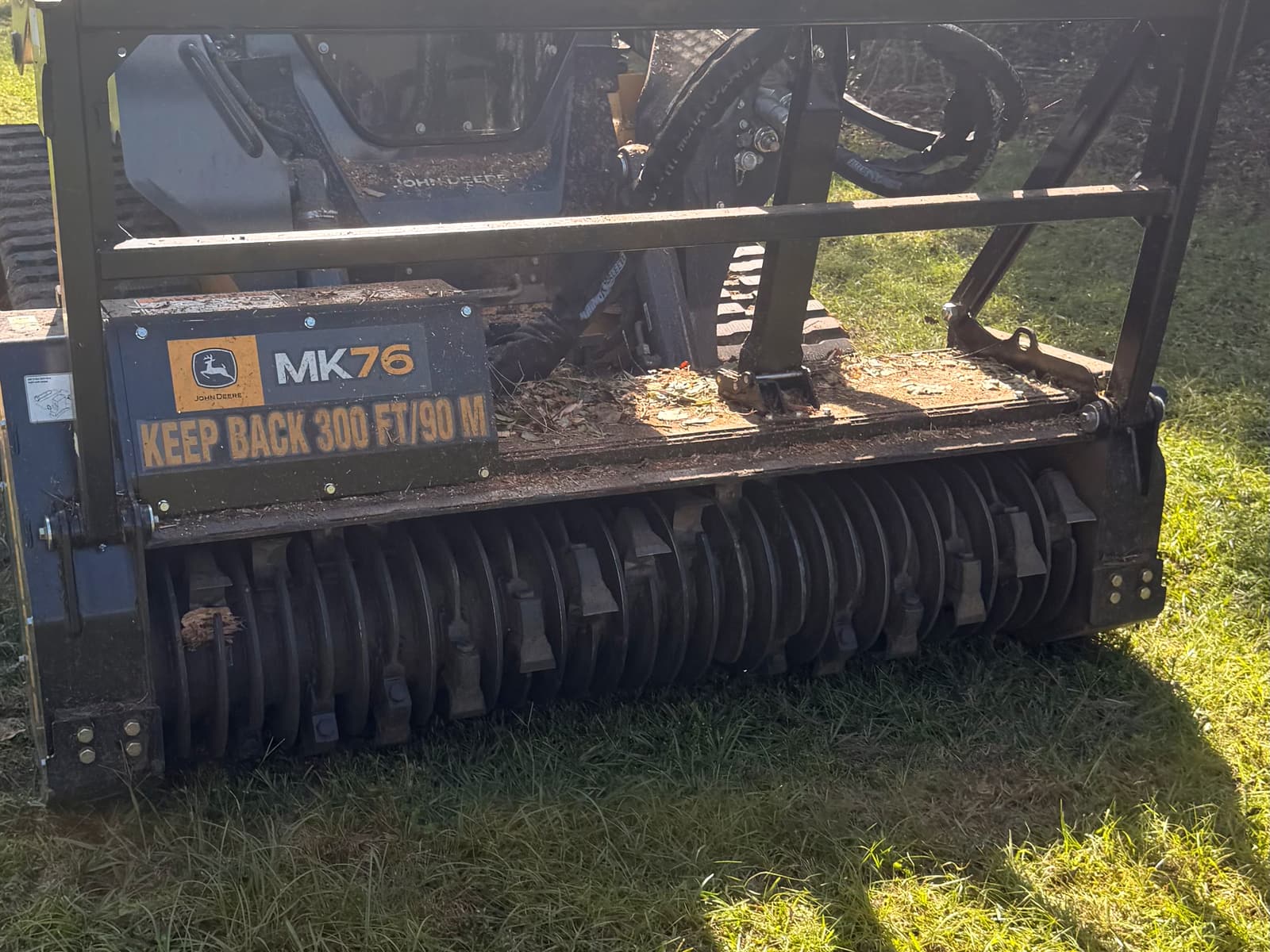
John Deere MK76 mulching head
Forestry mulching head. A steel drum of cutting teeth that mounts on the front of the 335P.
Handles what is outside the footprint. Brush, vines and small trees on ground that will not be built on get mulched where they stand.

Massey Ferguson cab tractor with front loader
Farm tractor with a closed glass cab and a front loader. It pulls and powers the batwing cutter.
On open, weedy ground the tractor and the batwing cutter can mow first, so everyone can see the ground before any dirt moves.


Sources (30)
Rules change. Every link below was read on November 11, 2026. Check with the office named before you act on it.
Construction Activity: NPDES Stormwater Construction Generic Permit (opens in a new tab). Florida Department of Environmental Protection. Checked .
Generic Permit for Stormwater Discharge from Large and Small Construction Activities (effective February 2015), Part 5.4 (opens in a new tab). Florida Department of Environmental Protection. Checked .
Environmental Resource Permitting (opens in a new tab). Florida Department of Environmental Protection. Checked .
Environmental Resource Permits (opens in a new tab). Northwest Florida Water Management District. Checked .
Stormwater Best Management Practice: Silt Fences (EPA 833-F-11-008, April 2012) (opens in a new tab). U.S. Environmental Protection Agency. Checked .
Florida Statutes, section 556.105: Procedures (Underground Facility Damage Prevention and Safety Act) (opens in a new tab). The Florida Legislature, Online Sunshine. Checked .
Private Utility Locators (opens in a new tab). Sunshine 811. Checked .
The 811 Process (opens in a new tab). Georgia 811. Checked .
Florida Statutes, section 553.79: Permits; applications; issuance; inspections (opens in a new tab). The Florida Legislature, Online Sunshine. Checked .
Florida Statutes, section 335.1825: Access permit required; authority to close unpermitted connections (opens in a new tab). The Florida Legislature, Online Sunshine. Checked .
Rule 391-3-7-.01: Definitions (Erosion and Sedimentation Control) (opens in a new tab). Rules and Regulations of the State of Georgia, Georgia Secretary of State. Checked .
Official Code of Georgia, section 12-7-17: Exemptions (Erosion and Sedimentation Act of 1975) (opens in a new tab). State of Georgia, public copy of the code linked from the Georgia Secretary of State rules site. Checked .
General Permit GAR100001: Stormwater Discharges Associated with Construction Activity for Stand Alone Construction Projects (opens in a new tab). Georgia Environmental Protection Division. Checked .
NPDES Construction Storm Water General Permits (opens in a new tab). Georgia Environmental Protection Division. Checked .
Land Disturbance Permit application (February 2024) (opens in a new tab). City of Valdosta Engineering Department. Checked .
Land Development Regulations, Chapter 302, Article 5: Development Permits (Section 302-44) (opens in a new tab). City of Valdosta. Checked .
Planning Department (opens in a new tab). Decatur County, Georgia. Checked .
Gadsden County Land Development Code, Chapter 5, Subsection 5404 (version dated December 19, 2023) (opens in a new tab). Gadsden County, Florida. Checked .
Tree Removal and Clearing Permit Application (revised October 20, 2020) (opens in a new tab). Gadsden County Planning Division. Checked .
Environmental Permits (opens in a new tab). Leon County Government. Checked .
Environmental Management Permit (opens in a new tab). City of Tallahassee, Growth Management. Checked .
Planning, Zoning and Land Use (opens in a new tab). Jefferson County, Florida. Checked .
Gopher Tortoise Permits (opens in a new tab). Florida Fish and Wildlife Conservation Commission. Checked .
Conservation Subdivision: Construction Phase: Protecting Trees and Conserved Natural Areas (WEC278/UW323) (opens in a new tab). UF/IFAS Extension, University of Florida. Checked .
Protecting Trees During Construction (opens in a new tab). UF/IFAS Gardening Solutions, University of Florida. Checked .
Reducing Hazardous Fuels on Woodland Property: Mechanical Treatments (EC 1575) (opens in a new tab). Oregon State University Extension Service. Checked .
Know the Law: Land Clearing Debris Burns with ACI (opens in a new tab). Florida Department of Agriculture and Consumer Services, Florida Forest Service. Checked .
Burn Permits and Notifications (opens in a new tab). Georgia Forestry Commission. Checked .
Open Burning Rules for Georgia: Burn Types (opens in a new tab). Georgia Environmental Protection Division. Checked .
Soil Survey Geographic Database (SSURGO), survey area FL039, Gadsden County, Florida, read through Soil Data Access (opens in a new tab). USDA Natural Resources Conservation Service. Checked .