Lot Clearing for New Homes: House site opened up. Shade trees still standing.
You bought a wooded lot, and the builder wants it open. We clear the house site, drive and septic area and keep the trees you flag.
Quincy, Florida. Free estimates. Job minimum $2,000.

Is this what you need?
We bought a wooded lot and can't see where the house goes
You own it, but you have never stood in the middle of it.
The builder has a start date and the lot is still woods
The slab crew needs open ground, a way in for the trucks and room to lay out the house.
We want to keep the big oaks, and we are afraid of a crew that pushes everything
Most outfits push everything into a pile, and you spend years growing back the shade you paid to remove. We flag the keepers with you first and clear around them.
Nobody told us about the survey, the septic or the permit
A lot needs paperwork before it needs a machine: corner stakes, a site plan, a septic location and whatever the county asks for.
More on these
We bought a wooded lot and can't see where the house goes
Brush, vines and small pines hide the corners, the slope and the good trees, and until the lot is open, the house is a guess on paper.
The builder has a start date and the lot is still woods
Every week the lot sits in brush is a week nothing else can start.
Nobody told us about the survey, the septic or the permit
We tell you what to have in hand and which office to call.
There is an old trailer or shed where the house should go
That is two jobs on one lot, done by the same machines: the structure comes down and gets hauled off, then the ground gets cleared. See demolition.
How I do it

Flag what stays and mark the lines
We flag the keepers and mark the house, the drive and the septic area.
Locates and permits before the first cut
We request utility locates before we dig. I tell you which permit office to call.
Cut the way in, then open the house site
We start at the road, on the line where your driveway will go.
Dig the stumps where concrete and pipe will go
The 60P digs stumps out of the footprint, the drive and the septic area.
Every step in detail
See a price range first
Draw the lot in the instant quote and mark what you want kept.Time: About 2 minutes
I walk the lot with you
Bring your survey and site plan. Free, at a set start time, Monday to Friday.Time: One visit
Flag what stays and mark the lines
We flag the keepers and mark the house, the drive and the septic area.
Locates and permits before the first cut
We request utility locates before we dig. I tell you which permit office to call.Time: 2 to 3 business days of notice
Cut the way in, then open the house site
We start at the road, on the line where your driveway will go.
Dig the stumps where concrete and pipe will go
The 60P digs stumps out of the footprint, the drive and the septic area.
Debris handled, rough grade, one more walk
Brush is mulched, stumps are piled or hauled, and ruts are smoothed out.
What it costs
- Half an acre of brush and small trees, stumps out
- $2,850 to $4,650
- One acre of light brush, stumps out
- $3,200 to $5,200
- One acre of brush and small trees, stumps out
- $4,400 to $7,150
- The same acre with a house pad built
- $7,000 to $12,050
Estimates, not quotes. I confirm the price on site, and the visit is free. Job minimum $2,000.
What moves the price
These are estimates for flat, dry ground with open access and the debris piled on the lot: I confirm the price after I walk your lot, and the estimate is free.
How much you open
Price follows the ground we clear, not the size of the deed. Small openings cost more per acre, because two machines still have to be brought out.
What is growing
Light brush is the cheapest to clear. Heavy mixed woods and mature timber cost the most, and I look at those in person before any number is promised.
Stumps out, or left in the ground
Digging stumps takes a second machine: a half acre of brush and small trees runs about $2,850 to $4,650 with the stumps out and about $2,000 to $2,500 mulched. Most house lots need stumps out only where you build, drive and bury pipe.
Where the debris goes
Mulched in place or piled on the lot is inside the clearing price. Hauling it off is extra, priced by the load.
A pad, fill dirt or a finish grade
A rough grade comes with the clearing. A built house pad of up to 2,500 square feet on the soil that is there adds about $2,600 to $4,900, and fill dirt is priced on site.
An old structure on the lot
Demolition is its own line: a single wide mobile home runs about $2,800 to $5,400 and a double wide about $3,500 to $6,750, hauling and dump fees included.
Slope, wet ground and tight access
Slope and wet ground each raise the price, and wet ground also widens the range. Tight access slows the machines.
Distance from Quincy
The first 30 road miles from Quincy carry no delivery charge, and Tallahassee and Bainbridge fall inside that. Farther out, the estimate shows an equipment delivery line.
What stays protected
Keepers are picked before a machine starts
The order I work in is walk, flag, then clear.
The root zone, not only the trunk
A ribbon on the trunk does not protect a tree, so tracks and blades stay off the ground over its roots.
No fill, no cuts and no piles under a tree you keep
The stump pile, the dirt pile and the rough grade all stay outside the root zones of the keepers.
More on what stays protected
Keepers are picked before a machine starts
Gadsden County's own code tells developers the same: work out what must be protected before any other design work or clearing begins.
The root zone, not only the trunk
UF/IFAS puts the line at the drip line, the outer edge of the branches, and Gadsden County's code uses one foot of radius for every inch of trunk diameter.
No fill, no cuts and no piles under a tree you keep
UF/IFAS says raising or lowering the soil around a tree, even by a few centimeters, can kill it.
One road in, where the driveway goes
We run one route in and out, the one that becomes your driveway. UF/IFAS reports that over 90 percent of soil compaction happens in the first three tire passes. A machine that wanders packs the whole lot.
Topsoil stays where it is
Outside the footprint we mulch instead of scraping. The roots and the topsoil stay where they are, and the mulch covers the soil and helps hold it when it rains.
The septic ground stays loose
A drain field works because water soaks down through the soil. The EPA says not to park or drive on a drain field. Show us the septic plan on the walk. The piles and the truck route go somewhere else.
Rain still has somewhere to go
Clearing changes where water runs. UF/IFAS notes that trees slow the rain on the way down, which cuts the amount of water and soil that washes away. On the walk we look at which way the lot drains, so the rough grade does not block the path the water already takes.
Questions I get asked
How much does it cost to clear a lot for a house?
It depends on the size of the opening, what is growing there and whether the stumps come out. With the stumps out, a half acre of brush and small trees runs about $2,850 to $4,650 and a full acre about $4,400 to $7,150, left rough graded with the debris piled on the lot. Those are estimates for flat, dry ground, and I confirm the price after I walk it. See your own range.
Do I need a permit to clear my lot?
It depends on the county, the city and what you are building. In unincorporated Gadsden County, one detached single family house on a lot is exempt from the county's tree protection rules, while Leon County, the City of Tallahassee and Jefferson County each have permits of their own. Call the planning office before you clear. Our permits guide lists the rules, each with its source.
Is the lot ready to build on when you leave?
It is ready for your builder to stake and for the pad work to start: the house site is open, the stumps are out where you build, and the ground is rough graded. It is not a finished pad. If your builder wants the pad built and shaped, that is site preparation, and we do that too.
Do all the stumps have to come out?
No. They have to come out where you pour concrete, drive or bury pipe, and the Florida Building Code wants stumps and dead roots gone from the foundation and one foot around it. In the rest of the yard, the mulching head works at ground level and the roots stay in the ground. That costs less, and it is easier on the trees you keep.
Which trees can I keep close to the house?
The ones whose roots will not be cut or buried. UF/IFAS says roots often reach as far from the trunk as the tree is tall, and most of the fine roots sit in the top few inches of soil, so a big oak a few steps from the slab will lose roots to the footing and the pad. I tell you on the walk which trees have a fair chance. We do not promise that any tree survives construction, but we keep machines, fill and piles out of its root zone.
More questions
What should I have ready before you come out?
The survey, with the corners staked if you can, the site plan from your builder, the septic plan, or at least the spot the installer has in mind, and a ribbon on every tree you want kept. If you have none of that yet, book the walk anyway: I can look at the lot with you and tell you what to get first.
Can you find my property corners?
No. Corners are a surveyor's job, and we clear to the surveyor's stakes. What we can do is mulch a path along the line so the surveyor can get through the brush.
What happens to the trees, stumps and brush?
Brush and small trees are ground into mulch and left on the lot, and logs and stumps are piled where you want them or hauled off by the load. Burning is a separate question: in Florida a land clearing pile needs an authorization from the Florida Forest Service, and on a home site it has to sit 300 feet from any occupied building that is not yours, which rules it out on many lots.
How long does it take to clear a house lot?
It depends on the size of the opening, what is growing and whether the stumps come out: mulching alone is the quick end, digging stumps, piling and rough grading take longer, and big timber longer still. Add the wait for utility locates: at least 2 full business days in Florida and at least 3 business days in Georgia. I give you the number of days after I walk the lot.
There is an old mobile home on the lot. Can you take that out too?
Yes. Demolition is one of our services: a single wide runs about $2,800 to $5,400 and a double wide about $3,500 to $6,750, torn down and hauled off. Those are estimates, and I confirm the price on site. Florida law requires a permit to demolish a building, so check with your county building department before the date is set.
I think there are gopher tortoises on my lot. Now what?
Tell me before the walk. In Florida the burrows are protected by state law, and any work within 25 feet of one counts as a disturbance. If the house has to go where a burrow is, a relocation permit from the Florida Fish and Wildlife Conservation Commission comes first. We do not move tortoises.
Do you clear lots in Georgia too?
Yes. We work up to 100 miles out from Quincy, on both sides of the state line, and our photo record includes a lot we mulched in Thomasville, Georgia, posted in November 2026. Georgia has its own rules: utility locates need at least 3 business days, and state waters that require a buffer carry a 25 foot undisturbed buffer. Some cities want a land disturbance permit before any clearing, so call the city or county first.

The details
The longer answers, for when you want them.
What it is, in plain words
Lot clearing is the first trade on a home site. It turns a wooded lot into ground a builder can stake, drive on and pour on.
It is not the same job as opening a pasture or mulching the back five. A house lot has lines that matter to the foot: the property corners, the setbacks, the footprint of the house, the driveway, the septic tank and its drainfield. We clear to those lines, not to the edge of the woods.
What the lot needs before the slab crew
- The house site opened. Trees, brush and stumps gone from the footprint, plus the working room your builder asks for around it. The layout stakes and string lines sit outside the footprint, so the opening has to be bigger than the house.
- Stumps and roots out where concrete and pipe go. Under the slab, the driveway, the septic tank and the trench lines.
- A way in for trucks. One entrance on the line of your future driveway. Ask your builder what the concrete truck and the lumber delivery need, and we open it to that.
- The septic area cleared, then left alone. Trees come off it. After that, no piles and no truck traffic, so the soil stays loose.
- Keepers flagged. The oaks, the pines and the screening you want for shade, privacy and value, marked before the first cut.
- A rough grade. Stump holes filled and ruts smoothed. A built pad is the next step. That is site preparation.
There are two ways to clear a lot, and most lots get both. Where you will build, drive or bury pipe, the trees come down and the John Deere 60P excavator digs the stumps and roots out. Everywhere else, the John Deere 335P and its MK76 mulching head grind brush and small trees into mulch where they stand. That leaves the roots and the topsoil in place around the trees you keep.
- Job minimum
- $2,000
- One acre lot, brush and small trees
- $4,400 to $7,150Estimate: stumps out, rough graded, debris piled on the lot. I confirm on site.
- Estimate visit
- Free, Monday to FridayA set start time, not a window.
- Where we work
- Up to 100 miles from Quincy, Florida
- Machines
- John Deere 60P excavator with thumb. John Deere 335P with the MK76 mulching head and a root grapple.
Why mulching alone does not finish a house site
The Florida Building Code has a section on preparing a building site (R318.6 in the Residential volume, 2304.12.6 in the Building volume). It covers the foundation and the area within 1 foot of it. All vegetation, stumps and dead roots must be removed there. The fill must be free of vegetation and compacted. A mulching head works at ground level and leaves the roots. So under the house, the stumps get dug. Your building department has the last word on what it wants to see.
Right call or wrong tool
The right call
You have a site plan and a builder waiting
This is the plain case. The house, the drive and the septic are on paper. We put them on the ground with flags, clear inside the marks and leave the rest of the lot alone.
You own the lot but have not placed the house yet
Start smaller. We mulch the underbrush so you, the surveyor and the builder can walk it and see the trees and the slope. The stumps and the big clearing wait until the house is placed. That way you do not clear ground you later wish you had kept.
You are a builder with a lot to open
You get a clear scope: what comes out, what stays, where the debris goes and how the ground is left. We are licensed and insured, and the machines and the crew are our own. More on the commercial page.
You are adding a second house, a shop or a barn on land you already own
Same job with a smaller footprint. The building site, the drive to it and any new septic get opened. The woods between the buildings can stay.
An old house or mobile home has to come out first
We take the structure down and haul it off, then clear the lot, with the same excavator. Demolition is priced as its own line.
The wrong tool
You have no survey and no stakes
Instead: Get the corners marked first. We clear to stakes, not to a fence line somebody remembers. If you only need to see the lot, we can mulch the underbrush well inside the lines and leave the edges for later.
You want acreage opened, not a house site
Instead: That is land clearing if the stumps come out, or forestry mulching if they can stay. Both are priced by the acre.
It is one or two yard trees beside a house or under a power line
Instead: That is work for a tree service with climbers and a bucket truck. Our machines need room to work, and our jobs start at $2,000.
The lot is low, or holds water part of the year
Instead: Stop before anything is cut. In the Florida Panhandle, even isolated wetlands are regulated. Call the Northwest Florida Water Management District first. Once you know where the line is, we clear the high ground.
The lot needs a pad built up, fill hauled in or a slope cut down
Instead: Clearing leaves a rough grade, not a pad. Moving dirt to an elevation is site preparation or grading. We do both, and it makes sense to price them with the clearing.
The open part of the lot is only weeds and tall grass
Instead: That is tractor work. Bush hogging with the batwing cutter handles it, and there is nothing to dig.
How long it takes
Typical time on site. Estimates, not promises.
- A price range for your lot
- About 2 minutes onlineBefore anyone calls you.
- The estimate visit
- One visit, Monday to FridayBooked for a set start time, not a window.
- Utility locates before any digging
- At least 2 full business days in Florida, at least 3 business days in GeorgiaSet by Florida law and by Georgia 811. Stumps are not dug before the lines are marked.
- Half acre lot, brush and small trees, mulched only
- I give the time after the walkFor scale only: Virginia Cooperative Extension says an acre of mulching can take anywhere from one to eight hours. That is not our pace on your lot.
- One acre lot, stumps out and rough graded
- Longer than a mulching job. I give the number of days after the walk.Every stump is dug, the debris is piled and the ground is graded. Big timber and wet ground add time.
- Florida stormwater notice, when one acre or more is disturbed
- Filed at least 2 calendar days before work startsThe notice goes to the Florida Department of Environmental Protection. Ask your builder who files it.
Rules, permits and more to know
What to have in hand before we clear
Clearing is fast, and it cannot be undone. These five things keep the machine on the right ground.
A survey, with the corners staked
We clear to stakes and flagged lines. If the corner pins are lost in the brush, a surveyor finds them and marks them. We can mulch a path along the line so the surveyor can work.
The site plan from your builder
It shows the footprint, the driveway, the setbacks and which way the house faces. Ask the builder to stake the corners of the house before the walk. Ask how much working room they want around it.
The septic location
In Gadsden, Leon, Jackson and Jefferson counties, the Florida Department of Environmental Protection issues septic permits. The application takes a site evaluation of the soil and a site plan. Once that plan exists, we know which ground to clear and which ground to keep trucks off.Counties and offices change. Check the state's septic permitting page for yours.
The answer from the county or the city
One call to the planning office before you sign anything. The rules below show how much they change from one county to the next.
Your keep list
Walk the lot and tie a ribbon on anything you would hate to lose. I will tell you which ones can live next to a house and which ones cannot.
Rules that touch a house lot
Rules change by county, by city and by what the land will be used for. These are the main ones, each with its source. We clear land. We are not a law office. The office named in each note has the last word.
Gadsden County, outside city limits
The county's tree protection section exempts placing one detached single family house on a piece of property, and it waives tree protection for the driveway. Subdivisions, commercial and industrial sites are different: before development approval, only underbrush under 4 inches may be cut, and only for the survey. The county also has a Tree Removal and Clearing Permit application with a $100 fee. Ask the county Planning Division which applies to your lot. For the City of Quincy's rules, ask the city if your lot is inside the limits.
Leon County and the City of Tallahassee
Outside the city, Leon County requires an environmental management permit for tree removal and tree protection projects. Whether your lot needs one depends on the site: canopy road zones, wetlands, floodplains, slopes and zoning all count. Inside Tallahassee, an Environmental Management Permit or a waiver must be in hand before building permits are issued. If the project needs no such permit and removes protected trees, the owner applies for a tree permit, and one tree permit covers no more than 10 trees.
Jefferson County and Monticello
Every development needs a Development Permit from the county Planning Department before the Building Department will issue a building permit. The county's land development rules cover buildings of any type and driveways. Inside the City of Monticello, City Hall handles permits.
Gopher tortoise burrows (Florida)
Gopher tortoises and their burrows are protected by state law. Any work within 25 feet of a burrow counts as a disturbance. That includes clearing, grading and parking heavy equipment. Keep everything 25 feet away from every burrow and you may not need a permit. Closer than that, a relocation permit from the Florida Fish and Wildlife Conservation Commission comes first. We look for burrows on the walk.
One acre or more disturbed (Florida)
Construction that disturbs one acre or more, and drains to surface waters or a city storm sewer, needs coverage under the state's construction stormwater permit. So does a smaller lot that is part of a larger common plan of development. The notice goes to the Florida Department of Environmental Protection at least 2 calendar days before work starts. The fee for 1 to 5 acres is $250. Ask your builder whether your lot is covered.
Low and wet ground (Florida Panhandle)
In the Northwest Florida Water Management District, Environmental Resource Permits cover dredging and filling in wetlands, and that includes isolated wetlands. The state permit is separate from the federal one. Nobody on a machine can tell you a wet spot is not a wetland. Call the district before that part of the lot is cleared.
Georgia lots
Georgia's erosion law exempts building a single family home that disturbs less than one acre and is not part of a larger development. The work still has to meet the law's minimum requirements. The general exemption for projects under one acre does not apply within 200 feet of the bank of state waters. State waters that require a buffer carry a 25 foot undisturbed buffer. Cities add their own rules. Inside the City of Valdosta, land disturbing work needs a land disturbance permit unless the city's erosion chapter exempts it. The permit form names clearing and grubbing. In Bainbridge and Decatur County, tree removal requests go through the joint building and planning office.
Burning the pile
A land clearing pile is not a yard waste pile. In Florida, every land clearing pile burn needs an authorization from the Florida Forest Service. On a home site the pile must sit at least 300 feet from any occupied building other than the landowner's. It must also sit 100 feet from a paved public road and 50 feet from woods or brush. Many small lots cannot meet those distances. In Georgia, debris piled by machine counts as land clearing. A land clearing burn there means contacting the Georgia Forestry Commission first, for a permit or a notification.
An old house, septic tank or well on the lot (Florida)
Florida law requires a building permit to demolish any building. An old septic tank is abandoned under a state permit. It is pumped out by a permitted septage company. Then the tank is ruptured, collapsed or removed and filled with clean sand or other suitable material. The Northwest Florida Water Management District says only a Florida licensed water well contractor can apply for the permit to plug an old well. The septic pump out and the well plugging belong to those licensed trades.
Why clearing less can be worth more
The cheapest shade tree is the one already growing on your lot. Plant a new one and you wait years for the shade the old one gave you on day one. So before we talk about what comes out, we talk about what is worth more standing.
- Shade. UF/IFAS reports that shade over a home can cut cooling electricity by 10 to 50 percent, depending on how much shade there is. East and west walls take about 50 percent more sun in the warm months than north and south walls, so trees on those sides do the most.
- Privacy. A strip of woods along the road and the lot lines is a screen that is already grown. Clear it, and you look at the neighbor's back porch until a hedge fills in.
- Drainage. Trees slow the rain on the way down. UF/IFAS notes that this cuts the amount of water and soil that washes away.
- Resale. UF/IFAS cites research that people pay more for a home with tree cover, in one study up to 10 percent of the price of the home.

What has to go no matter what
- Everything in the house footprint and one foot around it: trees, stumps and dead roots. That is building code. Your builder will want working room past that.
- Trees and stumps on the driveway line, and where the septic tank, the drain field and the utility trenches go. The EPA says to keep trees far enough from a drainfield that roots do not grow into the system.
- Trees that would end up in the fill, or lose their roots to the pad. A grade change can kill them, so do not count them as keepers.
- Dead, hollow and leaning trees that could reach the house. The time to take them is before there is a roof under them.
- Invasive brush like Chinese privet, mimosa, chinaberry and Chinese tallow. Gadsden County's code lists them as invasive and leaves them out of tree protection. Expect sprouts afterward. UF/IFAS says many invasive plants sprout back unless the roots are removed.
Where lot clearing stops and the next job starts
| Compared on | What it covers | When you need it |
|---|---|---|
| Lot clearing | Trees and brush off the house site, the drive and the septic area. Stumps out where you build. Keepers flagged. Rough grade. | On every wooded lot, first. |
| Site preparation | Lot clearing plus a built house pad, with the ground shaped for the builder. | When the builder wants a pad, not only open ground. |
| Grading | Shaping dirt: slopes, drainage and the ground the pad and the drive sit on. | When water or elevation is the problem. |
| Demolition | An old house, mobile home, shed or slab taken down and hauled off. | When something is standing where the house goes. |
Bottom lineOne crew with its own machines does all four. Each one is its own line in the estimate, so you can see what the clearing costs and what the dirt work costs.
Read more on site preparation, grading and demolition. If you want most of the lot left wooded and only the underbrush gone, look at selective clearing.
What house lots run
Estimates. I confirm every price on site.
| The job | Estimated range |
|---|---|
| Half acre, brush and small trees, mulched, roots left in the ground | $2,000 to $2,500 |
| Half acre, brush and small trees, stumps out, rough graded | $2,850 to $4,650 |
| One acre, light brush, stumps out, rough graded | $3,200 to $5,200 |
| One acre, brush and small trees, stumps out, rough graded | $4,400 to $7,150 |
| The same acre plus a built house pad of up to 2,500 square feet | $7,000 to $12,050 |
Flat, dry ground with open access, debris piled on the lot, close enough to Quincy that there is no delivery line. Heavy woods and mature timber are priced after I see them. The job minimum is $2,000.
The equipment and the sources
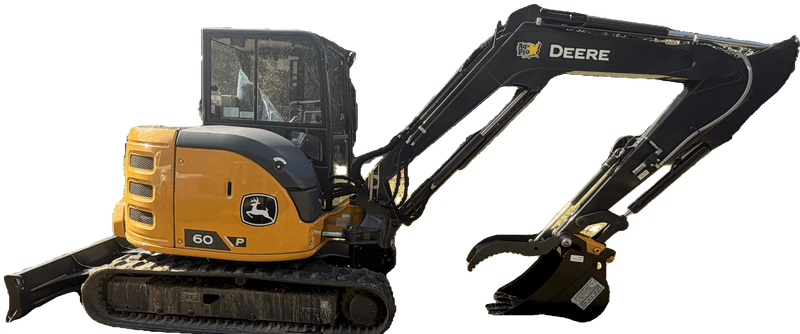
John Deere 60P
Compact excavator with a hydraulic thumb, a tooth bucket and a backfill blade.
The stump machine. It digs stumps and main roots out of the house footprint, the driveway and the septic area, and picks single trees out from between the keepers.
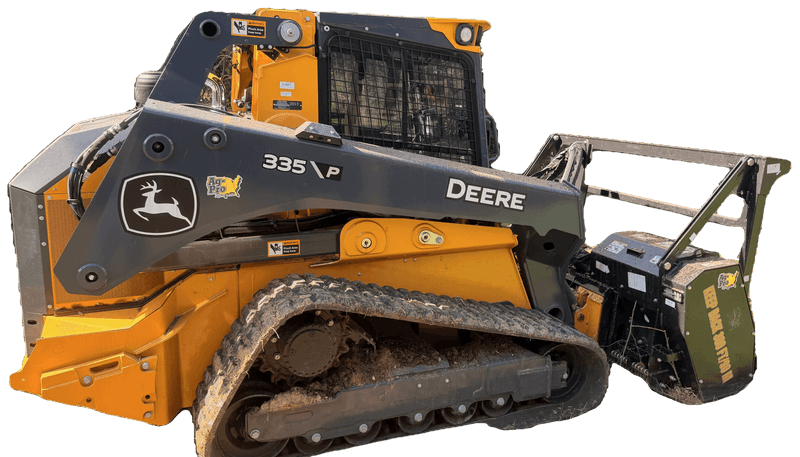
John Deere 335P
Compact track loader. A tracked carrier that swaps tools on its front.
A compact track loader on rubber tracks. It carries the mulching head and the root grapple.
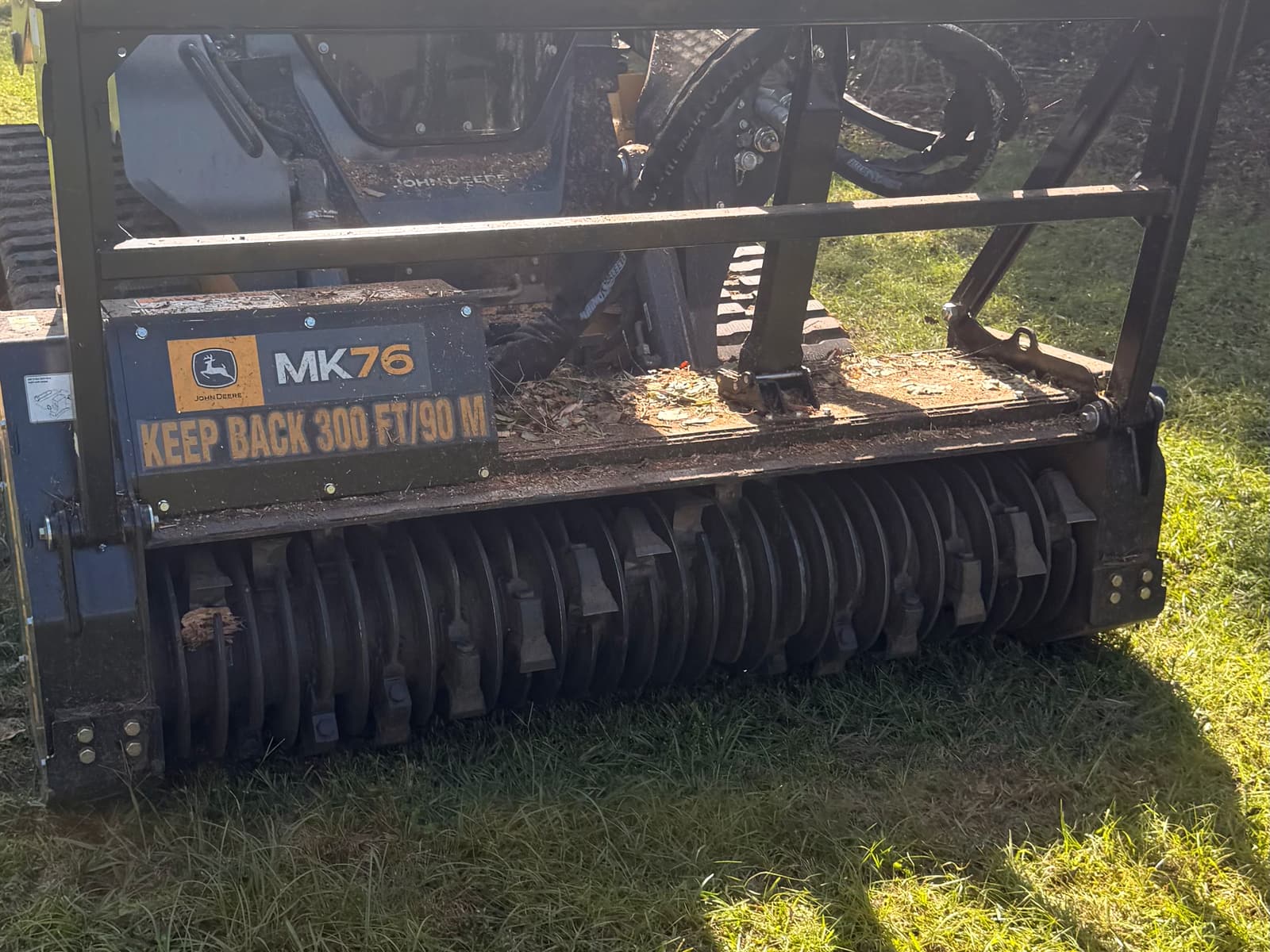
John Deere MK76 mulching head
Forestry mulching head. A steel drum of cutting teeth that mounts on the front of the 335P.
Grinds brush, vines and small trees into mulch where they stand, outside the footprint and under the trees you keep.
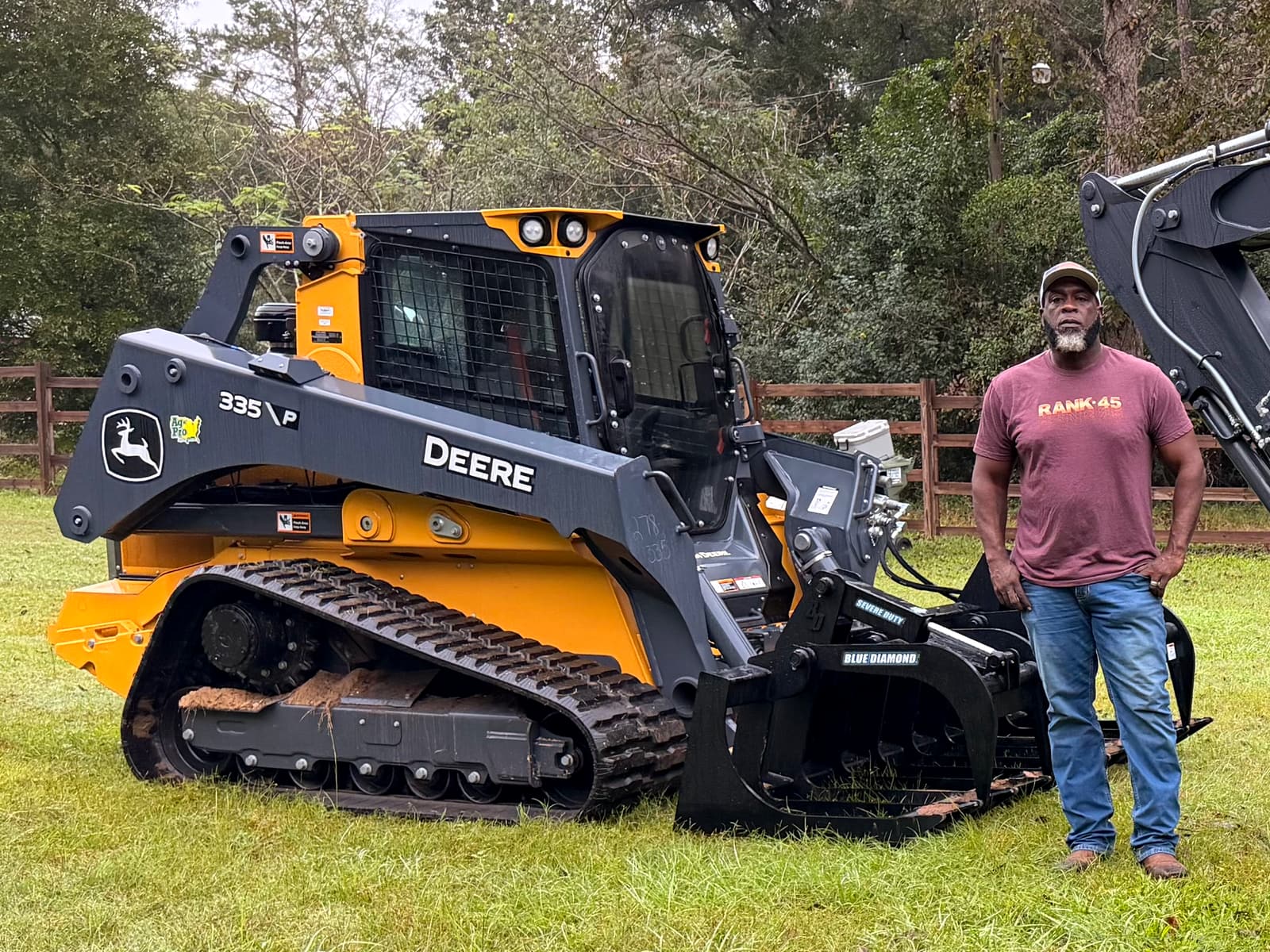
Blue Diamond root grapple
Root grapple. A steel rake with a hydraulic clamp, mounted on the 335P.
Picks up logs, stumps and brush and carries them to the pile. A blade would shove your topsoil in with them.

Massey Ferguson cab tractor with front loader
Farm tractor with a closed glass cab and a front loader. It pulls and powers the batwing cutter.
If part of the lot is only tall grass and weeds, the tractor mows it with the batwing cutter.


Sources (33)
Rules change. Every link below was read between November 11 and November 12, 2026. Check with the office named before you act on it.
Florida Building Code, 8th Edition (2023): Preparation of building site and removal of debris (Building volume, Section 2304.12.6.2; the Residential volume carries the section at R318.6) (opens in a new tab). Florida Building Commission, read on UpCodes. Checked .
Gadsden County Land Development Code, Chapter 5, Subsection 5404 (version dated 12/19/2023) (opens in a new tab). Gadsden County, Florida. Checked .
Tree Removal and Clearing Permit Application (form revised 10/20/2020) (opens in a new tab). Gadsden County Planning Division. Checked .
Environmental Permits (opens in a new tab). Leon County Development Support and Environmental Management. Checked .
Environmental Services: Frequently Asked Questions (opens in a new tab). Leon County Development Support and Environmental Management. Checked .
Environmental Management Permit (opens in a new tab). City of Tallahassee Growth Management. Checked .
Tree Permit (opens in a new tab). City of Tallahassee Growth Management. Checked .
Planning, Zoning and Land Use (opens in a new tab). Jefferson County, Florida. Checked .
Permits, Inspections and Code (opens in a new tab). Jefferson County, Florida. Checked .
Gopher Tortoise Permits (opens in a new tab). Florida Fish and Wildlife Conservation Commission. Checked .
Construction Activity: NPDES Stormwater Construction Generic Permit (opens in a new tab). Florida Department of Environmental Protection. Checked .
Environmental Resource Permits (opens in a new tab). Northwest Florida Water Management District. Checked .
Florida Statutes, Section 556.105: Procedures (Underground Facility Damage Prevention and Safety Act) (opens in a new tab). The Florida Legislature. Checked .
The 811 Process (opens in a new tab). Georgia 811. Checked .
Know the Law: Land Clearing Debris Burns (opens in a new tab). Florida Department of Agriculture and Consumer Services, Florida Forest Service. Checked .
Burn Permits and Notifications (opens in a new tab). Georgia Forestry Commission. Checked .
Official Code of Georgia, Section 12-7-17: Exemptions (Erosion and Sedimentation Act) (opens in a new tab). State of Georgia, public copy linked from the Georgia Secretary of State rules site. Checked .
General Permit GAR100001: Stormwater Discharges Associated with Stand Alone Construction Activity (opens in a new tab). Georgia Environmental Protection Division. Checked .
Land Development Regulations, Chapter 302, Article 5: Development Permits (Section 302-44) (opens in a new tab). City of Valdosta, Georgia. Checked .
Land Disturbance Permit Application (February 2024) (opens in a new tab). City of Valdosta Engineering Department. Checked .
Planning Department (opens in a new tab). Decatur County, Georgia. Checked .
Florida Statutes, Section 553.79: Permits; applications; issuance; inspections (opens in a new tab). The Florida Legislature. Checked .
DEP Form 4011: General Permit for the Abandonment of an Onsite Sewage Treatment and Disposal System (opens in a new tab). Florida Department of Environmental Protection. Checked .
Well Permits: Frequently Asked Questions (opens in a new tab). Northwest Florida Water Management District. Checked .
Onsite Sewage FAQ: Permitting (last modified September 24, 2026) (opens in a new tab). Florida Department of Environmental Protection. Checked .
How to Care for Your Septic System (opens in a new tab). U.S. Environmental Protection Agency. Checked .
WEC278/UW323: Conservation Subdivision: Construction Phase, Protecting Trees and Conserved Natural Areas (opens in a new tab). University of Florida IFAS Extension. Checked .
SS-ORH-03/MG089: Dispelling Misperceptions About Trees (opens in a new tab). University of Florida IFAS Extension. Checked .
Protecting Trees During Construction (opens in a new tab). University of Florida IFAS Extension, Gardening Solutions. Checked .
Benefits of Trees (opens in a new tab). University of Florida IFAS Extension, Gardening Solutions. Checked .
Planting Trees for Energy Savings (opens in a new tab). University of Florida IFAS Extension, Gardening Solutions. Checked .
FR133: Common Invasive Plants of North Florida Forests and Their Control (opens in a new tab). University of Florida IFAS Extension. Checked .
Options for Clearing Land to Establish Pasture (publication 465-341) (opens in a new tab). Virginia Cooperative Extension. Checked .