Hauling and Debris Removal: The trees are down. The pile is still sitting there.
A storm laid pines across the back lot, or somebody cut the trees and left you the brush. We load it with our own machines and haul it off.
Quincy, Florida. Free estimates. Job minimum $2,000.

Is this what you need?
The last crew left the pile
A tree crew or a logger dropped the trees, took what they wanted and left.
The storm put the pines on the ground
The wind laid trees across the drive, the fence and the back lot.
What is left of the old shed
The barn fell in years ago. What is left is tin, boards, block and a cracked slab, with weeds growing up through all of it.
The dump that came with the land
You bought the place and found where the last owner threw everything: tires, a freezer, wire, bed frames, roofing. None of it will burn and none of it will rot.
More on these
The last crew left the pile
Now a wall of tops, limbs and logs sits at the edge of the yard, and it is not getting any smaller.
The storm put the pines on the ground
You cut a path with a chainsaw, and the rest is more than a pickup and a weekend.
Concrete and stumps nobody will take
A stack of broken concrete, or a row of stumps somebody pushed up and walked away from. Too heavy for your trailer, and right where you want a yard.
How I do it

Decide what does not get hauled
Standing brush can be mulched. Only what has to leave gets counted in loads.
Pull it apart and sort it
The 60P sorts it on your land. A mixed load can cost more to dump.
Load it and haul it
The 335P carries each load to the truck. The dump fee is in our price.
Clean the spot and walk it
The ground where the pile sat gets cleaned up. Walk it with me.
Every step in detail
Count the piles online
Pick hauling in the instant quote and tell it how many piles there are.Time: About 2 minutes
I walk it and look in the pile
I look at what is in the pile and how a truck gets to it.
Decide what does not get hauled
Standing brush can be mulched. Only what has to leave gets counted in loads.
Pull it apart and sort it
The 60P sorts it on your land. A mixed load can cost more to dump.
Load it and haul it
The 335P carries each load to the truck. The dump fee is in our price.
Clean the spot and walk it
The ground where the pile sat gets cleaned up. Walk it with me.
What it costs
- One load
- $2,000 to $2,500
- Four loads
- $2,000 to $3,000
- Six loads
- $2,450 to $4,500
- Ten loads
- $4,100 to $7,450
Estimates, not quotes. I confirm the price on site, and the visit is free. Job minimum $2,000.
What moves the price
These are estimates.
I confirm the load count and the price on site, and the visit is free.
The job minimum is $2,000, which a hauling job by itself reaches at about four loads.
How many loads
Hauling is priced by the load: about 12 to 16 cubic yards, loaded, hauled and dumped, for about $400 to $750. With our job minimum a single load shows $2,000 to $2,500. Four loads show $2,000 to $3,000 in our tool, six show $2,450 to $4,500 and ten show $4,100 to $7,450.
What can stay
Every yard of brush that is mulched, burned or stacked in a back corner is a yard nobody pays to truck. It is the first place to look for savings.
What the pile is made of
Clean brush, building debris and household junk are three kinds of load, and they do not all cost the same to dump. A sorted pile usually costs less to get rid of than a mixed one.
How heavy it is
Concrete, dirt and green stumps reach the weight limit of a load long before it looks full, so a rubble pile takes more loads than a brush pile the same size.
How far it has to ride
The per load figure assumes a haul of about 30 miles or less. A longer ride to a site that takes the material is one of the things I price on site.
How the truck gets to it
A pile at the end of a firm drive loads fast. A pile across a wet bottom, behind a narrow gate or deep in the woods takes longer.
Tires, appliances and batteries
Each goes to its own place and carries its own fee. A few in a pile is normal, and a whole dump of them is priced on site.
How far you are from Quincy
Inside about 30 road miles of Quincy there is no equipment delivery line. Tallahassee and Bainbridge both fall inside that. Farther out the range adds one, figured by the road mile.
What stays protected
The pile is usually leaning on something you want
The pile is lifted away from the trunk a piece at a time, not shoved into it.
One way in and one way out
Every load uses the same track, picked on the walk. UF/IFAS (opens in a new tab) writes that over 90 percent of soil compaction happens in the first three tire passes.
Carried, not dragged
A blade pushes a pile and takes your topsoil along with it. The grapple lifts, and loose dirt drops back through its tines.
More on what stays protected
The pile is usually leaning on something you want
UF/IFAS (opens in a new tab) says to protect a tree out to the drip line, and the 60P reaches 20 feet 5 inches, so the excavator can sit back while it works.
Tracks on the yard
Both machines run on rubber tracks. Wet ground still ruts under any machine, so the weather is part of picking the day.
The septic field, the well and the lines
Show me where the tank, the drain field, the well and any buried lines are. The truck route and the loading spot are set to stay off them. If anything has to be dug or broken out of the ground, we request utility locates first, as the law requires in both states.
What you want out of the pile
Good logs for firewood, a stack of old brick, the tin off the barn. Say what you want kept before loading starts and it gets set to the side. Once it is on the truck, it is gone.
Questions I get asked
How much does it cost to have debris hauled off?
We price it by the load: about 12 to 16 cubic yards, loaded, hauled and dumped, for about $400 to $750. Four loads show $2,000 to $3,000 in our tool, and six show $2,450 to $4,500. Those are estimates: the load count is the part nobody can tell from the road, so I count it on site, and the visit is free. Count your piles and see a range.
Is there a minimum? What if I only have one pile?
Our job minimum is $2,000, so one load by itself shows $2,000 to $2,500 in our tool, and it takes about four loads for a hauling job to reach the minimum by itself. For one small pile we are the expensive answer, and we would rather tell you that now. Burn it if the rules allow, call your trash hauler about a bulk pickup, or have us take it on the same visit as other work.
Does it have to be hauled at all?
Often not, and hauling is usually the most expensive way to make debris disappear. Standing brush and small trees can be mulched where they stand, a clean brush pile can sometimes be burned on the land it came from, and a pile can also be carried to a back corner and left to rot. Hauling is for what is left: anything man made, anything too big to grind, and any pile with no legal spot for a fire. We go through that order with you at the estimate.
Can I burn the brush pile myself?
Sometimes. In Florida a small pile of yard waste needs no authorization if it meets the setbacks and the burn hours, and any land clearing pile needs one from the Florida Forest Service. In Georgia, land clearing burns and storm debris mean contacting the Georgia Forestry Commission first, at (800) 428-7337. Treated lumber, tires, plastic and household garbage may not be burned in either state.
Can you haul my brush somewhere else and burn it there?
No. The Georgia Forestry Commission says debris cannot be collected at one location and hauled to another site to be burned: once it is hauled, it falls under the state's solid waste rules and cannot be burned. Florida's burn law defines pile burning as burning debris that came from that same site. So a pile is burned where it grew, or it goes to a site that takes it.
More questions
What cannot go to the landfill?
Florida law names four things that may not be disposed of in a landfill: lead acid batteries, used oil, large appliances such as refrigerators and water heaters, and yard trash, which is what the law calls brush, limbs and other plant matter from landscaping and land clearing. The yard trash rule covers lined Class I landfills and has narrow exceptions, so yard trash goes to a site with a yard trash or composting area. Each site also keeps its own list: the Waste Pro page for the Quincy transfer station says it does not accept yard waste, batteries, paint, hazardous waste or appliances with Freon at its drop off. That is why a pile gets sorted before it is loaded.
What do dump fees run around here?
Florida's list of county disposal fees for 2025 shows $35 to $40 for yard trash in Suwannee, Jefferson and Calhoun counties, and $39 to $110 for construction and demolition debris in the four counties near us that report it. The list prints no unit, but the City of Valdosta's price list does: $37.80 per ton. Gadsden, Leon and Jackson counties report no figure on the state's list, and Decatur County, Georgia posts no fees and says to call the landfill at (229) 465-3188. Our per load price already has the dump fee in it.
Where does my debris go?
To a site that is allowed to take it: Florida law does not let anyone put solid waste on land or in water except in a manner the state approves, so every load goes to a landfill, a transfer station or a yard that accepts that material. Which one depends on where your land is and what is in the load. Ask me at the estimate where yours will go.
Do you clean up after storms?
Trees and limbs on the ground are the kind of work our machines do: the grapple and the thumb pick up logs and tops that are too much for a chainsaw and a pickup. We do not promise a response time, because after a storm every crew is booked at once. A tree on a house or a car is a call to your insurance company before anything is moved, and anything touching a power line belongs to the power company. After a declared disaster, also ask your county whether it is collecting storm debris at the road before you pay anyone to haul it.
Do you haul concrete and stumps?
Yes. Both are heavy, so they take more loads than a brush pile the same size, and I count them on site. Concrete that is still in the ground is priced by the square foot in our tool: a slab about 4 inches thick, broken out and hauled, shows about $3.00 to $5.60 per square foot. Stumps get hauled once they are out of the ground, and digging them out is part of land clearing.
What about tires, appliances and old paint?
Tires and appliances come out of the pile and go to a site that takes them, each with its own fee. Old batteries have a way out: Florida law makes a store that sells lead acid batteries accept a used one as a trade in for a new one. Paint, pesticide and other hazardous waste do not belong in a debris load, so ask your county solid waste office where those go. Tell me what is in the pile, so nothing is found halfway through loading.
If you clear my land, is the hauling included?
Not unless you ask for it, and that is on purpose. Our land clearing range leaves the trunks and stumps piled on your land, and hauling is added by the load, at about $400 to $750, so you only pay for trucking you chose. Demolition is the other way around: hauling is always inside a demolition price, because demolition debris may not be burned in either state.
Will the truck and the machines tear up my yard?
We plan against it on the walk: the route for the truck is picked with you and every load uses it. Both machines run on rubber tracks, and the 60P can reach about 20 feet, so it can sit back from a tree you are keeping and lift the pile out. Wet ground ruts under anything, so say so if the way in is soft, because the weather is part of picking the day.
How far do you travel for a hauling job?
Up to 100 miles out from Quincy, across North Florida and South Georgia. Inside about 30 road miles of Quincy there is no equipment delivery line, and farther out the range adds one, figured by the road mile. A few loads a long way from Quincy rarely make sense by themselves, but they do as part of a clearing, mulching or demolition job on the same land.

The details
The longer answers, for when you want them.
What it is, in plain words
Hauling and debris removal is the loading and the leaving. We pick up what is piled or scattered on your land, load it, carry it to a site that takes it and pay the dump fee. You are left with ground where the pile was.
This is what we load and haul:
- Brush piles, tops and limbs.
- Logs and whole down trees.
- Stumps and root balls, once they are out of the ground.
- Storm debris: blown down trees, broken tops, fence and tin the wind moved.
- What is left of a fallen structure: lumber, tin, block, shingles.
- Broken concrete, brick and block.
- Junk and old dump spots: scrap metal, wire, furniture, tires, appliances.
The John Deere 335P track loader does most of the picking up. It wears a Blue Diamond root grapple: steel tines that slide under a pile and a clamp that closes down on top of it. The John Deere 60P excavator works beside it. Its hydraulic thumb picks up one log, one stump or one slab of concrete at a time and sets it where it belongs.
More on what it is
Not everything in a pile has to leave, and what leaves does not all go to the same place. Clean brush is one kind of load. Lumber, tin and shingles are another. Appliances and batteries have rules of their own. So the first job is sorting. The second is deciding what can stay on your land for free.
We price hauling by the load. A load is about 12 to 16 cubic yards, loaded, hauled and dumped, with the dump fee inside the number, and it runs about $400 to $750. That is an estimate until I have seen the pile. You can count your piles in the instant quote and see a range in about two minutes.
Why part of the pile can never be burned
Brush, limbs and logs are plants, and plants can sometimes be burned on the land they grew on. Tires, plastic, treated lumber and trash cannot. Florida makes it illegal to burn household garbage, treated lumber, plastics, rubber and tires. Georgia makes it unlawful to burn man made materials such as tires, shingles, plastics, lumber and household garbage. That part of the pile leaves on a truck.
Heavy debris fills a load before it looks full
Concrete, dirt and green stumps weigh far more than dry brush. A load of them is limited by weight, not by room. Waste Pro writes that into its roll off container rules for Gadsden County. Concrete, dirt, stumps and bricks may not go in a 30 yard container. A 20 yard container with a very heavy load may be filled only half full. So a rubble pile can take more loads than its size suggests. I count loads on site, not from a photo.
Right call or wrong tool
The right call
There is no legal spot to burn it
On a house lot the nearest neighbor usually settles this. In Florida a land clearing pile at a home site has to sit 300 feet from any occupied building that is not yours. It also has to be 100 feet from a paved public road and 50 feet from woods or brush. For other development the distance from occupied buildings is 1,000 feet. Georgia puts a land clearing burn 1,000 feet from any occupied structure unless the state approves less. A pile that cannot meet that gets hauled.
It is not wood
Tin, shingles, treated posts, wire, tires, furniture, plastic. The burn rules in both states are written for plant matter, and none of this is plant matter. It does not rot either. Hauling is the only way it leaves.
The logs and stumps are too big to grind
Our mulching head grinds brush and small trees. Big logs, dug stumps and root balls are another matter. They get stacked, burned where that is allowed, or loaded and hauled.
A storm left more than you can cut and drag
Hurricane Michael crossed this region on October 10, 2018. The National Hurricane Center (opens in a new tab) describes a swath of major wind damage to buildings, farms and forests from the Florida Panhandle into southwest Georgia. On May 10, 2024, a tornado started near Spooner Road in eastern Gadsden County and ran into Tallahassee. The National Weather Service (opens in a new tab) describes pines snapped along its path. Timber on the ground after a day like that is grapple and excavator work.
Somebody is waiting on the ground
A burn waits on dry piles and on the forestry office. A pile left to rot is still a pile next spring. If a slab crew, a fence builder or a buyer needs the spot, loading it out is the way that does not wait on the weather.
An old dump on land you just bought
Somebody has to pull it apart and sort it. Florida law says lead acid batteries, used oil and large appliances may not be disposed of in a landfill. They come out of the pile and go where they are taken. The rest is loaded by kind.
The wrong tool
The brush is still standing
Instead: Do not pay anyone to cut it, stack it and truck it. Our John Deere MK76 mulching head grinds brush, vines and small trees where they stand and leaves the mulch on the ground. Nothing is piled and nothing is hauled. An acre of brush and small trees, mulched, runs an estimated $2,100 to $3,150. Cut and hauled, that same acre could make about four loads, which is about $1,650 to $3,000 for the trucking alone, on top of the cutting. That load count is a rough guide until I have seen the ground. See forestry mulching.
It is clean brush on land with room for a fire
Instead: Burning it where it lies saves the trucking and the dump fee. In Florida a pile of yard waste under 8 feet across needs no authorization if it meets the setbacks. Those are 25 feet from your house and from woods, 50 feet from a paved public road and 150 feet from other occupied buildings. A bigger pile, and any land clearing pile, needs an authorization from the Florida Forest Service. In Georgia, hand piled leaves and limbs need no permit. Machine piled debris and storm debris mean a call to the Georgia Forestry Commission first. The rules are spelled out below.
You do not mind the pile, only where it is
Instead: Moving a pile is not hauling it. The grapple can carry it to a back corner you choose and stack it there to rot. No truck leaves your land and nobody pays a dump fee. It is still a pile, so pick a corner you do not look at.
It is one pickup load
Instead: Our job minimum is $2,000, and one small pile does not come near it. Try the cheap ways first. Waste Pro's page for its Gadsden County customers (opens in a new tab) says yard waste and bulk items are picked up monthly when you call to schedule, up to 2 yards. Their number is (850) 561-0800. A national cost guide (opens in a new tab) puts a small junk or yard waste load of 2.5 to 5 cubic yards at $150 to $350 from a junk hauler. Or save the pile for the day we are there for bigger work.
You have the time and the help to load it yourself
Instead: Rent a roll off container and fill it. As one public example, the City of Valdosta (opens in a new tab) lists $81.00 to deliver one and $129.60 per pull for a resident. Rent is $3.24 a day and dumping is $37.80 per ton. Those prices took effect August 1, 2025. You do the lifting. We are for the pieces nobody can lift.
The tree is on the house, the car or a power line
Instead: That is not where we start. Call your insurance company before anything is moved, and the power company for anything touching a line. Once the tree is on the ground and you are cleared to move it, loading it out is our kind of work.
The structure is still standing
Instead: That is demolition. The permit and asbestos questions are on that page. Our demolition prices already include the loading, the hauling and the dump fees.
How long it takes
Typical time on site. Estimates, not promises.
- Price range online
- About 2 minutesCount your piles in the instant quote. Nobody calls you first.
- Free estimate visit
- Monday to Friday, at a set timeA solid start time, not a window.
- The loading and hauling
- Set at the estimateIt depends on the load count and the round trip to the dump site. I give you the days for your job once I have seen the pile.
- Dump site hours
- Weekdays, daytime (example)Dump sites keep short hours, and that shapes a hauling day. Two public examples. Decatur County's landfill at Attapulgus, Georgia takes its last truck at 4:30 p.m. Monday to Friday and closes its construction debris side on Saturdays. Waste Pro's page lists the Quincy transfer station at 8:00 a.m. to 2:30 p.m. on weekdays.
- A burn in Florida, if you go that way
- Authorization asked for on the day of the burnYou call the local Florida Forest Service office that day. The first time, someone may come out and inspect the site.
- A burn in Georgia, if you go that way
- Permit good for one dayA Georgia Forestry Commission burn permit is good only for the day it is issued.
- Utility locates, only if something is dug or broken out
- Florida: at least 2 full business days. Georgia: at least 3 business daysFor a buried stump or a slab that has to come out of the ground. The notice periods are for excavation and demolition.
- After a big storm
- No promised response timeAfter a storm every crew in the region is busy at once. Call or text and ask where you fall in line.
Rules, permits and more to know
Haul it, mulch it, burn it or leave it
There are four ways to make debris go away, and hauling is usually the most expensive. A page about hauling should say that first. Here is the trade, side by side.
| Compared on | Mulch in place | Burn on site | Stack and leave | Haul off |
|---|---|---|---|---|
| Works on | Standing brush, vines and small trees. | Plants only: brush, limbs, logs, stumps. | Brush, logs and stumps. | Anything: wood, metal, concrete, junk. |
| What you pay for | The mulching. No pile, no fire, no truck. | Stacking the pile and somebody staying with the fire. No truck, no dump fee. | Carrying it to a corner. No truck, no dump fee. | Loading, trucking and the dump fee. About $400 to $750 a load. |
| What the rules ask | Nothing is burned, so no burn authorization is involved. | Florida: an authorization for every land clearing pile, with setbacks. Georgia: a Forestry Commission permit for machine piled debris. | It stays on the land it came from. | Each kind of debris goes to a site that takes it. |
| What is left | A layer of mulch. Stumps cut near the ground, roots still in it. | Ash and a scorched spot. | A pile that rots down slowly. | Bare ground. |
| Where it falls short | It does not take big logs, dug stumps or anything man made. | Many house lots cannot meet the setbacks. The piles must be dry. | You still have a pile. | It is usually the most expensive of the four. |
Bottom lineMulch what is standing. Burn or stack what is clean and has the room. Haul only what is left. That is usually the cheapest order, and it is the order we go through with you at the estimate.
Florida: when a brush fire needs an authorization
Burning yard waste (brush, leaves, tree limbs) needs no authorization when the pile is under 8 feet across, meets the setbacks and is lit after 9 a.m. Eastern or 8 a.m. Central and out one hour before sunset. The setbacks are 25 feet from forests, 25 feet from your house, 50 feet from paved public roads and 150 feet from other occupied buildings. A pile more than 8 feet across needs an authorization and suppression equipment on hand. Every land clearing pile burn needs an authorization, and you ask your local Florida Forest Service office for it on the day you want to burn. At a home site that pile must be 300 feet from any occupied building other than your own. It must also be 100 feet from a paved public road and 50 feet from wildlands or brush. For other development it is 1,000 feet from occupied buildings. The piles must be dry and attended at all times.
Georgia: who needs a burn permit
Since July 1, 2021, hand piled leaves and limbs need no permit in Georgia. The Forestry Commission still asks for room and attention. Keep 25 feet between the fire and woodlands and 50 feet between the fire and structures. Burn between sunrise and sunset, with a person on site until the fire is out. Land clearing burns and vegetative storm debris are different. For those you contact the Georgia Forestry Commission to give notice or get a permit. A permit is good only for the day it is issued. State rules put a land clearing burn at least 1,000 feet from any occupied structure unless the Environmental Protection Division approves less, and allow plant growth only. Local burn ordinances apply where they exist.
A pile cannot be hauled off to be burned somewhere else
The Georgia Forestry Commission says debris cannot be collected at one location and hauled to another site for burning. Once it is collected and transported it falls under the state's solid waste rules and cannot be burned. Florida's statute defines pile burning as the burning of land clearing or tree cutting debris originating on site. A pile is burned where it grew, or it is hauled to a site that takes it.
What goes where
A pile is rarely one thing. Florida law sorts it into kinds, and each kind has its own place to go. This is why the 60P pulls a pile apart before the loader touches it.
How Florida law sorts what is in a pile
| In the pile | What Florida law calls it | What that means |
|---|---|---|
| Brush, limbs, logs, stumps | Yard trash: plant matter from landscaping and land clearing, with the rocks and soil that come with it | It may not go in a lined Class I landfill, with narrow exceptions. It goes to a site with a yard trash or composting area. |
| Lumber, tin, shingles, block and wallboard from a structure | Construction and demolition debris | It goes to a site that takes construction and demolition debris. Mix it with other waste and the law no longer counts the load as construction and demolition debris. |
| Clean broken concrete and brick | Clean debris: waste the law treats as virtually inert | The law names uncontaminated concrete and brick here. It is the heaviest kind to carry. Ask the site whether it takes it. |
| Refrigerators, freezers, ranges, water heaters, air conditioners | White goods | They may not be disposed of in a landfill. They go to a site that takes appliances. |
| Lead acid batteries and used oil | Named in the statute by themselves | They may not be disposed of in a landfill. A store that sells lead acid batteries has to accept a used one as a trade in for a new one. |
| Household trash and furniture | Class I waste on the state fee list | A Class I landfill or a transfer station. In the counties near us that report fees, it carries the highest fee of the three. |
Brush, limbs, logs, stumps
What Florida law calls it
Yard trash: plant matter from landscaping and land clearing, with the rocks and soil that come with it
What that means
It may not go in a lined Class I landfill, with narrow exceptions. It goes to a site with a yard trash or composting area.
Lumber, tin, shingles, block and wallboard from a structure
What Florida law calls it
Construction and demolition debris
What that means
It goes to a site that takes construction and demolition debris. Mix it with other waste and the law no longer counts the load as construction and demolition debris.
Clean broken concrete and brick
What Florida law calls it
Clean debris: waste the law treats as virtually inert
What that means
The law names uncontaminated concrete and brick here. It is the heaviest kind to carry. Ask the site whether it takes it.
Refrigerators, freezers, ranges, water heaters, air conditioners
What Florida law calls it
White goods
What that means
They may not be disposed of in a landfill. They go to a site that takes appliances.
Lead acid batteries and used oil
What Florida law calls it
Named in the statute by themselves
What that means
They may not be disposed of in a landfill. A store that sells lead acid batteries has to accept a used one as a trade in for a new one.
Household trash and furniture
What Florida law calls it
Class I waste on the state fee list
What that means
A Class I landfill or a transfer station. In the counties near us that report fees, it carries the highest fee of the three.
This is Florida law as of the date shown in the sources. Georgia has its own rules, and each site keeps its own list. The site has the last word.
The four things Florida keeps out of landfills
Florida Statutes section 403.708 lists what a person who knows or should know the nature of the waste may not dispose of in landfills. The list is lead acid batteries, used oil, white goods, and yard trash in lined Class I landfills. The yard trash rule has two exceptions: a landfill that collects its gas for a beneficial use, and yard trash mulched for landfill cover. The same section says nobody may place solid waste on land or in water except in a manner the state approves.
What dump fees look like
Our price per load already has the dump fee in it, so you never see this bill. It still helps to know what sits behind the number. These are the published figures we could open ourselves.
Published disposal fees in and near our working area
| Where | Yard trash | Construction and demolition debris | Household garbage |
|---|---|---|---|
| Jefferson County, Florida | $39.00 | $39.00 | $47.00 |
| Calhoun County, Florida | $40.00 | $40.00 | $50.00 |
| Suwannee County, Florida | $35.00 | No figure | $65.00 |
| Liberty County, Florida | No figure | $100.00 | No figure |
| Wakulla County, Florida | No figure | $110.00 | No figure |
| Gadsden, Leon and Jackson counties, Florida | No figure | No figure | No figure |
| City of Valdosta, Georgia, roll off containers | $37.80 per ton | Same fee | Same fee |
| Decatur County, Georgia | Not posted | Not posted | Not posted |
Florida rows: the Florida Department of Environmental Protection list of solid waste disposal fees for 2025. That list prints no unit, and a blank means no figure was reported, not that dumping is free. Valdosta: the city sanitation rate sheet effective August 1, 2025, which lists one disposal fee per ton for its roll off containers. Decatur County says to call its landfill at (229) 465-3188 for tipping fees.
What the fee table tells you
Two things stand out. In the three Florida counties in this table that report both, household garbage costs more to dump than yard trash. So a sorted pile is usually a cheaper pile. And our home county reports no figure at all. That is one reason our own per load number stays an estimate until I have seen the job.
After a storm
This region has had the kind of days that fill a yard with timber. Hurricane Michael came through on October 10, 2018. The National Weather Service office in Tallahassee (opens in a new tab) puts the Florida timber damage at almost 3 million acres. In Georgia it places the catastrophic damage mainly in Seminole, Decatur and Miller counties. On May 10, 2024, a tornado touched down near Spooner Road in eastern Gadsden County at about 6:38 in the morning. It ran more than 19 miles into Tallahassee. The same office rated it EF2 (opens in a new tab) and describes a swath where nearly every pine was snapped about 75 feet up.
What a storm leaves is mostly plant matter, and that is good news for the price. Logs and tops can be stacked. Where the setbacks fit, they can be burned on the land they fell on. What the wind added to the pile is the part that has to be hauled: fence, roofing tin, a shed in pieces.
Before anything is moved
A tree on a house or a car is an insurance matter first. Call your insurer before anything is moved. Anything touching a power line belongs to the power company. And after a declared disaster, ask your county whether it is collecting storm debris at the road before you pay anyone to haul it.
Storm debris and fire in Georgia
The Georgia Forestry Commission lists vegetative storm debris with land clearing burns: you contact the commission to give notice or get a permit before you burn it. Call (800) 428-7337.
If you want to do part of it yourself
A hauling job gets cheaper with every yard you deal with before we get there. These are real options, with the figures we could read ourselves. Call before you count on any of them, because haulers change their rules.
- Curbside pickup in Gadsden County. Waste Pro’s page for its Gadsden County customers (opens in a new tab) says yard waste and bulk items are picked up monthly. You call to schedule, the pickup may not exceed 2 yards, and anything beyond that is charged to you. Their number is (850) 561-0800. Yard waste does not go in the weekly cart.
- The Quincy transfer station. The same page says it takes bulk waste and appliances for a fee based on volume, and recycling for free. It lists 8:00 a.m. to 2:30 p.m. Monday to Friday and 8:00 a.m. to 1:30 p.m. on Saturday. It does not accept yard waste, batteries, paint, hazardous waste or appliances with Freon at the drop off.
- A roll off container. You load it, the company hauls it. The City of Valdosta lists $81.00 for delivery and $129.60 per pull for a resident. Rent is $3.24 a day, disposal is $37.80 per ton, and the deposit is $270.00.
- A small fire. In Florida, a pile of limbs and brush under 8 feet across can be burned without an authorization if it meets the setbacks in the rule above.
What is left after that is ours: the logs you cannot lift, the stumps, the slab, the pile that is too close to the house to burn.
Who to call
Offices for burning and dumping questions. Numbers read from each office’s own page.
| Question | Office | Contact |
|---|---|---|
| Burn authorization: Gadsden, Leon, Jefferson, Liberty and Wakulla counties | Florida Forest Service, Tallahassee Forestry Center | (850) 681-5951 |
| Burn authorization: Jackson and Calhoun counties | Florida Forest Service, Chipola Forestry Center | (850) 373-1801 |
| Burn authorization: Suwannee and Columbia counties | Florida Forest Service, Suwannee Forestry Center | (386) 243-6243 |
| Burn authorization: Madison and Taylor counties | Florida Forest Service, Perry Forestry District | (850) 223-0751 |
| Burn permits, Georgia | Georgia Forestry Commission | (800) 428-7337 |
| Curbside yard waste and bulk pickup, Gadsden County | Waste Pro | (850) 561-0800 |
| Tipping fees, Decatur County, Georgia | Decatur County Solid Waste Facility, Attapulgus | (229) 465-3188 |
Burn authorization: Gadsden, Leon, Jefferson, Liberty and Wakulla countiesFlorida Forest Service, Tallahassee Forestry Center
Contact
(850) 681-5951
Burn authorization: Jackson and Calhoun countiesFlorida Forest Service, Chipola Forestry Center
Contact
(850) 373-1801
Burn authorization: Suwannee and Columbia countiesFlorida Forest Service, Suwannee Forestry Center
Contact
(386) 243-6243
Burn authorization: Madison and Taylor countiesFlorida Forest Service, Perry Forestry District
Contact
(850) 223-0751
Burn permits, GeorgiaGeorgia Forestry Commission
Contact
(800) 428-7337
Curbside yard waste and bulk pickup, Gadsden CountyWaste Pro
Contact
(850) 561-0800
Tipping fees, Decatur County, GeorgiaDecatur County Solid Waste Facility, Attapulgus
Contact
(229) 465-3188
A starting list, not legal advice. The office named has the last word.
Before hauling day
Only if something comes out of the ground: 811
The locate laws are written for digging and demolition. So a buried stump or a slab that has to be dug or broken out gets a locate request first. Florida law asks for the locate request at least 2 full business days before any excavation or demolition. Georgia 811 asks for at least 3 business days before digging.
- You have settled what is mulched, what is burned, what is stacked and what is hauled.
- Anything you want out of the pile is pulled out or pointed out.
- I know which trees, fences and buildings stay.
- The septic tank, the drain field, the well and any buried lines have been shown.
- The way in is open: gate unlocked, vehicles moved.
- If a burn is in the plan, the setbacks have been measured and you know which forestry office to call.
- You have told me about anything odd in the pile: tires, appliances, batteries, paint, old roofing.
The equipment and the sources
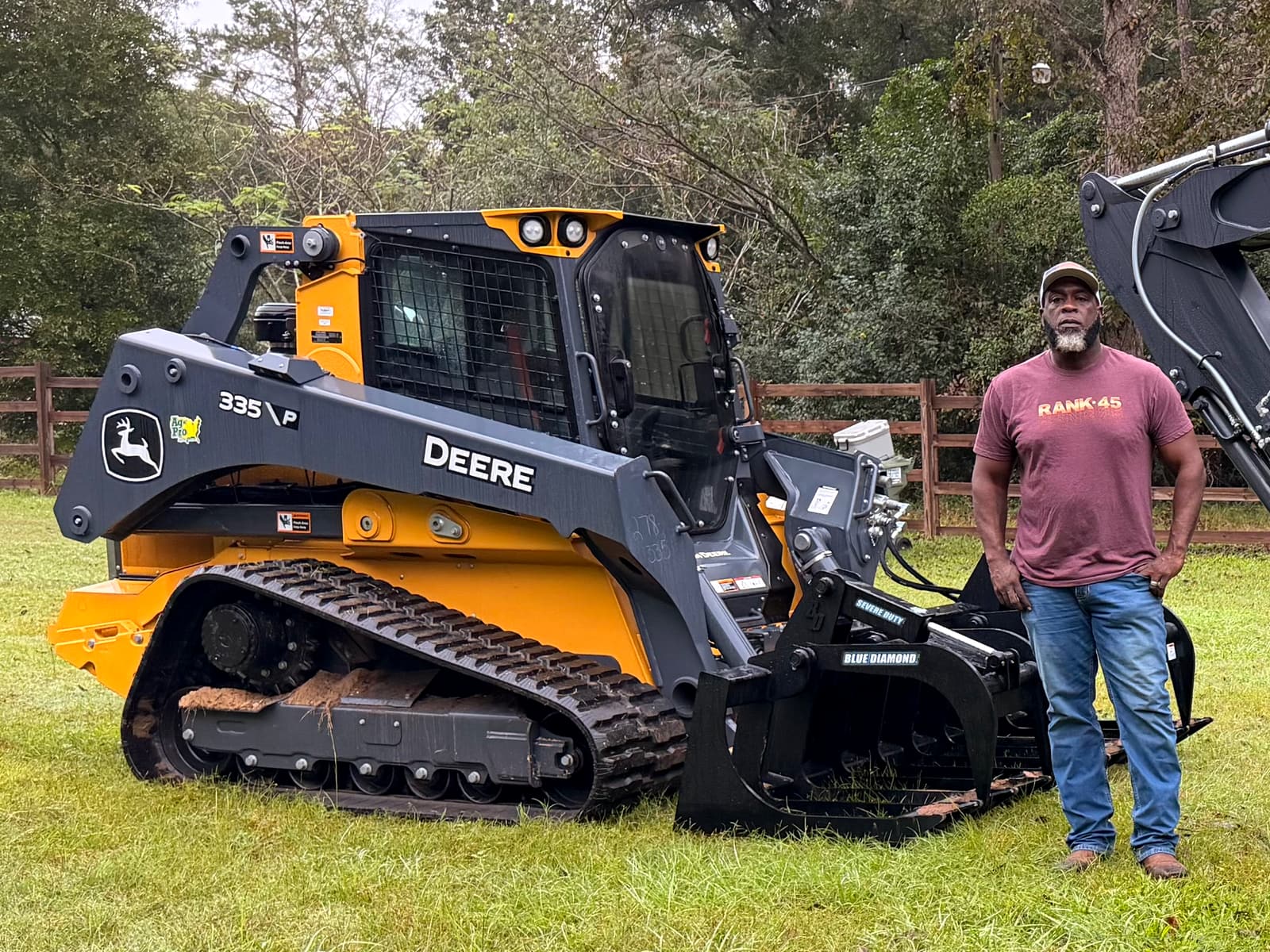
Blue Diamond root grapple
Root grapple. A steel rake with a hydraulic clamp, mounted on the 335P.
Does most of the picking up. The tines slide under brush, limbs and logs, the clamp closes on top, and dirt falls through the open floor.
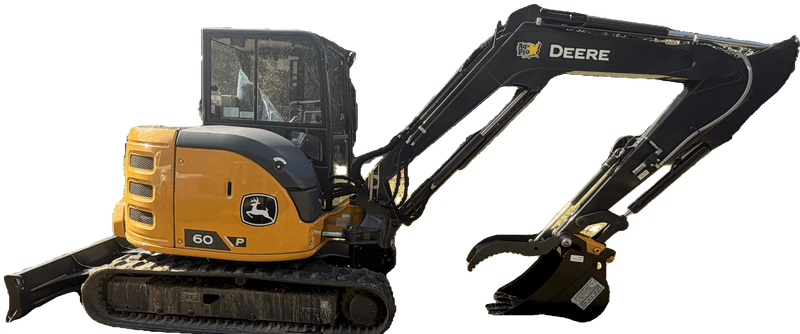
John Deere 60P
Compact excavator with a hydraulic thumb, a tooth bucket and a backfill blade.
The picker and the sorter. The hydraulic thumb lifts one log, one stump or one slab at a time and pulls a pile apart, so wood, metal and concrete can go their separate ways.
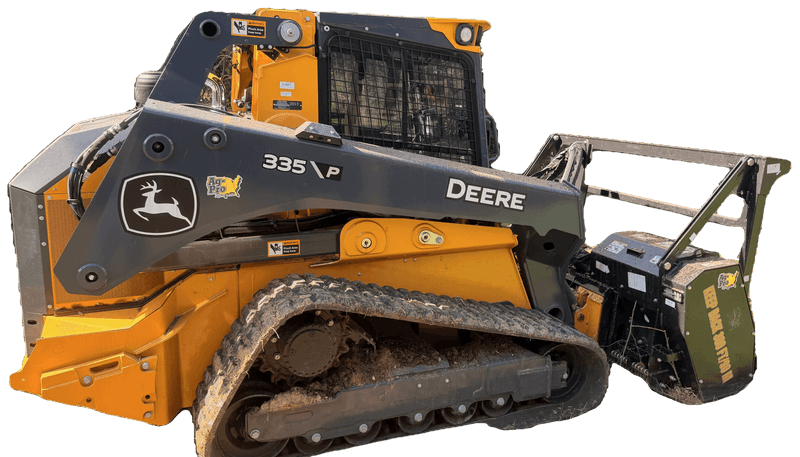
John Deere 335P
Compact track loader. A tracked carrier that swaps tools on its front.
Carries the grapple and every load in it. John Deere (opens in a new tab) lists a rated operating capacity of 4,025 pounds with one counterweight.
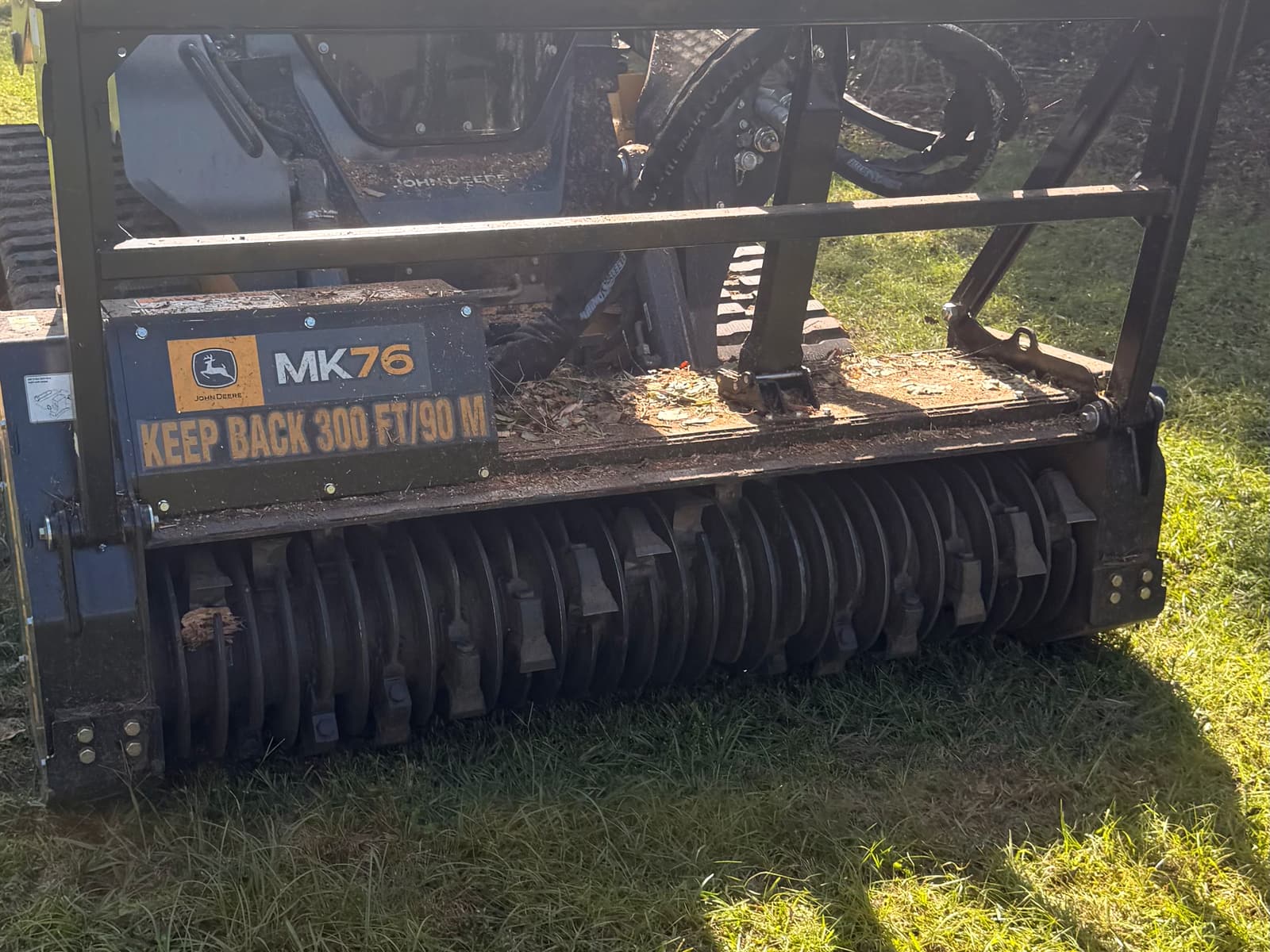
John Deere MK76 mulching head
Forestry mulching head. A steel drum of cutting teeth that mounts on the front of the 335P.
The tool that keeps loads off the truck. Standing brush, vines and small trees get ground into mulch where they are.


Sources (23)
Rules change. Every link below was read between November 11 and November 12, 2026. Check with the office named before you act on it.
Florida Statutes, section 403.703: Definitions (solid waste management) (opens in a new tab). The Florida Legislature, Online Sunshine. Checked .
Florida Statutes, section 403.708: Prohibition; penalty (opens in a new tab). The Florida Legislature, Online Sunshine. Checked .
Florida Statutes, section 590.125: Open burning authorized by the Florida Forest Service (opens in a new tab). The Florida Legislature, Online Sunshine. Checked .
Know the Law: Land Clearing Debris Burns with ACI (opens in a new tab). Florida Department of Agriculture and Consumer Services, Florida Forest Service. Checked .
Burn Permits and Notifications (opens in a new tab). Georgia Forestry Commission. Checked .
Open Burning Rules for Georgia (opens in a new tab). Georgia Environmental Protection Division, Air Protection Branch. Checked .
Open Burning Rules for Georgia: Burn Types (opens in a new tab). Georgia Environmental Protection Division, Air Protection Branch. Checked .
Florida Solid Waste Disposal Fees (2025) (opens in a new tab). Florida Department of Environmental Protection. Checked .
Sanitation Division rates, fiscal year 2025 to 2026 (effective 8/1/2025) (opens in a new tab). City of Valdosta, Georgia. Checked .
Landfill: Decatur County Solid Waste Facility (opens in a new tab). Decatur County, Georgia. Checked .
Gadsden County: guidelines for curbside, yard waste, bulk and roll off service (opens in a new tab). Waste Pro. Checked .
Brush Pile Removal Cost (opens in a new tab). HomeGuide. Checked .
Catastrophic Hurricane Michael Strikes Florida Panhandle, October 10, 2018 (opens in a new tab). National Weather Service, Tallahassee. Checked .
Tropical Cyclone Report: Hurricane Michael (AL142018) (opens in a new tab). National Hurricane Center. Checked .
May 10, 2024 Tornadoes (opens in a new tab). National Weather Service, Tallahassee. Checked .
Protecting Trees During Construction (opens in a new tab). UF/IFAS Gardening Solutions, University of Florida. Checked .
Conservation Subdivision: Construction Phase, Protecting Trees and Conserved Natural Areas (WEC278/UW323) (opens in a new tab). University of Florida IFAS Extension. Checked .
Florida Statutes, section 556.105: Procedures (Underground Facility Damage Prevention and Safety Act) (opens in a new tab). The Florida Legislature, Online Sunshine. Checked .
The 811 Process (opens in a new tab). Georgia 811. Checked .
335 P-Tier Compact Track Loader, specification sheet MK335CAU (opens in a new tab). John Deere. Checked .
60 P-Tier Compact Excavator, specification sheet ME60PAU (opens in a new tab). John Deere. Checked .