Selective Clearing and Tree Preservation: Clear the mess. Keep the oaks and their roots.
There are good trees on your land, somewhere behind the privet and the vines. Your best trees get a ring of ribbon, and nothing heavy drives inside it.
Quincy, Florida. Free estimates. Job minimum $2,000.

Is this what you need?
I know there are oaks in there, and I can't get to them
Privet and vines have filled in under the big trees until the trunks are gone from view. You cannot walk it, mow it or see what you own.
I don't want it scraped down to dirt
You have seen what a dozer leaves behind. You want the brush gone, with the shade, the topsoil and the good trees still there when the machine pulls out.
The vines are winning
They are up in the crowns now. Kudzu can grow a foot a day, and University of Florida extension says it will overtop and kill grown trees.
We bought it for the trees, and now we have to build on it
The house needs a pad, a drive and a drain field. Somebody has to decide which trees stay before the first machine shows up, not after.
More on these
The pines are fine, but what came up under them is not
Hardwood brush has taken the floor of the stand. You cannot see through it or walk it, and sunlight no longer reaches the ground.
How I do it

The keepers get their ribbon
Every keeper is flagged before a machine starts. Your best trees get a full ring.
The lanes are picked
The way in, the way out and the trailer spot stay clear of the rings.
The brush comes out
The MK76 turns privet, vines, briars and saplings into mulch where they stood.
The close work around the keepers
The loader stops at the ring. The 60P can reach in for single stems.
Every step in detail
Mark what stays before anyone shows up
Ring your keepers on the instant quote map. Your marks come to me.Time: About two minutes online
The walk: you, me and your map
We walk it tree by tree. Free, at a solid start time, Monday to Friday.Time: One visit
The keepers get their ribbon
Every keeper is flagged before a machine starts. Your best trees get a full ring.
The lanes are picked
The way in, the way out and the trailer spot stay clear of the rings.
The brush comes out
The MK76 turns privet, vines, briars and saplings into mulch where they stood.
The close work around the keepers
The loader stops at the ring. The 60P can reach in for single stems.
Last walk, and what the ground does next
Walk it against the ribbon. Then plan to mow the sprouts that come back.
What it costs
- Half an acre of brush around a house
- $2,000 to $2,500
- Two acres of brush and small trees
- $4,250 to $6,250
- The same two acres, half an acre marked to keep
- $3,700 to $5,500
- Twenty acres of light brush under pines
- $22,950 to $33,750
Estimates, not quotes. I confirm the price on site, and the visit is free. Job minimum $2,000.
What moves the price
Selective clearing is priced the same way as forestry mulching, with no added line for protecting trees.
That does not make the care free: it takes time, and time is what a clearing price is made of.
The figures here are planning ranges, not bids: I give you the price after I have walked the ground with you, and that visit is free.
What is growing there
This moves the price most. On flat, dry ground the instant quote starts from these per acre figures: $1,530 to $2,250 in light brush, $2,125 to $3,125 in brush and small trees and $2,890 to $4,250 in heavy mixed growth.
How many acres
The price per acre comes down as the job grows. The full rate holds up to 2 acres. Past that it steps down: 90 percent at 5 acres, 80 percent at 10 acres, 75 percent at 20 acres. Twenty acres of light brush under pines figures at $22,950 to $33,750 for the whole job, and past 25 acres I price it on the walk. A small job runs into the job minimum first. Half an acre of brush around a house does not reach it by the acre, so the tool shows $2,000 to $2,500.
What you mark to keep
A patch you draw as a keep zone comes off the acres we bill: 50 percent of it, not all, because working around what stays takes time. Two acres of brush and small trees figures at $4,250 to $6,250, and with half an acre of it marked to keep it figures at $3,700 to $5,500. Single trees you ring do not change the acres.
How close the keepers stand
A few big keepers with room between them are simple to work around. Fifty keepers ten feet apart turn the job into reach work, and a satellite photo cannot show that, so that part of the price waits for the walk.
Slope and wet ground
The instant quote raises the range for sloped ground and for wet spots. Wet ground can also mean waiting for a dry week.
Big stems that have to go
Trees bigger than the mulching head should take are excavator work at a different pace. The tool still shows a range, and I confirm it on site.
Stumps out and logs carried off
Stumps ground low and mulch left on the ground are inside the price. Digging stumps out or carrying logs off is extra: see hauling and debris removal.
Distance from Quincy
Our normal range is about 100 miles around Quincy. For a job near home the tool adds nothing for bringing the machine. For a job farther out it lists equipment delivery as a separate line.
What stays protected
The ring sits where the roots are
The trees you care about most get a ring of ribbon on the ground, sized to their roots.
Nothing heavy inside a ring, not even once
The rule inside a ring is zero passes, not few. UF/IFAS says one pass with heavy equipment can do significant root damage.
In a stand, the care is in how the machine travels
In a stand of pines the rings would cover the whole floor, and no machine can stay off every root.
More on what stays protected
The ring sits where the roots are
UF/IFAS puts the line at the drip line, and Gadsden County writes it as one foot of radius for every inch of trunk width.
In a stand, the care is in how the machine travels
So I work when the soil is dry, travel on the fresh chips and make as few passes as the job takes.
No digging, no fill and no piles on the roots
Inside a ring no stump is dug, no dirt is spread and nothing is stacked. UF/IFAS warns that raising or lowering the grade by even a few inches can kill a tree.
Bark stays whole
UF/IFAS says even a small trunk wound from equipment can cause major injury. The ring keeps the head, the bucket and the tracks away from the trunk as well as the roots.
Oaks get room on every side
On an oak, the roots on one side mostly feed the branches on that same side. So a ring that is generous on three sides and tight on the fourth is not good enough.
The soil stays covered and in place
Nothing is pushed, scraped or grubbed, and what the head grinds stays as a layer over the ground. Virginia Cooperative Extension says mulching helps keep soil organic matter and reduces erosion. It does not stop it.
The lightest machine that does the job
UF/IFAS says the heaviest machine is not always the best choice, because heavy equipment packs soil more than the job needs. Ours is a compact track loader on rubber tracks, not a dozer.
Keepers left in groups
After ten hurricanes, UF/IFAS found that trees standing in groups came through wind better than trees standing alone. When you choose, think in clumps, not single stems. The numbers are in our guide on protecting trees.
A real job
A lot beside the street had grown shut with brush and vine. We mulched it with the John Deere 335P and the MK76 head and left big trees standing.


Thomasville, Georgia. Posted November 2026.
See the whole job: Thomasville, Georgia: a roadside lot grown shut with vine
Questions I get asked
How do I show you which trees I want to keep?
Three ways, and you can use all of them: ring single trees and draw around whole patches on the satellite photo in the instant quote, write it in words, or point on the walk while I flag. The map is a head start, not the last word, because tree crowns hide a lot from above. Nothing is final until the ribbon is up and you have seen it.
How do you decide what stays and what goes?
You decide. It is your land. On the walk I tell you what I see: which trees look sound, which are crowding better ones, which stand where the machine has to pass, and which ones the work would hurt no matter how careful we are.
We are a clearing outfit, not arborists, so for a tree that leans over the house or looks sick, bring in an ISA certified arborist before you build your plans around it.
How far do your machines stay from a tree I am keeping?
Outside the ribbon, for every tree that gets a ring. UF/IFAS sizes the ring at the drip line, and Gadsden County at one foot of radius per inch of trunk width, so a 30 inch live oak gets a circle 60 feet across. I set each ring with you on the walk. In a stand where every pine stays no ring is possible, so the machine works dry ground, rides on its own chips and makes as few passes as it can.
Can you clear the privet right up to the trunk of my oak?
Not by driving a machine over its roots. Inside the ring, brush comes out one of three ways: the excavator reaches in from outside, it is cut by hand, or it stays. John Deere lists the reach of the 60P at 20 feet 5 inches at full stretch, which covers the ring of a small tree and falls short under a big oak. I go through it tree by tree on the walk and tell you what each choice adds.
Does it cost extra to protect trees?
There is no tree protection line on our prices. Selective clearing runs on the same rate card as forestry mulching, and a patch you mark to keep comes off the acres we bill: in the tool today 50 percent of the kept area, not all of it, because working around what stays is slower than mowing down everything. Where keepers stand close together, I may price above the range the tool showed, and I tell you that on the walk, before you agree to anything. Every job has a $2,000 minimum.
More questions
Will the trees you leave survive?
We cannot promise that, and nobody honest can. What we can say: the ring keeps tracks, blades, fill and piles off the roots, and those are the things the UF/IFAS guides warn about. It does not undo what happened before we came, and even a ring at the drip line leaves about half of the root system outside it. A tree already stressed by drought, old fill or a trench can still decline, and UF/IFAS says that decline can take 5 to 15 years to show, often after a drought.
Which trees are worth keeping around here?
Start with live oak and southern magnolia: UF/IFAS puts both in its highest wind resistance group for this region and lists both as long lived. Be slower to plan a yard around a big old laurel oak or water oak, which are in the lowest group. A longer list is in our guide on protecting trees.
Will the privet and the vines grow back?
Yes, unless there is a second step. Mulching removes what is above the ground, but the roots are still alive, and privet and mimosa both sprout from them: UF/IFAS notes that a cut mimosa can put on three feet or more in one season. The second step is mowing, which keeps the sprouts down but does not kill the roots, or herbicide on the young sprouts, which is what the UF/IFAS guide calls for on privet. The bush hogging page covers the mowing.
Do I need a permit to clear brush and keep the trees?
It depends on the county, the city and what the land is for, so check before you cut. Keeping the big trees helps, because local tree rules protect trees by size. Our permits guide has the offices and the links.
Is the mulch good or bad for the trees I kept?
Good, in the right amount. UF/IFAS recommends about 4 to 6 inches of organic mulch over the root zone of a protected tree to hold moisture, and says to keep mulch off the trunk, because it can cause fungus at the base.
Deeper is not better everywhere: University of California extension found fewer kinds of plants coming back where shredded material lay more than 4 inches deep, so if you want grass or wildflowers under the trees, a thinner layer is the goal. And mulch is still fuel on the ground, not fire protection.
Can you trench a water or power line past a tree I am keeping?
Route it around the ring if there is any way to. UF/IFAS says not to run utilities through protected areas at all, and that roots should never be cut closer than five times the trunk width. For a 24 inch oak that is 10 feet. Trenching is excavation work, and the route gets planned on the same walk.
What if there are gopher tortoise burrows?
Then the burrow gets a ring of its own, 25 feet out. That number comes from the state wildlife commission (FWC). If you know of a burrow, mark it on the map or show me on the walk. Where the work cannot stay 25 feet back, that part of the job waits until you have talked to FWC.
Is the Spanish moss killing my oak?
No. UF/IFAS says moss is a native plant and does not kill trees. A heavy load of it can be a sign, though: a tree weakened by root damage loses leaves, more light gets in, and the moss grows faster. Pulling the moss off fixes nothing, and a thin crown full of moss is a hint that the tree was already struggling.
What can I do after you leave to help the trees?
Water them when it turns dry. UF/IFAS calls irrigation the single best thing for the survival of a protected tree during construction: two to three times a week, enough to wet about the top foot of soil.
Keep cars, trailers and fill dirt off the root zones for good, not just during the job, and rake the mulch back a little from the trunks. And stay on the sprouts, so the privet does not get a second start.

The details
The longer answers, for when you want them.
What it is, in plain words
Selective clearing means the choosing comes before the cutting. Tree by tree and patch by patch, you decide what stays. Then we clear what is left, and every move of the machine is planned around the roots of what you kept.
The clearing itself is forestry mulching. The John Deere 335P carries the MK76 mulching head, which grinds brush, vines and small trees into mulch where they stand. The mulch stays on the ground. There is no burn pile, and nothing is hauled unless you want logs or deadfall carried off.
What makes it selective is everything around the machine: the walk with me, the ribbon, the paths the machine may use and the ground it never touches. That planning is the service. It is the Preservation half of our name.
What usually goes
- Privet, the evergreen shrub that fills in under everything
- Vines: kudzu and whatever else has climbed into the crowns
- Briars and the saplings crowding the trees you want
- Trash trees such as Chinese tallow (popcorn tree), mimosa, chinaberry and camphor
- Deadfall and dead stems the machines can reach
What usually stays
- Specimen oaks, live oaks first
- Straight, healthy pines
- The shade trees near the house
- A screen of trees and brush along the road or the property line
- Thickets and acorn trees you want left as wildlife cover
- Small trees worth having, like dogwood and holly. A machine takes them for brush unless they are flagged.
- Anything else you name. It is your land.
A tree we cut is ground down close to the soil, and its roots stay in the ground. Near a keeper that is on purpose. Roots of neighboring trees share the same top few inches of soil. Dig one stump out and you can tear up roots of the tree beside it.
- Cutting width of the MK76 head
- 76 inchesJohn Deere figure
- Overall width of the head
- 91 inchesA gap between two keepers has to be wider than this before the machine can use it
- What the head is rated for
- Vegetation up to 8 inches thickThe published John Deere rating, not a promise about every tree
- Job minimum
- $2,000
A ribbon on the trunk is not protection
University of Florida extension says it plainly: a fence or flagging around the trunk alone is not enough. The line has to sit out where the roots are. That is why our ribbon marks a ring on the ground around the tree, not a bow on the bark.
Right call or wrong tool
The right call
Good trees buried in privet
This is the job the mulching head fits best. UF/IFAS describes privet as a shade tolerant evergreen shrub that grows to about 30 feet. Its stands get thick enough to stop pine and hardwood seedlings and block access. Its guide starts with the same first step: cut the thicket down. After that the sprouts get treated.
A home site where the trees are the reason you bought
Decide what stays before the house is drawn, not after the pad is staked. Gadsden County writes that order into its code for development sites. Then lot clearing or site preparation opens the footprint, and selective clearing handles everything around it.
A yard that has grown in around the house
You want to see the yard again and keep the shade on the roof. Near a house the keepers are usually few and large, so their rings take up most of the plan. The brush between them is the easy part. The care around them is the job.
A pine stand choked with hardwood brush
Tall Timbers, the Red Hills research station in Tallahassee, says sunlight has to reach the ground cover if wildlife is the goal. Mulching the brush under the pines opens the stand in one visit. The machine has to travel between the pines to do it, so the care there is in how it travels. Keeping the stand open takes fire or mowing afterward. Prescribed burning is not on our list of services, so that part is a separate job.
Vines climbing into the canopy
UF/IFAS says kudzu can grow 60 feet in a season and will overtop and kill trees, even grown ones. The head cuts the vines off at the ground and clears the mat around the trunks. Killing an old kudzu patch for good takes herbicide over several years, so plan for that second step.
A screen you want to keep along the road
Clear the inside and leave a band of trees and brush where the neighbors or the highway would look in. Draw that band as a keep zone in the instant quote. It comes off the acres we bill, though not in full.
Hunting land that needs lanes, not a clear cut
You pick the thickets, the acorn trees and the bedding cover that stay. We open the lanes, edges and openings around them. A map with the keep zones already drawn on it makes that a short conversation.
The wrong tool
The ground has to be bare dirt for a pad, a drive or a drain field
Instead: Mulching leaves roots and low stumps in the ground. That is good for trees and wrong under a slab. Use land clearing or site preparation for the footprint, and selective clearing for the rest of the lot.
The tree you want to save stands where the work has to happen
Instead: If the pad, the trench or the fill has to land inside its root zone, ribbon will not save it. UF/IFAS is blunt about this: when the grade has to change close to a tree, take the tree out and plant several young ones. Move the work, or let the tree go now instead of watching it die slowly.
One big tree hanging over the roof
Instead: That is climbing and rigging work for a tree service. Our machines work from the ground. If you think the tree is dangerous, have an ISA certified arborist look at it first. In Florida, their written finding also matters for permits.
An open field of weeds, briars and thin saplings
Instead: There is nothing to work around, so you do not need this. The tractor and the batwing cutter are the right tool. See bush hogging.
You want the privet gone for good in one visit
Instead: No machine does that. Mulching takes the tops and leaves live roots. UF/IFAS says many invasive plants sprout back unless the roots are removed or treated. Plan a second step: mow the sprouts on a schedule, or have a spray contractor treat them.
A patch of cogongrass
Instead: Keep machines out of it. UF/IFAS says mechanical control alone does not work on established cogongrass, and that breaking up its roots can spread it. In forests, it says, herbicide is the only effective method. Show me the patch on the walk so it is marked as ground no machine crosses.
Soft, wet ground this week
Instead: Wait. Wet soil packs harder under a machine, and extension guides say to run equipment when the soil is dry. If a low spot never dries, leave it out of the job. It may be a wetland. That is a question for the water management district, so ask them before any machine goes in.
Big timber that has to come down
Instead: John Deere rates the MK76 for vegetation up to 8 inches thick. Trees past what the head should take are excavator work or a land clearing job. I look at them before any price is set.
How long it takes
Typical time on site. Estimates, not promises.
- A price range from the map
- About two minutesOnline, before anyone calls you.
- The walk with me
- A solid start time you pick, Monday to FridayFree, and not a window. Bring your list of what stays.
- A house lot under an acre, yard trees kept
- Estimate: up to a day of machine timeFigured from a Virginia Cooperative Extension number of one to eight machine hours an acre for mulching, not from our own job records. Close work around many keepers runs longer.
- Two to five acres with scattered keepers
- Estimate: a day to about a weekThe same one to eight hours an acre, in eight hour days. I give you a day count for your ground after the walk.
- Twenty acres of brush under pines
- Estimate: a few days to four weeksA wide range on purpose. Light brush under an open stand sits at the fast end. A job this size is always confirmed on site.
- Sprouts from cut privet and mimosa
- The first growing seasonUF/IFAS notes that a cut mimosa can put on three feet or more in one season. Plan the mowing or the spraying before then.
- Knowing how the kept trees took it
- Years, not weeksUF/IFAS says a damaged tree can show it within a year or two. It can also decline slowly over 5 to 15 years, often after a drought.
Rules, permits and more to know
How far off a tree is far enough
Roots do not stop where the branches stop. A tree in the woods often has roots reaching as far from the trunk as the tree is tall, UF/IFAS says. About half of the root system lies outside the drip line. Most of the fine roots that take up water sit in the top few inches of soil. That is the layer a machine track presses on.
So a ring is always a compromise. It cannot cover every root. It covers the part the tree can least afford to lose. Two published rules tell you where to put it.
- The drip line rule, from UF/IFAS. Stand under the tree and find the outer edge of the leafy crown. That is the line. For a tall, narrow tree such as a pine, go out one and a half times that distance. A pine whose branches reach 8 feet from the trunk gets a 12 foot ring.
- The trunk rule, from Gadsden County. Measure the trunk at chest height. Each inch of trunk width earns one foot of ring, measured out from the trunk. The county uses this for protected trees on development sites.
To measure a trunk without calipers, wrap a tape around it at chest height and divide by 3.14. A trunk 75 inches around is about 24 inches across.
The trunk rule, worked out
| Trunk width at chest height | Tape around the trunk | Ring, measured out from the trunk | Ring from side to side |
|---|---|---|---|
| 10 inches | About 31 inches | 10 feet | 20 feet |
| 20 inches | About 63 inches | 20 feet | 40 feet |
| 30 inches | About 94 inches | 30 feet | 60 feet |
| 40 inches | About 126 inches | 40 feet | 80 feet |
From the Gadsden County Land Development Code: one foot of drip line radius for every inch of trunk diameter at breast height. Side to side is twice that, not counting the trunk. Where the drip line reaches farther than this number, the drip line is the safer line.
What the Gadsden County code adds
For protected trees on development sites, the county wants barriers at least 10 feet beyond the drip line. Inside the barrier it allows no fill, no stored material or debris, and no tractors or heavy machinery working or parked. It counts root removal with a backhoe or other powered excavator inside the zone as removing the tree. A single house on its own lot is exempt from these standards. They are a good yardstick anyway.
On the ground the numbers add up fast. By the county yardstick, two 20 inch trees standing 30 feet apart have rings that overlap. If both are ringed, no machine goes between them, and the brush in there is reached from the side, cut by hand or left.
That works around a dozen yard trees. It does not work in a pine stand, where every tree would be ringed and the rings would cover the floor. There the machine travels between the trees, through gaps wider than its 91 inch head, and the care goes into how it travels. So the first thing to settle on the walk is which of your trees get a full ring.
Which trees are worth keeping here
A few facts make this choice easier. After ten hurricanes, UF/IFAS researchers measured which yard trees stood and which fell. They sorted the trees of the Southeastern Coastal Plain, which includes North Florida, into four wind resistance groups. They also list how long common trees live. Both matter when you pick what will stand over your house for decades.
Common trees on land around here, by the UF/IFAS lists
| Tree | Wind resistance group | What that means when you choose |
|---|---|---|
| Live oak, sand live oak | Highest. Live oak is listed as long lived, past 100 years. | Flag these first and give them the biggest rings. |
| Southern magnolia | Highest. Listed as long lived. | A keeper wherever it stands. |
| Baldcypress, American holly, dogwood, sabal palm | Highest | Keep them. Dogwood and holly stand at brush height, so flag them or they go with the privet. |
| Sweetgum, pignut and mockernut hickory, post oak, Shumard oak, persimmon, black tupelo | Medium high. Sweetgum is listed as long lived. | Solid keepers. Sweetgum gets called a trash tree, but it stands up to wind better than its reputation suggests. |
| Longleaf, slash and loblolly pine | Medium low. Pines can look fine after a storm and die over the next six months to two years. | Keep the straight, healthy ones, and keep them in groups. |
| Laurel oak, water oak | Lowest. Laurel oak typically lives about 50 years and starts to decay around 40. | Fine back in the woods. A big old one over a roof is a tree to have an arborist check. |
| Pecan, tulip poplar, southern red oak, southern red cedar | Lowest | Your call. Plenty of people keep a pecan for the nuts. Know what it is before you build next to it. |
| Chinese tallow | Lowest, and prohibited in Florida | It goes. |
Live oak, sand live oakHighest. Live oak is listed as long lived, past 100 years.
What that means when you choose
Flag these first and give them the biggest rings.
Southern magnoliaHighest. Listed as long lived.
What that means when you choose
A keeper wherever it stands.
Baldcypress, American holly, dogwood, sabal palmHighest
What that means when you choose
Keep them. Dogwood and holly stand at brush height, so flag them or they go with the privet.
Sweetgum, pignut and mockernut hickory, post oak, Shumard oak, persimmon, black tupeloMedium high. Sweetgum is listed as long lived.
What that means when you choose
Solid keepers. Sweetgum gets called a trash tree, but it stands up to wind better than its reputation suggests.
Longleaf, slash and loblolly pineMedium low. Pines can look fine after a storm and die over the next six months to two years.
What that means when you choose
Keep the straight, healthy ones, and keep them in groups.
Laurel oak, water oakLowest. Laurel oak typically lives about 50 years and starts to decay around 40.
What that means when you choose
Fine back in the woods. A big old one over a roof is a tree to have an arborist check.
Pecan, tulip poplar, southern red oak, southern red cedarLowest
What that means when you choose
Your call. Plenty of people keep a pecan for the nuts. Know what it is before you build next to it.
Chinese tallowLowest, and prohibited in Florida
What that means when you choose
It goes.
Source: UF/IFAS, Wind and Trees: Lessons Learned from Hurricanes, tables 1 and 3. The authors add that no tree is wind proof, and that soil, tree health, age and past pruning all count.
Health counts as much as species
A sound water oak can be a better keeper than a hollow live oak. The same UF/IFAS study found that older and unhealthy trees fail more often in wind. If a big tree near the house has dead tops, cavities or a lean, have an ISA certified arborist look before you decide. That is their trade, not ours.
What should go, and what going takes
Gadsden County lists nine plants as invasive, bars their sale and planting, and exempts them from its tree protection rules: mimosa, kudzu, Chinese tallow, chinaberry, Japanese climbing fern, coral ardisia, Chinese privet, nandina and camphor. Taking them out fits a preservation job. With most of them, cutting is only the first half.
The plants that usually go, and what it takes
| Plant | What UF/IFAS says about it | What clearing does, and what comes after |
|---|---|---|
| Privet (Chinese, Japanese and glossy) | Shade tolerant evergreen shrub that grows to about 30 feet. Spreads by bird carried seed and underground runners. Forms stands that stop pine and hardwood seedlings and block access. | The best fit for the mulching head. The UF/IFAS guide: cut or mow the thicket, then treat the new sprouts with herbicide. |
| Kudzu | Can grow a foot a day and 60 feet in a season. Overtops and kills trees, even mature ones. Roots wherever a vine touches the ground. | The head cuts it off at the ground. Killing a patch takes herbicide, with spot treatment for several years on old patches. |
| Chinese tallow (popcorn tree) | Seeds are spread by birds and by water. Florida prohibits further planting, and the USDA lists it as a noxious weed. | Cutting is step one. The control method in the UF/IFAS guide is herbicide. |
| Mimosa | If cut, it sprouts back quickly: three feet or more in one season. | Expect sprouts the first year. UF/IFAS says herbicide works best for full control. |
| Japanese climbing fern | A vine that covers trees and shrubs. Spreads by spores that ride on animals, equipment and people. | Tell us if you have it. Where the machine goes next matters. |
| Cogongrass | Ranked among the ten most invasive weeds in the world. Spreads mostly as pieces of root moved in soil. Mechanical control alone does not work, and breaking up the roots can spread it. | Not a mulching job. Machines stay out of the patch. Herbicide is the only effective method in forests. |
Privet (Chinese, Japanese and glossy)
What UF/IFAS says about it
Shade tolerant evergreen shrub that grows to about 30 feet. Spreads by bird carried seed and underground runners. Forms stands that stop pine and hardwood seedlings and block access.
What clearing does, and what comes after
The best fit for the mulching head. The UF/IFAS guide: cut or mow the thicket, then treat the new sprouts with herbicide.
Kudzu
What UF/IFAS says about it
Can grow a foot a day and 60 feet in a season. Overtops and kills trees, even mature ones. Roots wherever a vine touches the ground.
What clearing does, and what comes after
The head cuts it off at the ground. Killing a patch takes herbicide, with spot treatment for several years on old patches.
Chinese tallow (popcorn tree)
What UF/IFAS says about it
Seeds are spread by birds and by water. Florida prohibits further planting, and the USDA lists it as a noxious weed.
What clearing does, and what comes after
Cutting is step one. The control method in the UF/IFAS guide is herbicide.
Mimosa
What UF/IFAS says about it
If cut, it sprouts back quickly: three feet or more in one season.
What clearing does, and what comes after
Expect sprouts the first year. UF/IFAS says herbicide works best for full control.
Japanese climbing fern
What UF/IFAS says about it
A vine that covers trees and shrubs. Spreads by spores that ride on animals, equipment and people.
What clearing does, and what comes after
Tell us if you have it. Where the machine goes next matters.
Cogongrass
What UF/IFAS says about it
Ranked among the ten most invasive weeds in the world. Spreads mostly as pieces of root moved in soil. Mechanical control alone does not work, and breaking up the roots can spread it.
What clearing does, and what comes after
Not a mulching job. Machines stay out of the patch. Herbicide is the only effective method in forests.
Sources: UF/IFAS, Controlling Invasive Plants in North Florida Forests, and UF/IFAS, Biology and Control of Cogongrass in Southern Forests.
Machines can carry these plants
UF/IFAS warns that any soil disturbance with heavy equipment can help invasive plants get started. It says equipment should be cleaned off before it leaves a site that has them. Cogongrass moves as bits of root in soil. Climbing fern moves as spores. If you know either one is on your land, say so before the walk, so the plan can keep the machine out of it.
What the mulch layer does for the soil
The head carries nothing away. Brush goes in as a standing plant and comes out as chips on the same patch of ground. After a dozer the soil is bare. After the mulching head it is covered.
- It covers soil that a blade would leave bare.
- It reduces erosion and builds organic matter as it rots (Virginia Cooperative Extension).
- It holds moisture and evens out soil temperature (University of California extension).
- Over the roots of a kept tree, mulch is what UF/IFAS recommends anyway, as long as it stays off the trunk.
- It does not stop erosion. It reduces it.
- It does not kill roots. Sprouts come up through it.
- It is not fire protection. Oregon State extension notes that mulching can raise surface fire intensity for a while, because the fuel is now on the ground.
- Deeper is not better. Past about 4 inches, fewer kinds of plants come back through it.

Rules to check before you cut
The tree rules we could read are about big trees, and on a selective job the big trees stay. That helps. It does not settle the question. Rules change at every county line and city limit, and they depend on what the land will be used for. These are the ones we could read and link. Treat them as a place to start, and check with the office named before you cut.
Gadsden County, Florida
This covers sites headed for subdivision, commercial or industrial use. The county lets the understory be cut outside conservation areas. Trees more than 20 inches across must be preserved or replaced. Before development approval, clearing on such sites is limited to underbrush under 4 inches, for surveying. A single detached house on its own lot is exempt. The county has a Tree Removal and Clearing Permit application. Check with the Planning Division at (850) 875-8663.
Tallahassee and Leon County, Florida
The City of Tallahassee defines protected trees by species and size. Removing one takes a tree permit, or it is handled inside an Environmental Management Permit when the project needs one. In Leon County outside the city, whether a permit is needed depends on things like canopy road zones, wetlands, floodplains, slopes and zoning. Check with City Growth Management at (850) 891-7001 or with Leon County Development Support and Environmental Management at (850) 606-1300.
Valdosta, Georgia
The city lists specimen trees by size: live oak and southern magnolia at 14 inches across, longleaf pine at 10 inches, other canopy trees at 16 inches. Tree removal by a single family homeowner is on its list of exemptions. On non residential property, all tree removal needs approval from the city Arbor Division first. Check with the Arbor Division at (229) 259-3530.
Gopher tortoise burrows in Florida
Florida law protects the tortoise and the burrow both. FWC, the state wildlife commission, treats any work inside 25 feet of a burrow as a disturbance. A relocation permit has to come first. Its page also says a permit may not be needed when clearing, grading and equipment staging all stay at least 25 feet back. Check with FWC before anything happens closer than that.
A dangerous tree on a Florida home lot
Florida Statutes section 163.045 covers trees on residential property. A local government may not require a permit, a fee or mitigation to prune or remove one when the owner holds the right paper. That paper is documentation from an ISA certified arborist or a Florida licensed landscape architect that the tree poses an unacceptable risk. We are not arborists, and we do not write that document.
Low ground that stays wet
In the Florida Panhandle, the Northwest Florida Water Management District regulates dredging and filling in wetlands, isolated ones included. Whether a low spot is a wetland is not ours to say. If part of your land stays wet, check with the district first.
Other cities and counties have their own rules. If your land is inside a city limit, ask the city as well as the county.
What we will not promise
- That every kept tree lives. We control what our machines do. We do not control drought, old damage or what the roots went through before we came.
- That no root ever feels a track. Roots run out past any ring. And in a stand where everything stays, the machine has to travel among the trees.
- That the brush stays gone. Roots sprout. Without mowing or treatment, privet comes back.
- That protecting trees takes no extra time. It does. There is no separate line for it, but close work is slower, and the price follows the time.
- That the map is the plan. The range from the tool is a range. The plan is made on the walk.
- That a tree is safe to live under. That is a call for an arborist.
What we will say is this. Before a machine starts, you will have walked your land with me. The trees you care about most will have ribbon around their ground.
The equipment and the sources
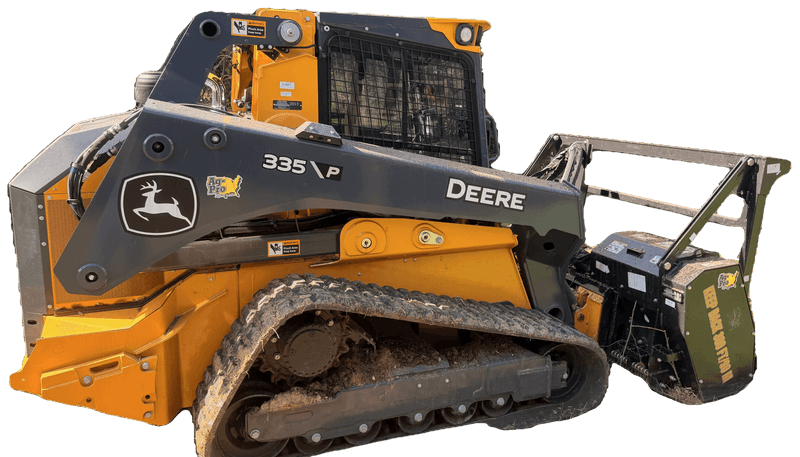
John Deere 335P
Compact track loader. A tracked carrier that swaps tools on its front.
Carries the mulching head and the grapple on rubber tracks. Around a ringed tree it works from outside the ribbon.
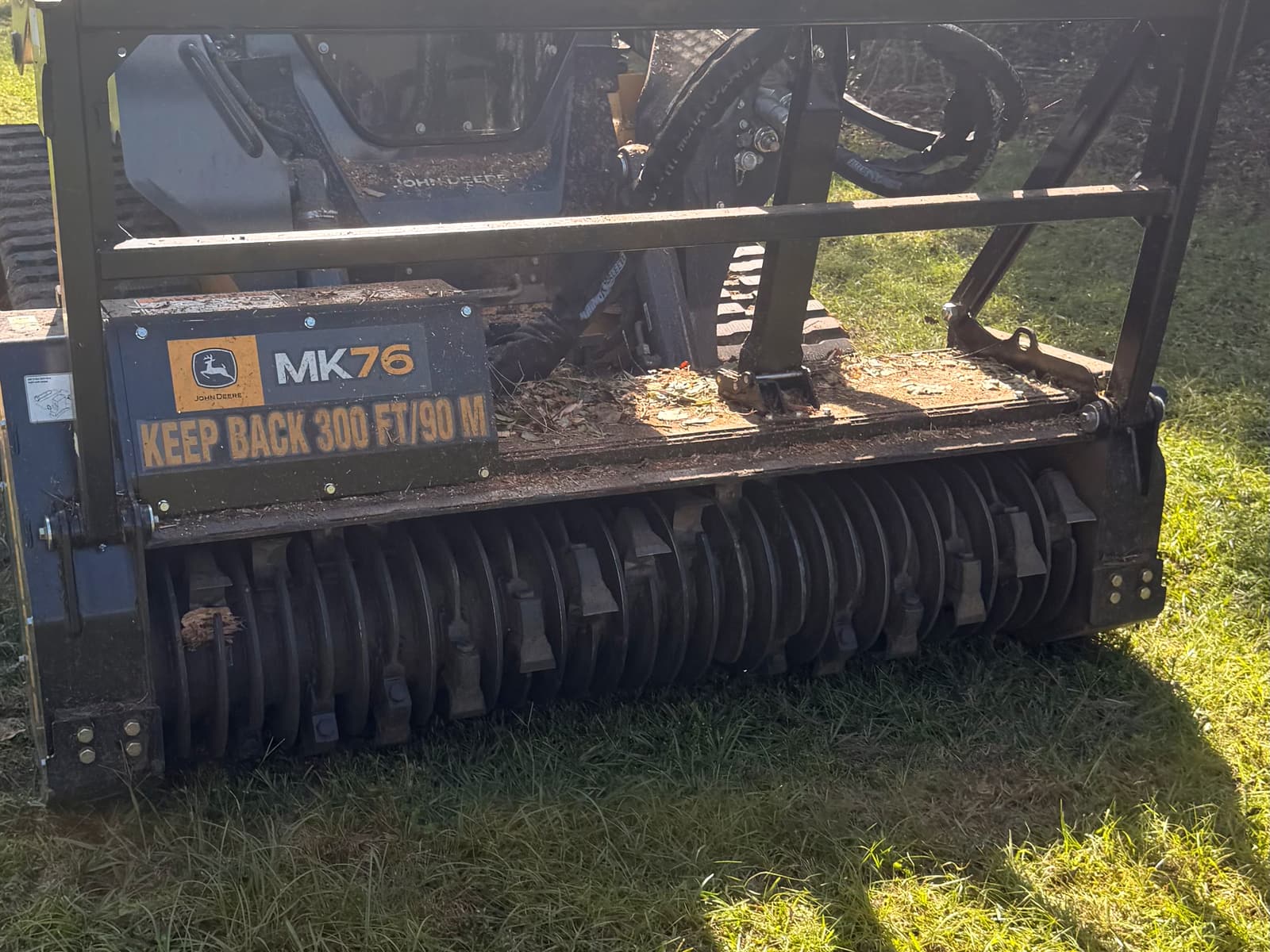
John Deere MK76 mulching head
Forestry mulching head. A steel drum of cutting teeth that mounts on the front of the 335P.
Does the clearing. It measures 91 inches overall, a little over seven and a half feet, and that decides which gaps between keepers the machine can use.
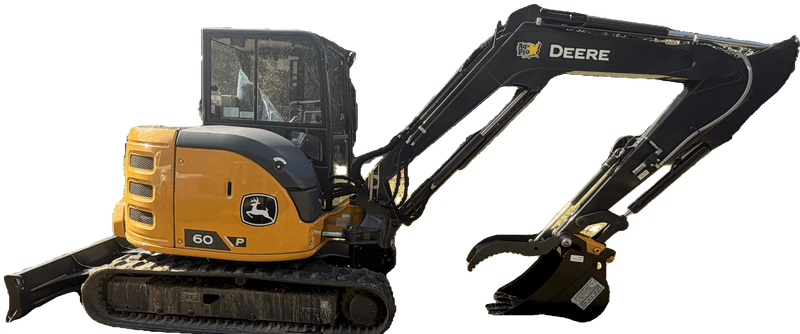
John Deere 60P
Compact excavator with a hydraulic thumb, a tooth bucket and a backfill blade.
The reach. Its hydraulic thumb picks out one stem or one piece of deadfall at a time. John Deere lists a maximum reach of 20 feet 5 inches, so it parks outside the ribbon and reaches in.
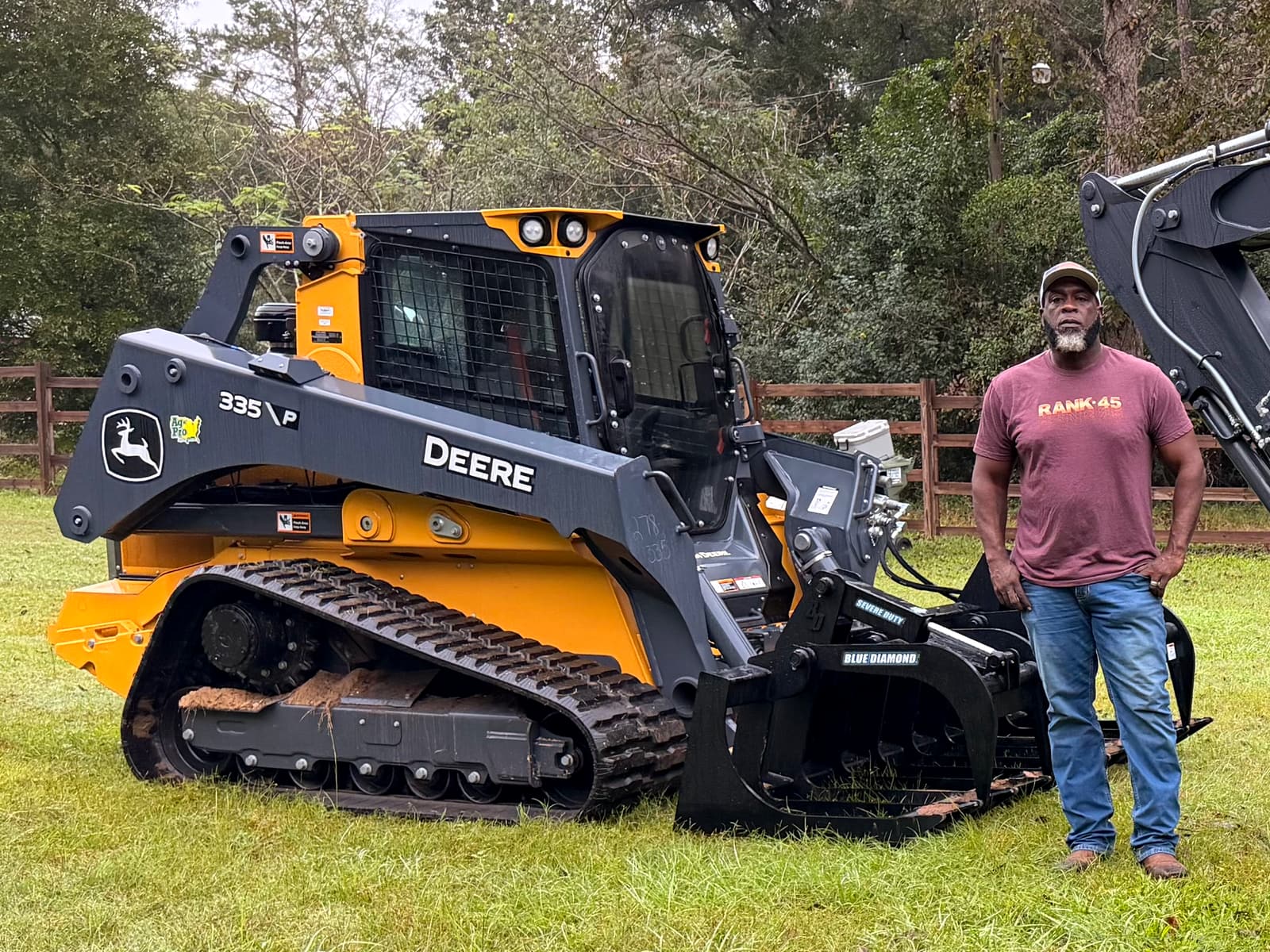
Blue Diamond root grapple
Root grapple. A steel rake with a hydraulic clamp, mounted on the 335P.
Goes on the 335P when logs and deadfall have to move. It lifts them and carries them out, where dragging would plow the topsoil along.
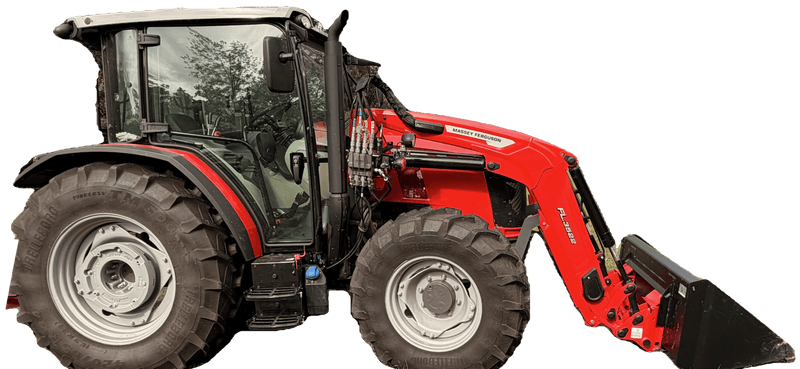
Massey Ferguson cab tractor with front loader
Farm tractor with a closed glass cab and a front loader. It pulls and powers the batwing cutter.
Comes back after the clearing if you want the opened ground kept open. See bush hogging.


Sources (22)
Rules change. Every link below was read on November 11, 2026. Check with the office named before you act on it.
Conservation Subdivision: Construction Phase, Protecting Trees and Conserved Natural Areas (WEC278/UW323) (opens in a new tab). University of Florida IFAS Extension. Checked .
Dispelling Misperceptions About Trees (SS-ORH-03/MG089) (opens in a new tab). University of Florida IFAS Extension. Checked .
Protecting Trees During Construction (opens in a new tab). University of Florida IFAS Gardening Solutions. Checked .
Wind and Trees: Lessons Learned from Hurricanes (FOR118/FR173) (opens in a new tab). University of Florida IFAS Extension. Checked .
Controlling Invasive Plants in North Florida Forests (SS-FOR-19/FR133) (opens in a new tab). University of Florida IFAS Extension. Checked .
Biology and Control of Cogongrass (Imperata cylindrica) in Southern Forests (FR342/FR411) (opens in a new tab). University of Florida IFAS Extension. Checked .
Land Development Code, Chapter 5, Subsection 5404: Tree and Native Vegetation Protection Standards (version dated 12/19/2023) (opens in a new tab). Gadsden County, Florida. Checked .
Tree Removal and Clearing Permit Application (form revised 10/20/2020) (opens in a new tab). Gadsden County, Florida, Planning Division. Checked .
Options for Clearing Land to Establish Pasture (publication 465-341) (opens in a new tab). Virginia Cooperative Extension. Checked .
Mastication Considerations for Forest Landowners (2026) (opens in a new tab). University of California Agriculture and Natural Resources. Checked .
Reducing Hazardous Fuels on Woodland Property: Mechanical Treatments (EC 1575) (opens in a new tab). Oregon State University Extension Service. Checked .
Land Management: Managing Forest Resources (opens in a new tab). Tall Timbers. Checked .
MK76 Mulching Head: features and specifications (opens in a new tab). John Deere. Checked .
335 P Tier Compact Track Loader: specifications (opens in a new tab). John Deere. Checked .
60 P Tier Compact Excavator: specifications (opens in a new tab). John Deere. Checked .
Gopher Tortoise Permits (opens in a new tab). Florida Fish and Wildlife Conservation Commission. Checked .
Florida Statutes, section 163.045 (opens in a new tab). The Florida Legislature, Online Sunshine. Checked .
Tree Permit (opens in a new tab). City of Tallahassee, Growth Management. Checked .
Environmental Services: Frequently Asked Questions (opens in a new tab). Leon County, Development Support and Environmental Management. Checked .
Land Development Regulations, Chapter 328: exemptions (section 328-14) and specimen trees (section 328-21) (opens in a new tab). City of Valdosta, Georgia. Checked .
Arbor Division (opens in a new tab). City of Valdosta, Georgia. Checked .
Environmental Resource Permits (opens in a new tab). Northwest Florida Water Management District. Checked .