Excavation: Stumps, ditches and trenches, dug with our own machine.
The plumber wants a trench, and the stump sits right where the slab goes. We dig it with our own John Deere 60P, after the buried lines are marked.
Quincy, Florida. Free estimates. Job minimum $2,000.

Is this what you need?
The plumber wants the trench open first
The water line, the power to the shop or the drain has to go in the ground, and the trade that lays it wants a trench waiting, dug where they said and as deep as they said.
A stump sits where something has to go
The tree is down but the stump is not, and it sits in the pad, in the drive or in the middle of the yard.
Water stands and has nowhere to go
Every hard rain leaves the same pond by the barn or across the drive.
The drive has to cross the ditch
You bought land on a county road, and a ditch runs between the pavement and your gate.
More on these
The plumber wants the trench open first
Digging that by hand across a yard is not a weekend job.
A stump sits where something has to go
Cutting it off at the dirt leaves the root ball right where the concrete goes.
Water stands and has nowhere to go
The ground needs a ditch or a swale to carry it off, and somebody has to know where that water is allowed to end up.
The drive has to cross the ditch
You need a pipe in it and dirt over it, set so the ditch still runs.
You want a pond, if the ground will hold one
A pond for the cows, the fish or the view starts with two questions that have nothing to do with digging. Will that dirt hold water, and is that low spot a wetland?
How I do it

The buried lines get marked
We request the utility locate. The lines you own are yours to show us.
Permit questions come first
A pond, a ditch near wet ground or a road culvert can need a permit.
The dig
You look at the marked line first, then the 60P digs.
Your trade does its part
The plumber lays the line. The trench stays open until any inspection is done.
Every step in detail
Tell us what needs digging
Pick Excavation in the instant quote and book a time for me to come out.Time: About two minutes
I walk it with you
We settle where the dig goes, how deep, and where the dirt ends up.
The buried lines get marked
We request the utility locate. The lines you own are yours to show us.Time: Florida: at least 2 full business days. Georgia: at least 3 business days.
Permit questions come first
A pond, a ditch near wet ground or a road culvert can need a permit.
The dig
You look at the marked line first, then the 60P digs.
Your trade does its part
The plumber lays the line. The trench stays open until any inspection is done.
Backfill, shape and a last look
Dirt goes back in, topsoil last. Decide on seed, straw or sod before we leave.
What it costs
- One day of the excavator with its operator
- $2,000 to $2,600
- Two to three days
- $5,000 to $6,500
- A week
- $10,000 to $13,000
- A driveway culvert, pipe included
- $2,000 to $3,200
Estimates, not quotes. I confirm the price on site, and the visit is free. Job minimum $2,000.
What moves the price
These are planning estimates, not a price list: I confirm every figure on site, and the visit is free.
No job is under our $2,000 minimum, which is about one day of the 60P with its operator, and a machine day runs about $2,000 to $2,600.
The instant quote does not guess at a dig: for excavation it shows a starting figure, from $2,000, and books the visit.
How many machine days
Most digging is priced by the day of the 60P and its operator: as planning estimates, about $2,000 to $2,600 for one day, about $5,000 to $6,500 for two to three days and about $10,000 to $13,000 for a week. Hours past a full day are figured at about $250 an hour.
How much dirt
A pond is figured by the cubic yard, about $4.20 to $9 a yard with the dirt spread on your land. Length times width times average depth, in feet, divided by 27, gives the yards.
Where the dirt goes
Dirt that goes back in the trench costs nothing extra. Dirt that has to leave is trucked by the load, which is hauling.
How deep
Every foot down is more dirt and slower digging. A trench 5 feet deep or more that people work in needs its walls sloped back or held.
What the ground is
University of Florida extension notes that clay stands at a steeper angle than sand, so a hole in sand has to be dug wider at the top. Wet ground may have to wait for a dry spell.
What is buried
Near every marked line the machine slows down and the last of the dirt comes out by hand. Show us every private line, because an unmarked one that gets hit is a repair bill.
Pipe and materials
The culvert estimate, about $2,000 to $3,200, includes the pipe. Concrete ends, where the county requires them, and rock for the drive are not in our figures and get settled at the estimate.
Getting in
The 60P is 6 feet 7 inches wide and 8 feet 4 inches tall by John Deere figures. A narrow gate, a low limb or a long way in from the trailer adds time.
Distance from Quincy
We work about 100 miles out from Quincy. Close in, there is no delivery charge. Farther out, the price adds equipment delivery as its own line, so you can see it.
What stays protected
The trench bends around the roots
I lay the trench out to miss the trees you are keeping, because a trench cuts every root it crosses.
On an oak, a cut root shows on the same side
I ask which trees matter before I ask where the trench goes. UF/IFAS says roots on one side of an oak mostly feed the branches on that side.
The dirt pile stays off the root zones
The dirt pile goes where you and I pick on the walk, off the root zones.
More on what stays protected
The trench bends around the roots
UF/IFAS says most tree roots sit in the top 3 feet of soil. Gadsden County puts a number on it for protected trees: underground utilities stay at least 10 feet away.
The dirt pile stays off the root zones
University of Florida extension warns that raising the soil around a tree by even a few centimeters can kill it.
Topsoil off first, back on last
On a trench across a yard the dark top layer is set to one side and goes back on top, so grass has something to grow in. Tell us on the walk if you want it kept on a bigger dig.
A compact machine on rubber tracks
The 60P is 6 feet 7 inches wide, and John Deere lists 5.1 psi of ground pressure. It can work beside a house, a fence or a kept tree. It still leaves track marks, and on soaked ground it leaves ruts.
The water has to end up somewhere it can go
A ditch that stops in the wrong place only moves the puddle. We cut toward ground that can take the water. If the only outlet is a creek, a pond or a wet area, that is a permit question first.
What is buried gets found before the bucket finds it
Utility lines are marked through 811, and your own lines, the septic tank and the well get pointed out by you. In Florida the state wildlife commission counts any work within 25 feet of a gopher tortoise burrow as disturbing it. We keep 25 feet back, or the job waits.
Questions I get asked
How much does excavation cost?
Digging is priced by the job or by the machine day, not by the acre. No job is under $2,000, about one day of the 60P with its operator, and as planning estimates one machine day runs about $2,000 to $2,600 and two to three days about $5,000 to $6,500. A driveway culvert with the pipe is an estimated $2,000 to $3,200, and a pond is figured at about $4.20 to $9 a cubic yard with the dirt spread on your land. I confirm every one of these on site, and the visit is free.
How deep can your excavator dig?
John Deere lists the 60P at 12 feet 4 inches of digging depth and 20 feet 5 inches of reach with the standard arm, and most jobs never get close to it. A hole is usually limited by its walls before it is limited by the arm: loose sand caves and wet ground fills. Any deep dig gets looked at in person first.
Can you dig the trench for my water line or my power?
Yes. Your plumber or electrician gives us the route and the depth, because their code and their inspector set both. We dig it, leave it open for them through any inspection your permit calls for, and push the dirt back with the blade when they say it is ready. We do not lay the pipe, pull the wire or make the connection.
Who calls 811, you or me?
We do: in both states the law puts the locate request on whoever does the digging, at least 2 full business days before the dig in Florida and at least 3 business days in Georgia. Your part is the lines 811 does not know about. Sunshine 811 says private lines, like power run to a shed or a barn, water, septic and irrigation lines and propane, are not in its database. Show me every one you know of, and if nobody knows where they run, Sunshine 811 suggests hiring a private locator.
It is my own land. Do the lines really have to be marked?
For a machine dig, plan on it. Florida law has a short list of exceptions, and two matter to a landowner: a homeowner digging no more than 10 inches deep on their own single family lot, and normal farm work that stays off any marked utility easement. Georgia law covers digging with mechanized equipment anywhere in the state, and its farm exception is the tilling of fields. The marks show the route of a line, not how deep it is, so inside 24 inches to each side of a marked line Florida law has the line found by hand digging or another careful method.
More questions
Do I need a permit to dig a pond?
Often, and the answer depends on the spot more than the size. A pond dug in a wet low spot is work Florida regulates through Environmental Resource Permits, and in Georgia whether yours counts as an exempt farm pond is a question for your county or Georgia EPD. For a Panhandle parcel, the Northwest Florida Water Management District takes pre application calls at (850) 951-4660. The rules are further down this page.
Will my pond hold water?
It depends on the dirt and on the water table, and nobody can promise it from a truck window. University of Florida extension says to check the soil first: clay soils are good, sandy clays and loams still hold water, and soils high in sand or gravel may seep badly unless the water table is naturally high, where a sealer or a liner raises the cost a lot. Both kinds of ground are in our area, so take its tip and look at the ponds your neighbors already have. The Florida wildlife commission says your local NRCS office can help with soil testing and with whether a liner is needed.
How big a pond can you dig?
A small one: the 60P is a compact excavator, and a pond is a lot of dirt. A pond 100 feet by 60 feet, at an average depth of 5 feet, is about 1,100 cubic yards, a planning estimate of $4,650 to $10,000 with the dirt spread on your land, and one 60 feet by 40 feet at the same depth is about 440 cubic yards, an estimated $2,000 to $4,000. Hauled away at 12 to 16 cubic yards a load, the bigger pond is around 70 to 90 loads, so pond dirt almost always stays on the property. Our figures stop at about 1,500 cubic yards: past that I look at it in person, and it may be a job for a bigger machine than ours.
Can you put in a culvert for my driveway?
Yes. We dig the bed, set the pipe and cover it, and as a planning estimate one driveway culvert with the pipe runs about $2,000 to $3,200. Call whoever owns the road first, because they set the pipe size and often want a permit: Gadsden County has a Driveway Connection Permit, and a state highway takes an access permit from the Department of Transportation. Some counties set the pipe themselves, so ask your county before you hire anybody, us included.
Can you dig out stumps, and what happens to the hole?
Yes. The 60P digs around the stump, breaks the roots loose and lifts the root ball out with the thumb, then the dirt goes back in the hole and the blade levels it. A filled stump hole is loose dirt, so tell your builder where the big ones stood before anything is poured over them. Stumps alone are priced by the machine day, and no job is under $2,000.
Can you bury the stumps and brush on my land?
In Florida, sometimes: state law allows trees, tree remains, rocks and soil from land development to be buried on your own property when it creates no nuisance and no harm. Your county may be stricter, so ask before a hole is dug, and for Georgia land ask your county or the state Environmental Protection Division first. Nothing gets buried in wet ground, or where a pad, a drive or a septic field will go. Shingles, treated lumber, tin and trash are hauled.
Can you dig footings or a basement?
Footings for a shop, a barn or an addition: yes. We dig to your builder's layout, and the builder and the building inspector decide when they pass. A full basement is a deep hole, a lot of dirt to move and walls that have to be kept from caving, so I look at those in person. Some need a bigger machine brought in as a rental, and I will tell you if yours belongs to a larger outfit.
Will a trench hurt my oak?
It can, because a trench cuts every root it crosses. The fix is the route: University of Florida extension says not to run utilities through a protected root zone, and Gadsden County code keeps underground utilities at least 10 feet from protected trees. Show me the trees you care about and the trench bends around them. I cannot promise that any tree lives, but I can show you exactly where the trench went.
Can you dig when the ground is wet?
Sometimes it has to wait: tracks rut soaked ground, and a wet hole does not hold its shape. In the creek bottoms around Quincy, the federal soil survey describes ground where the water table sits less than 10 inches down for more than 8 months of most years, and a trench there fills about as fast as it is dug. The common upland soil around Quincy is rated well drained, so a dig on the hills waits on the surface drying out, not on the water table. Low ground gets dug in a dry spell or not at all, and if it stays wet most of the year, the first call is to the water management district.
How much room does the machine need?
Less than most people expect. John Deere lists the 60P at 6 feet 7 inches wide across the tracks and 8 feet 4 inches tall, so a gate or a gap between trees has to be wider than that. The back of the machine swings inside a 4 foot 3 inch radius and the boom swings at its base, so it can turn close to a wall or a fence and dig alongside a building. It still needs a way in and a place to put the dirt, and both get picked on the walk.
Can you take out an old septic tank or fill in an old well?
Not on my own, and nobody should. In Florida, abandoning a septic tank runs under a state permit, so check with your county health department before anyone touches it, us included. For a well, a Florida licensed water well contractor has to get the permit and do the plugging. The Northwest Florida Water Management District is at (850) 539-5999.
Do you take small digging jobs?
Our minimum is $2,000 on every job. One stump, one post hole or an hour of trenching does not fill a machine day, and a smaller operator near you is the better call, which we will tell you. If we are already clearing, grading or tearing something down for you, ask me to price the dig with that job at the estimate.
How far do you travel for a digging job?
We work about 100 miles out from Quincy, across North Florida and South Georgia. The towns we cover are on the service areas page.

The details
The longer answers, for when you want them.
What it is, in plain words
Excavation is the digging: a hole, a trench or a cut, made where it is needed and no bigger than it has to be. We do it with one machine of our own, a John Deere 60P.
The 60P is a compact excavator on rubber tracks. On one end is a tooth bucket with a hydraulic thumb that closes against it like a hand. On the other end is a blade that pushes the dirt back. A bare bucket can only scoop. With the thumb, the machine can lift a stump out of its hole, set a length of pipe or load a slab onto a truck.
- Stumps and root balls: dug out, lifted clear, the hole filled back in.
- Ditches and swales that give standing water a way out.
- Trenches for water, power, drains and conduit, dug for your plumber or electrician.
- Driveway culverts and new driveway cuts, where a drive has to cross a ditch or reach the back of the land.
- Small ponds, on ground that can hold water, after the wet ground rules are checked.
- Footings for a shop, a barn or an addition, dug to your builder's layout.
- Debris: stumps, logs and broken concrete loaded onto a truck, or tree debris buried on your own land where the law allows it.
More on what it is
- Machine
- John Deere 60P compact excavatorClosed cab, rubber tracks, hydraulic thumb, tooth bucket, backfill blade.
- Engine
- 53 net horsepowerJohn Deere's published figure.
- Weight
- 13,620 poundsJohn Deere's operating weight with the cab, rubber tracks and the standard arm.
- Digging depth
- 12 feet 4 inchesJohn Deere's maximum with the standard arm. The long arm is listed at 13 feet 6 inches.
- Reach
- 20 feet 5 inchesJohn Deere's maximum digging reach with the standard arm.
- Dumping height
- 13 feet 8 inchesJohn Deere's maximum with the standard arm. The maker says the lift height and reach ease truck loading.
- Width
- 6 feet 7 inchesAcross the tracks, and the blade is the same width. A gate has to be wider. The machine is 8 feet 4 inches tall.
- Tail swing
- 4 feet 3 inch radiusJohn Deere calls it a reduced tail swing design, for work in tight places.
- Ground pressure
- 5.1 psiJohn Deere's figure with the cab, rubber tracks and the standard arm.
How big this machine is
The 60P is a compact excavator. It weighs about 13,600 pounds. That is the right size for a yard, a farm, a house lot and a tight spot beside a building or a tree you are keeping. It is the wrong size for a deep basement, a big pond or dirt moved by the thousands of yards.
I look at the bigger digs in person. Some need a bigger machine brought in as a rental. Some belong to a larger outfit, and I will tell you so.
We dig. Your trade lays and connects.
We open the trench and close it. Your plumber, your electrician or your septic contractor lays what goes in it, hooks it up and gets it inspected. On a culvert, the county or the state says what size the pipe has to be.
Right call or wrong tool
The right call
A stump, or a handful of them, sits where a pad, a drive or a lawn has to go
A saw or a mulching head cuts a stump off at the dirt and leaves the root ball. The 60P digs around it, breaks the roots loose and lifts the whole thing out with the thumb. The blade pushes the dirt back in the hole. If the whole lot is stumps, that is land clearing.
Rain stands in the same place every time
Standing water needs a path. A ditch or a shallow swale, cut with fall toward ground that can take it, gives it one. Shaping the whole yard so it sheds water is grading. The two often go together, and one visit covers both.
Your plumber or your electrician needs a trench
We open it along the route and to the depth they give us. They lay the line and get it inspected. Then we close it. One machine digs and backfills, so nobody waits on a second crew.
The new drive has to cross the roadside ditch
That takes a culvert: a pipe big enough and long enough for whoever owns the road, set so the ditch still runs through it. In Gadsden County the driveway permit form calls for an 18 inch pipe at least 24 feet long on a residential drive. We dig the bed, set the pipe with the thumb and cover it.
You need a way to the back of the land
A new drive starts as a cut. The topsoil and roots come off the line, the bed gets shaped and the low places get opened so water can cross. Rock goes on after that, and rock is not part of our figure.
You want a small pond, and the ground can hold one
A dug pond is a pit below the ground around it. University of Florida extension says these work well where the water table is naturally high, and that soils with a lot of clay hold water. On that kind of ground a small pond is work the 60P can do.
The builder has the footings laid out
A shop, a barn or an addition needs trenches of a set width and depth. We dig to the lines your builder puts on the ground. The builder and the inspector decide when they are right.
A pile of stumps, logs or broken concrete has to get on a truck
The thumb holds what a bucket alone would drop: a root ball, a log, a slab. John Deere lists the dumping height at 13 feet 8 inches and says the lift height and reach ease truck loading. Carrying the load away is hauling and debris removal.
The wrong tool
One stump, one post hole or an hour of digging
Instead: Our minimum is $2,000 on every job, and a job that small does not fill a machine day. A smaller operator near you is the better call, and we will say so. If the small dig rides along with clearing or grading we are already doing for you, ask me to price it with that job.
A basement, a deep cut or dirt by the thousands of yards
Instead: That is more hole than a compact excavator should take on. I look at it in person. Some of these need a bigger machine brought in as a rental, and some belong to a larger outfit. You get a straight answer on the walk.
A trench that somebody has to climb into, 5 feet deep or more
Instead: Tell me the depth before the estimate. Federal job safety rules require a protective system, such as sloped sides or a trench shield, before a worker goes into a dig that deep. The 60P can reach that far down. The plan for the walls has to exist before the plumber steps in.
The low spot stays wet, or the ditch would empty into a creek, a pond or a swamp
Instead: Stop before anyone digs. Florida regulates digging and filling in wetlands and other surface waters, and in the Panhandle that reaches isolated wetlands too. For a Panhandle parcel, call the Northwest Florida Water Management District (opens in a new tab) at (850) 951-4660 and ask for a pre application meeting. Whether your spot counts is never a call for a contractor to make.
You want the pipe laid, the wire pulled or the septic system put in
Instead: That work belongs to a plumber, an electrician or a septic contractor, with their license and their inspection. We dig for them and close up after them.
An old well has to be closed off
Instead: Not with an excavator. The Northwest Florida Water Management District says every abandoned well must be properly plugged, and that a Florida licensed water well contractor has to get the permit and do the work.
The whole lot is stumps and roots
Instead: That is land clearing: trees down, stumps and roots out, ground left rough graded. It is priced by the acre, and the instant quote puts a range on it.
The ground is open and only needs shaping
Instead: That is grading. Open ground is shaped with the track loader and priced by the acre, not by the dig.
The only route for the trench runs under a tree you want to keep
Instead: Change the route, not the tree. University of Florida extension says not to run utilities through a protected root zone, and Gadsden County code keeps underground utilities at least 10 feet from protected trees. If there is truly no other way, you hear that from me before the dig, and you choose.
Old shingles, tin, treated lumber or a whole trailer to bury
Instead: No. Only trees and dirt go in a hole. Building debris and trash get loaded and carried off. See hauling and debris removal, and demolition if the structure is still standing.
How long it takes
Typical time on site. Estimates, not promises.
- Utility locates, before any digging
- Florida: at least 2 full business days. Georgia: at least 3 business days.Set by Florida law and by Georgia 811, not by us. A Florida ticket is good for 30 calendar days.
- A few stumps, one culvert or a short trench
- Set at the estimateOur $2,000 minimum is priced as about one day of the 60P and its operator. I tell you on the walk how long yours takes.
- A longer dig: a ditch across a pasture, a long trench, a new drive cut
- Set at the estimateLength, depth, roots and how many marked lines the dig crosses all move it. I give you my number of days on the walk.
- A small pond
- Set at the estimateIt depends on the soil, the depth and how far the dirt has to be carried. I give you my number of days after I see the ground.
- A trench waiting on your plumber, electrician or inspector
- Their schedule, not oursLine them up before the dig, so the trench is not open longer than it has to be.
- A permit for a pond, a culvert or work near wet ground
- Set by the office that issues itAsk the office early how long its review takes.
- After a hard rain
- We wait for the groundSoaked ground ruts under tracks, and a wet hole does not hold its shape.
Rules, permits and more to know
Whose job is which
A dig is rarely the whole job. Somebody lays the line, somebody passes it and somebody owns the road. This table sorts out what is ours, what is not and who to ask before a machine is unloaded.
What we do on each kind of dig, and what belongs to somebody else
| The job | What we do | What is not ours | Ask first |
|---|---|---|---|
| Water or power trench | Dig it on the route and to the depth your trade gives us. Close it when they are done. | The plumber or electrician lays the line, connects it and gets it inspected. | 811 for the utility lines. You for the private ones. |
| Driveway culvert | Dig the bed, set the pipe, cover it. | The owner of the road says what size the pipe is and whether a permit is needed. | The county for a county road. The Florida Department of Transportation for a state highway. |
| Small pond | Dig it and put the dirt where you and I agreed. | The water management district, the county and sometimes the Army Corps of Engineers decide whether it can go there. | The district, before anything else. |
| Footings | Dig to the layout on the ground. | The builder lays it out. The inspector passes it. | Your builder. |
| Stumps | Dig them, lift them out, fill the holes. | Where the stump ends up is your call: piled, hauled or buried where the law allows. | 811. Pulling a stump is digging. |
| Old septic tank | Nothing until the notice is approved and the tank is pumped. | The owner sends the notice. A permitted septage company pumps the tank. The county health department says who may break and fill it. | Your county health department. |
| Old well | Nothing. | A Florida licensed water well contractor gets the permit and plugs it. | The water management district. |
Water or power trenchDig it on the route and to the depth your trade gives us. Close it when they are done.
What is not ours
The plumber or electrician lays the line, connects it and gets it inspected.
Ask first
811 for the utility lines. You for the private ones.
Driveway culvertDig the bed, set the pipe, cover it.
What is not ours
The owner of the road says what size the pipe is and whether a permit is needed.
Ask first
The county for a county road. The Florida Department of Transportation for a state highway.
Small pondDig it and put the dirt where you and I agreed.
What is not ours
The water management district, the county and sometimes the Army Corps of Engineers decide whether it can go there.
Ask first
The district, before anything else.
FootingsDig to the layout on the ground.
What is not ours
The builder lays it out. The inspector passes it.
Ask first
Your builder.
StumpsDig them, lift them out, fill the holes.
What is not ours
Where the stump ends up is your call: piled, hauled or buried where the law allows.
Ask first
811. Pulling a stump is digging.
Old septic tankNothing until the notice is approved and the tank is pumped.
What is not ours
The owner sends the notice. A permitted septage company pumps the tank. The county health department says who may break and fill it.
Ask first
Your county health department.
Old wellNothing.
What is not ours
A Florida licensed water well contractor gets the permit and plugs it.
Ask first
The water management district.
The rules behind each row have their own sections here, with their sources.
Before the first bucket: what is buried
An excavator finds a buried line the hard way. So every dig starts with a locate request, and the request takes days, not hours. Plan for it when you plan the job.
Florida: 2 full business days, and 24 inches
The excavator must give notice through the one call system at least 2 full business days before digging starts. The notice is good for 30 calendar days. Utilities then mark the route of the lines they own. Florida law sets a tolerance zone 24 inches out from each side of a marked line. Inside it the law calls for hand digging, pot holing, soft digging or vacuum methods, and any machine work has to be supervised. If the marks are gone, digging near that line stops until they are redone.
Georgia: at least 3 business days
Georgia 811 says to submit a ticket at least 3 business days before digging. Utilities have at least two full business days after the day of the ticket to mark their lines. Georgia law bars digging with mechanized equipment anywhere in the state until a locate request has been made. Its farming exception covers the tilling of fields and no other machine digging on a farm.
The utilities mark what they own. They do not mark what you own. Sunshine 811 lists these as private lines that are not in its database. Show us every one you know of.
- Power run to a shed, a garage, a barn or an electric fence.
- Water, septic and irrigation lines.
- Propane or natural gas run to a grill or a pool heater.
- Dog fence wire, data cable and landscape lighting.
If nobody knows where the line runs
Old farm places have water lines and power runs nobody drew a map of. Sunshine 811 suggests hiring a private locator to mark private lines that could be in the way. That beats finding the well line with the bucket on a Friday afternoon.
Also in the ground: gopher tortoise burrows
Florida protects gopher tortoises and their burrows. The Florida Fish and Wildlife Conservation Commission counts any work within 25 feet of a burrow as a disturbance, and that takes a permit from the commission first. Work that stays at least 25 feet away may not need one. Show us any burrow in sandy ground on the walk.
Trenches that people work in
The 60P can dig deeper than a person should stand without protection. The arm reaches 12 feet 4 inches. The rule for people starts at 5 feet.
Federal trench rules
The Occupational Safety and Health Administration requires that each worker in an excavation be protected from cave ins by a protective system. There are two exceptions: a dig made entirely in stable rock, and a dig less than 5 feet deep where a competent person has looked at the ground and found no sign of a possible cave in. In a trench 4 feet deep or more, a ladder or other safe way out must be within 25 feet of each worker. Dug dirt and equipment stay at least 2 feet back from the edge.
So tell me two things before the estimate: how deep the trench has to be, and whether anybody has to get in it. A deep trench gets planned with the trade that will work in it.

Ponds: the soil and the rules come before the digging
A pond is the easiest thing on this page to dig and the easiest to get wrong. The digging is the last decision. The first two are whether the ground will hold water and whether the spot can legally be dug.
- Soil
- Check it before constructionUniversity of Florida extension: clay soils are good, sandy clays and loams still hold water, and sand or gravel may seep unless the water table is naturally high.
- Depth
- At least 6 to 8 feetThe University of Florida figure for ponds in Florida. For a fishing pond, the state wildlife commission says 8 to 15 feet and no deeper.
- Sides
- Always flatter than 1 to 1University of Florida extension. Sandy soil needs flatter sides than clay.
- Losses
- 1 to 4 feet of water a year to seepageThe University of Florida range, depending on the soil and the water table. Summer evaporation can approach 6 inches a month.
- Fish
- Under one acre, think catfishThe state wildlife commission says ponds under one surface acre generally do not hold a good bass and bream fishery for long.
Where the pond figures come from
The soil, depth, side and seepage figures are from the University of Florida bulletin on farm ponds. The fishing pond figures are from the pond management pages of the Florida Fish and Wildlife Conservation Commission. Both are guidance, not law.
Florida: wet ground and surface waters
Environmental Resource Permits cover dredging and filling in wetlands and other surface waters. In the Panhandle they cover isolated wetlands too, and they are separate from the federal permit the Army Corps of Engineers handles. Farm work has an exemption, but only for normal and customary practice on land classified as agricultural, and never when the main purpose is to block or divert water or to affect wetlands. Ask the water management district before anyone digs in low, wet ground.
Leon County
Leon County says an Environmental Management Permit is required to construct a pond. It also says an environmental permit is required for drainage improvements in most cases. Ask the county whether your ditch counts. The county office is Development Support and Environmental Management at (850) 606-1300.
Georgia
Georgia counts excavating as land disturbing activity. State law lists farm ponds among the agricultural operations exempt from the erosion and sedimentation act. Projects under one acre are exempt too, but not within 200 feet of the bank of state waters and not inside a larger development plan. A 25 foot undisturbed buffer runs along state waters. The erosion and sedimentation unit of Georgia EPD is at (470) 524-4621.
Then there is the dirt. Our 1,100 cubic yard example is a pile most people have never pictured. It can be spread thin, shaped into a pad or used to fill a low place that is not a wetland. Decide where it goes on the walk. The pond figure assumes it stays on your land.
Driveway culverts and new drives
Where a drive meets a public road, the road owner has a say. The pipe under your drive is part of their ditch. Find out what they require before anybody buys pipe.
- Gadsden County permit
- Driveway Connection Permit, $35From the county form, revised October 2020.
- Pipe size, residential
- 18 inches acrossBigger if the pipes up and down the ditch are bigger.
- Pipe length, residential
- At least 24 feet
- Drive width, residential
- No more than 18 feet
- Pipe ends
- Mitered, with poured concrete collars or headwallsThe form says so in capital letters.
- Marking
- Flags from the Planning DivisionThe form says the drive location is to be flagged within 24 hours of the application.
Where the drive meets the road
On a state highway, a connection may not be built or substantially altered without an access permit from the Florida Department of Transportation first. Gadsden County has its own Driveway Connection Permit, with the pipe sizes above. Jefferson County says its land development rules apply to driveways. Fees and sizes change, so confirm with the office before the pipe goes in. Gadsden County Planning is at (850) 875-8663.
Ask whether the county sets the pipe
Some county road crews install driveway culverts themselves. Holmes County lists a $25 permit and a $300 installation fee when the owner buys and delivers the pipe. If your county does that, get its price before you hire a contractor, us included.
A new drive cut is figured by the foot: about $12.60 to $27 a foot as a planning estimate. With the minimum, the first 100 feet come to about $2,000 to $2,700, and 200 feet to about $2,500 to $5,400. That covers stripping and shaping the bed on the soil that is there. It does not cover rock, and rock is often the bigger bill. Putting the crown and the ditch on a finished drive is grading.
Digging near the trees you keep
Our name says land clearing and preservation. A trench is a quiet way to lose a tree you meant to keep. Nothing gets cut down. The roots on one side just stop at a line in the dirt.
Route the trench around the roots
The University of Florida's construction guide says not to run utilities through protected areas, and to lay them in shared trenches near or under pavement where that can be done. Where roots have to be cut, it says to cut them cleanly with a saw, outside the protected zone. Gadsden County code keeps underground utilities at least 10 feet from protected trees and allows no extra soil or fill inside the barrier around one.
So the trees get pointed out on the walk, before the route is fixed. The trench bends, the dirt pile sits somewhere else, and the machine comes in from the far side. If the only route runs through the roots of an oak you love, you hear that before any dirt moves.
What the ground here does to a hole
The same trench is three different jobs in three kinds of ground. All three are mapped in our home county.
Three kinds of ground mapped in Gadsden County
| Ground | What the federal soil survey says | What it means for a dig |
|---|---|---|
| Red clay hills (Orangeburg soils) | About 7 inches of loamy sand on top. Yellowish red sandy clay loam from about a foot down to past four feet. Well drained. | Holds a steeper side than sand does. The top layer and the red layer are different dirt, so they go back in the order they came out. |
| Deep sand (Lakeland soils) | Very deep sand. Excessively drained. Water moves through it fast. | Sand will not stand as steep as clay, so a trench has to be wider at the top. A pond here may not hold water. |
| Creek bottoms (Pickney soils) | Very poorly drained. The water table is less than 10 inches below the surface for more than 8 months in most years. | A hole fills with water. This is also where wetland rules are most likely to apply. Ask before digging. |
Red clay hills (Orangeburg soils)
What the federal soil survey says
About 7 inches of loamy sand on top. Yellowish red sandy clay loam from about a foot down to past four feet. Well drained.
What it means for a dig
Holds a steeper side than sand does. The top layer and the red layer are different dirt, so they go back in the order they came out.
Deep sand (Lakeland soils)
What the federal soil survey says
Very deep sand. Excessively drained. Water moves through it fast.
What it means for a dig
Sand will not stand as steep as clay, so a trench has to be wider at the top. A pond here may not hold water.
Creek bottoms (Pickney soils)
What the federal soil survey says
Very poorly drained. The water table is less than 10 inches below the surface for more than 8 months in most years.
What it means for a dig
A hole fills with water. This is also where wetland rules are most likely to apply. Ask before digging.
Soil descriptions are from the USDA Natural Resources Conservation Service. The soil mapped at downtown Quincy is Orangeburg loamy sand, 2 to 5 percent slopes. The right hand column is our reading for digging. A soil map is a starting point, and I look at the dirt itself on the walk.
Where the soil facts come from
The descriptions are the official series descriptions of the USDA Natural Resources Conservation Service. The Quincy map unit comes from its Soil Data Access service for Gadsden County.
Old septic tanks, old wells and burying debris
Three things people ask an excavator to make disappear. Each one has a rule, and none of the three is as simple as digging a hole.
Florida: an old septic tank
Abandoning a septic system runs under a state general permit. The owner or an agent submits a notice and gets approval first. A permitted septage disposal company pumps the tank. The bottom is ruptured or the whole tank collapsed so it cannot hold water. Then it is filled with clean sand or other suitable material and covered with soil.
Florida Panhandle: an old well
The Northwest Florida Water Management District says all abandoned wells must be properly plugged. A homeowner cannot get the permit. A Florida licensed water well contractor has to apply for it and do the work. The district is at (850) 539-5999.
Florida: burying tree debris on your own land
State law does not require a solid waste permit when a person disposes of rocks, soils, trees, tree remains and other plant matter from land development on their own property. The exemption does not cover material that could create a public nuisance or harm the environment or public health. It does not list building debris. Your county may add rules, so ask before the hole is dug.
The equipment and the sources
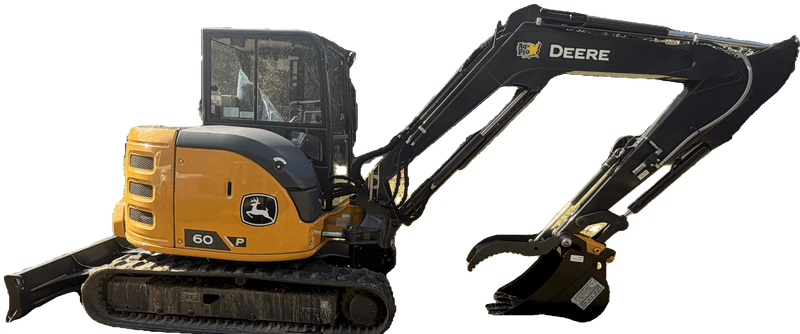
John Deere 60P
Compact excavator with a hydraulic thumb, a tooth bucket and a backfill blade.
Does the digging. John Deere lists 12 feet 4 inches of digging depth and 20 feet 5 inches of reach with the standard arm. The thumb lifts stumps and sets pipe, and the blade backfills.
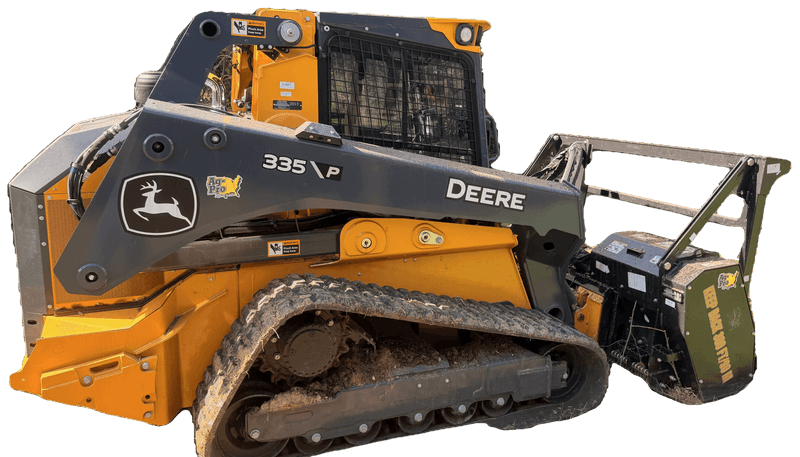
John Deere 335P
Compact track loader. A tracked carrier that swaps tools on its front.
Comes when there is dirt to carry. It moves what the excavator digs to where it gets spread.
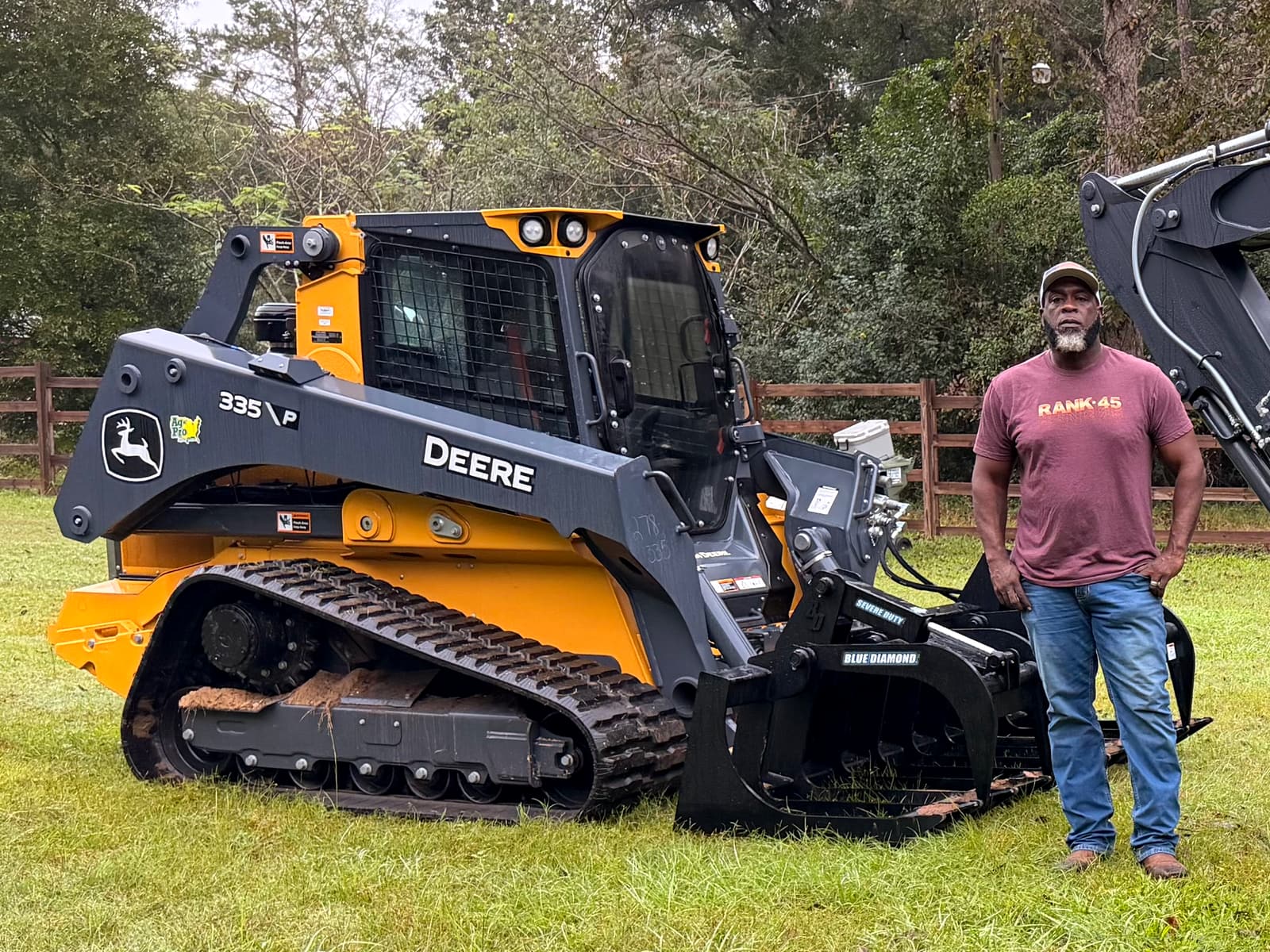
Blue Diamond root grapple
Root grapple. A steel rake with a hydraulic clamp, mounted on the 335P.
Goes on the 335P when stumps and roots come out. Loose dirt falls through its tines and stays on your land.


Sources (33)
Rules change. Every link below was read on November 11, 2026. Check with the office named before you act on it.
60 P-Tier Compact Excavator, product brochure ME60PAU (23-07), specifications on pages 6 and 7 (opens in a new tab). John Deere. Checked .
Florida Statutes, section 556.105: Procedures (notice before excavation, marking, tolerance zone) (opens in a new tab). The Florida Legislature, Online Sunshine. Checked .
Florida Statutes, section 556.102: Definitions (excavation, tolerance zone, business days) (opens in a new tab). The Florida Legislature, Online Sunshine. Checked .
Florida Statutes, section 556.108: Exemptions (opens in a new tab). The Florida Legislature, Online Sunshine. Checked .
Private Facilities (opens in a new tab). Sunshine 811. Checked .
The 811 Process (opens in a new tab). Georgia 811. Checked .
Georgia Utility Facility Protection Act, O.C.G.A. 25-9-3 and 25-9-6 (opens in a new tab). Georgia 811. Checked .
29 CFR 1926.652: Requirements for protective systems (opens in a new tab). Occupational Safety and Health Administration. Checked .
29 CFR 1926.651: Specific excavation requirements (opens in a new tab). Occupational Safety and Health Administration. Checked .
Environmental Resource Permitting (opens in a new tab). Florida Department of Environmental Protection. Checked .
Environmental Resource Permits (opens in a new tab). Northwest Florida Water Management District. Checked .
Florida Statutes, section 373.406: Exemptions (agriculture and silviculture) (opens in a new tab). The Florida Legislature, Online Sunshine. Checked .
Pond Management (opens in a new tab). Florida Fish and Wildlife Conservation Commission. Checked .
Farm Ponds in Florida Irrigation Systems (BUL257/AE143) (opens in a new tab). University of Florida, IFAS Extension. Checked .
Environmental Services: Frequently Asked Questions (opens in a new tab). Leon County Development Support and Environmental Management. Checked .
Rule 391-3-7-.01: Definitions (Erosion and Sedimentation Control) (opens in a new tab). Rules and Regulations of the State of Georgia, Georgia Secretary of State. Checked .
Official Code of Georgia, section 12-7-17: Exemptions (Erosion and Sedimentation Act) (opens in a new tab). State of Georgia, public copy linked from the Secretary of State rules site. Checked .
General Permit GAR100001: stormwater discharges from stand alone construction activity (opens in a new tab). Georgia Environmental Protection Division. Checked .
Driveway Connection Permit application (revised October 2020) (opens in a new tab). Gadsden County Planning Division. Checked .
Florida Statutes, section 335.1825: Access permit required (opens in a new tab). The Florida Legislature, Online Sunshine. Checked .
Planning, Zoning and Land Use (opens in a new tab). Jefferson County, Florida. Checked .
Road and Bridge Projects (driveway culvert permit and installation fee) (opens in a new tab). Holmes County, Florida, Board of County Commissioners. Checked .
Form DEP 4011: General permit for abandonment of an onsite sewage treatment and disposal system (opens in a new tab). Florida Department of Environmental Protection. Checked .
Well Permits: Frequently Asked Questions (opens in a new tab). Northwest Florida Water Management District. Checked .
Florida Statutes, section 403.707: Permits (solid waste), subsection 2, paragraph a (opens in a new tab). The Florida Legislature, Online Sunshine. Checked .
Dispelling Misperceptions About Trees (MG089) (opens in a new tab). University of Florida, IFAS Extension. Checked .
Conservation Subdivision, Construction Phase: Protecting Trees and Conserved Natural Areas (WEC278/UW323) (opens in a new tab). University of Florida, IFAS Extension. Checked .
Gadsden County Land Development Code, Chapter 5, Subsection 5404 (tree protection) (opens in a new tab). Gadsden County, Florida. Checked .
Gopher Tortoise Permits (opens in a new tab). Florida Fish and Wildlife Conservation Commission. Checked .
Official Series Description: Orangeburg series (opens in a new tab). USDA Natural Resources Conservation Service. Checked .
Official Series Description: Lakeland series (opens in a new tab). USDA Natural Resources Conservation Service. Checked .
Official Series Description: Pickney series (opens in a new tab). USDA Natural Resources Conservation Service. Checked .
Soil Data Access: soil survey of Gadsden County, Florida (survey area FL039), map units (opens in a new tab). USDA Natural Resources Conservation Service. Checked .