Forestry Mulching: Brush becomes mulch. The trees you flag stay.
The back lot grew up in privet and vines, and you can't walk it. We grind it to mulch where it stands and leave the trees you flag.
Quincy, Florida. Free estimates. Job minimum $2,000.

Is this what you need?
The back lot grew up
A few years ago you could walk to the fence. Now it is privet, briars and vines to the tree line, and you don't know what is living in it.
You bought land you can't see
You know the acreage from the deed, but you have never stood in the middle of it.
The fence line is gone
Privet and vines took the line years ago. A mulched strip along it gets you back to the posts, with room to walk it and mend it.
Good pines, a thick mess under them
The pines are worth keeping, and the hardwood brush, privet and vines under them are not. Mulching takes the understory and leaves the pines standing in open ground.
More on these
You bought land you can't see
Mulching opens it up without scraping it bare, so you can pick the house site and the keeper trees.
You can't burn where you live
Florida wants 300 feet between a home site burn pile and any occupied building that is not yours. On a lot in town there is often no such spot, and mulching needs no fire.
How I do it

What stays gets flagged
Every keeper is flagged before the machine comes off the trailer, roots included.
The machine opens it up
The MK76 grinds brush, vines and saplings to chips where they stand. Nothing is piled.
Around the keepers, the work slows down
Tracks stay off the root zone and the head stays off the bark.
A last look before the trailer is loaded
Walk it again while the machine is still there, and point out anything missed.
Every step in detail
See a range before anyone calls you
Draw the area on the instant quote map and mark what you want kept.Time: About 2 minutes
I walk it with you
We walk what goes and what stays. Free, at a set time, Monday to Friday.
What stays gets flagged
Every keeper is flagged before the machine comes off the trailer, roots included.
The machine opens it up
The MK76 grinds brush, vines and saplings to chips where they stand. Nothing is piled.
Around the keepers, the work slows down
Tracks stay off the root zone and the head stays off the bark.
A last look before the trailer is loaded
Walk it again while the machine is still there, and point out anything missed.
Afterward: keep it open
The roots are alive, so mow the sprouts while they are soft: bush hogging.
What it costs
- One acre of light brush
- $2,000 to $2,500
- One acre of brush and small trees
- $2,100 to $3,150
- One acre of heavy mixed growth
- $2,850 to $4,250
- Two acres of brush and small trees
- $4,250 to $6,250
Estimates, not quotes. I confirm the price on site, and the visit is free. Job minimum $2,000.
What moves the price
These are estimates from our online price tool, not quotes: a range is a range until I have walked the ground, and the visit is free.
Mature trees get a range too, but I look before any number is promised.
What is growing
The quote sorts your ground into four kinds: light brush, brush and small trees, heavy mixed growth, and mature trees. Each step up is slower work, so it costs more per acre.
How many acres
A small lot is priced as a job, not by the acre. On bigger jobs the per acre figure comes down.
How many trees stay
Protecting trees is not a line on your bill. But tight work around a lot of keepers is slower than open ground.
Wet ground and slope
Soft ground, hills, banks and ravines slow the machine. Tell the quote tool, and the range gets wider to say so.
Getting to it
The mulching head is 7 feet 7 inches wide. A narrow gate or a long way in from the trailer adds time.
Distance from Quincy
We work about 100 miles out from Quincy. Close in, there is no delivery charge. Farther out, the quote adds equipment delivery as its own line, so you can see it.
What is hiding in the brush
Old wire, roofing tin, a junk pile or a slab has to come out before the head goes through. That is hauling and debris removal.
How clean you want it
A rough first pass and a fine, even finish are different amounts of machine time.
What stays protected
The walk comes before the machine
I walk the ground with you, and what you want kept is flagged before the loader comes off the trailer. It is in our name: Land Clearing and Preservation.
A tree is wider underground than it looks
I keep the tracks off the roots, not only off the trunk.
Where the line goes
The line for each of your trees gets settled on the walk, before a machine starts.
More on what stays protected
A tree is wider underground than it looks
UF/IFAS says the roots of a tree in the woods often reach as far from the trunk as the tree is tall, and even one pass of heavy equipment over them can do real damage.
Where the line goes
The University of Florida's rule of thumb is the drip line, the outer edge of the branches, and Gadsden County sets one foot of radius for every inch of trunk on development sites. Those are the published yardsticks, and our guide on protecting trees has them all.
In a stand of keepers, the care is in how the machine travels
No machine can stay off every root in a stand of pines. So I work on dry soil, drive on top of the fresh chips and make as few passes as the job takes, which is what extension foresters list as limiting the harm.
The soil stays where it is
A mulching head cuts at ground level and does not dig, so the roots and the topsoil stay put. Virginia Cooperative Extension says clearing with a bulldozer nearly always destroys the topsoil.
A cover of chips where bare dirt would be
The chips lie where the brush stood. University of California extension foresters credit that layer with reducing erosion and holding moisture in the soil. It slows washing. It does not stop it.
No burn pile and no haul trucks
Nothing is piled, so nothing is lit and nothing is trucked across your yard. One machine comes in on rubber tracks.
A real job
A lot beside the street had grown shut with brush and vine. We mulched it with the John Deere 335P and the MK76 head and left big trees standing.


Thomasville, Georgia. Posted November 2026.
See the whole job: Thomasville, Georgia: a roadside lot grown shut with vine
Questions I get asked
How much does forestry mulching cost per acre?
It depends on what is growing. On flat, dry ground the per acre figures start at about $1,530 to $2,250 for light brush, $2,125 to $3,125 for brush and small trees and $2,890 to $4,250 for heavy mixed growth. No job is under $2,000, and the per acre figure comes down on bigger jobs. Those are estimates: I confirm the price after I walk it, and the visit is free.
How big a tree can the mulcher take?
John Deere rates our MK76 head for vegetation up to 8 inches thick. Brush, vines and saplings go fast, and stems near the limit go slower and leave bigger pieces. Grown trees past that are not mulched: they stay, or they come down as land clearing. That gets sorted out tree by tree on the walk.
Does forestry mulching remove stumps?
No. The head grinds a stem down to about ground level, and the root ball stays in the ground. For a yard, a view, a trail or a pasture that is usually fine: Virginia Cooperative Extension says most pine stumps rot away in three to five years, and hardwood stumps take anywhere from a few years to decades. Under a house pad, a driveway or a septic system, stumps usually have to be dug out with the excavator, which is land clearing.
Will the brush grow back?
Some of it will, because mulching cuts the top of the plant and leaves the roots alive. So plan the second step with the first: mow the sprouts while they are soft, which is bush hogging. For privet, UF/IFAS describes treating the new sprouts with herbicide, and your county extension office can tell you what to use.
How deep is the mulch, and do I have to rake it up?
It depends on how much was standing: more wood, more mulch. On the Thomasville lot in our photos the layer is thin, and soil shows through it. You do not rake it, because it breaks down where it lies, small pieces first. Deeper is not better: University of California extension foresters say the variety of plants that come back can drop significantly where the layer is more than 4 inches deep, so if you plan to seed grass or plant something, tell me on the walk.
More questions
Will clearing the brush cut down on snakes and ticks?
It takes away cover. UF/IFAS says tall grass, overgrown shrubs and piles of brush or wood can give snakes places to hide, and mulched ground lets you see where you put your feet and leaves no brush pile behind. For ticks, the CDC says to keep grass mowed and clear tall grass and brush, and notes that fewer blacklegged ticks have been found on well kept lawns that are not near brushy or grassy areas. Nobody can promise you land with no snakes and no ticks, and UF/IFAS also says most snakes people meet around homes are not venomous.
Can you mulch wet ground, or right after a heavy rain?
Not well. Tracks on soaked soil cut ruts and pack the ground, and Oregon State and University of California extension guides both say to run this kind of equipment when the soil is dry. A low spot that dries out in a dry spell can be done then. Ground that holds water all year should be left alone: in the Florida Panhandle the Northwest Florida Water Management District regulates digging and filling in wetlands, isolated ones included, so check with the district before anybody clears a wet area.
How long does it take?
Virginia Cooperative Extension puts mulching at one to eight machine hours an acre, depending on what is growing, the ground and how clean you want it. By that yardstick a brushy house lot is usually a day, and a couple of acres is a day or two. Those are estimates from a published figure, not a promise, so ask me for my own number for your ground on the walk.
Can you mulch during a burn ban?
Yes. Mulching lights no fire, so it needs no burn authorization and no burn permit. If a ban is on where you live, ask the office that issued it whether it covers anything besides burning.
Do I need a permit to have land mulched?
Sometimes. It depends on the county, the trees and what the land will be used for, and a protected tree is protected no matter which machine cuts it. Call the planning office for your parcel before work starts: Gadsden County Planning is at (850) 875-8663 and Tallahassee Growth Management at (850) 891-7001.
Can I watch while you work?
Be there for the walk at the start and the look at the end. In between, stay well back. The mulching head carries a warning to keep back 300 feet, because the drum throws chips and sticks. That goes for kids, dogs and the neighbor who wants a closer look.
Is the ground ready to build on after mulching?
No. Mulched ground has stumps at ground level, roots under them and a layer of wood on top, and a house pad or a driveway needs the stumps out and the ground shaped. Mulching is still a good first move on land you cannot see, because it lets you pick the house site before anything is dug. The pad itself is site preparation.
Will the machine tear up my yard?
It leaves marks: you can see the track prints in our Thomasville after photo. The 335P runs on rubber tracks, not steel, and it is one machine, not a line of trucks, but John Deere lists the loader at 12,300 pounds and the head at 2,980 more. On a lawn you care about, show me where the machine may drive and where it may not. Soft, wet ground marks the worst.
How do you know where my property line is?
You show us. We clear to the line you mark, and we are not surveyors. If the corners are lost in the brush, have a surveyor set them before the machine comes. A line mulched in the wrong place cannot be put back.

The details
The longer answers, for when you want them.
What it is, in plain words
Forestry mulching is one machine doing three jobs in one pass. It cuts the brush, grinds it up and spreads it. What was standing ends up as a layer of wood chips on the same ground.
Ours is a John Deere 335P compact track loader with a John Deere MK76 mulching head on the front. The head is a steel drum that cuts a path 76 inches wide. A push bar on top leans the stem over, and the drum grinds it down to about ground level.
John Deere rates this head for vegetation up to 8 inches thick. That is the maker's ceiling, not the everyday diet. Privet, vines, briars and saplings go fast. A stem near the limit takes longer and leaves bigger pieces. John Deere's published figures for both machines are on the equipment page.
What it leaves behind
Behind the machine you get open ground under a layer of shredded wood. Stumps are cut to about ground level and the roots stay in the soil. You will also see track marks. They show in our own after photo from Thomasville, and we did not crop them out.
What it does not do
It does not pull stumps. It does not level ground. It does not kill roots, so some of what was cut will sprout again.
Right call or wrong tool
The right call
A house lot or a back acre grown up in brush, privet and vines
This is the job the head is built for. The stems are small, the machine keeps moving, and you get your ground back with nothing to burn and nothing to truck away.
Land you just bought and want to see before you decide anything
Mulching leaves your options open. The soil is in place, the big trees are standing and nothing has been graded. You walk it first. Then you decide where the house, the drive and the shade go.
Underbrush under pines or oaks you are keeping
The head is 7 feet 7 inches wide. Where your keeper trees stand farther apart than that, the machine can work between them and take the understory out from under them. Show me the stand on the walk.
Fence lines, trails, lanes and field edges
A mulcher clears a strip and leaves no pile at the end of it. You can walk the line as soon as the machine has passed.
Pasture or field edges gone to saplings too thick to mow
When the stems are past what a tractor and cutter should take, the mulching head brings them down. After that the ground can be kept open with bush hogging.
A lot with houses close by, where a burn pile has no legal place to sit
Florida requires an authorization for every land clearing pile burn. On a home site the pile must sit 300 feet from any occupied building other than your own. It must also sit 100 feet from a paved public road. Mulching needs none of that.
A slope or sandy ground you do not want washing away
Mulching leaves the roots in the soil and a cover of chips on top of it. University extension foresters credit that cover with reducing erosion. A blade leaves bare dirt.
The wrong tool
Big timber
Instead: John Deere rates the MK76 for vegetation up to 8 inches thick. Grown pines and hardwoods past that are not a mulching job. They stay and we mulch around them, or they come down as land clearing. If the timber may be worth money, talk to a forester before anyone cuts it.
Stumps that have to come out for a foundation, a driveway or a septic system
Instead: A mulching head works at ground level. The root ball stays in the dirt. Under a house pad, a driveway or a drain field, stumps and roots usually have to be dug out with the excavator. That is land clearing or site preparation.
Ground that has to be graded
Instead: Mulching does not move dirt. It leaves the ground the shape it found it, with wood chips on top. If you need a pad built, a slope cut or water turned, that is grading, and the stumps under that spot come out first.
Standing water and soft, wet ground
Instead: Tracks on soaked ground cut ruts and pack the soil. University extension guides say to run this kind of machine when the soil is dry. The fix is timing: mulch it in a dry spell, or leave the wet part alone. Whether a low spot is a wetland is not your call or ours. In the Florida Panhandle, ask the Northwest Florida Water Management District before anything is cleared there.
You want it gone for good in one visit
Instead: Mulching cuts the top of the plant and leaves the roots alive. Privet, mimosa and most hardwood brush sprout back. Plan on mowing the sprouts, which is bush hogging, and on treating the worst of it.
A patch of cogongrass
Instead: Machines do not kill cogongrass. UF/IFAS says mechanical control alone does not work on an established patch. In forests, it says, the only treatment that works is herbicide. It also warns that soil and equipment can carry the grass to new ground. Show us the patch on the walk so nothing gets dragged through it. If you are not sure it is cogongrass, ask your county extension office.
Bare, smooth dirt ready for sod
Instead: Mulching leaves wood on the ground, not clean soil. Some owners like the look and some do not. If you want a lawn right away, say so on the walk. It changes the plan, and it may change the service.
Fire protection
Instead: Chips on the ground are still fuel. Oregon State University Extension says mulching can lower the odds of fire climbing into the treetops. It also says a ground fire may burn hotter for a while, because more fuel is lying there. We will not sell it to you as fireproofing.
How long it takes
Typical time on site. Estimates, not promises.
- One acre, by the published yardstick
- 1 to 8 machine hoursThe range Virginia Cooperative Extension gives for mulching an acre. It says pine goes easier and small sites go faster. Rocky ground, rough terrain and a cleaner finish slow it down. It is a Virginia figure, not our own pace.
- A house lot under an acre, in brush and vines
- Usually within one working day (estimate)Worked out from that same yardstick, not from a count of our own jobs.
- Two acres of brush and small trees
- About 1 to 2 working days (estimate)Same yardstick: 2 to 16 machine hours.
- Five acres of mixed brush
- Up to about a working week (estimate)Same yardstick: 5 to 40 machine hours. The spread is wide because growth varies. Ask me to narrow it for your ground on the walk.
- After heavy rain
- Wait for the ground to firm upTracks on soaked soil cut ruts. Extension guides say to work it dry.
- From the walk to the first cut
- Ask me on the walkIt depends on the jobs ahead of yours and on dry ground.
Rules, permits and more to know
Mulching or stumps out: which job is yours
There are two ways to open up grown over land, and they leave different ground behind. The question that sorts them is simple. Is anything going to be built or poured on that spot?
| Compared on | Forestry mulching | Land clearing, stumps out |
|---|---|---|
| What happens to the brush | Ground into chips that stay on the ground. | Taken down and piled. A pile then has to be burned or hauled. |
| Stumps and roots | Cut to about ground level. Roots stay. | Dug out with the excavator. |
| The soil | Stays in place under the chips. | Disturbed. Roots take topsoil with them when they come out. |
| Burning | None. Nothing to light. | A pile burn needs a state authorization in Florida or a permit in Georgia, and room for the setbacks. |
| Trucks | None. Nothing leaves. | Needed if the debris is hauled off. |
| Ready for a house pad | No. Stumps and roots are still in the ground. | Closer. The pad itself is site preparation. |
| Best for | Seeing, walking and using the land. Views, trails, fence lines, pasture, the ground under keeper trees. | House sites, driveways, septic areas, anything that gets dirt work. |
Bottom lineIf you want to see it, walk it and use it, mulch it. If something will be built or poured on that spot, the stumps have to come out, and that is land clearing. Plenty of jobs are both: mulch the acreage, clear the house site.
The burn pile you do not need
A lot of people land on mulching after they look up what a burn pile takes. These are the rules a pile would have to meet. A mulching job meets them by not having a pile.
Florida
Every land clearing pile burn needs an authorization from the Florida Forest Service. On a home site, the pile must be 300 feet from any occupied building other than the landowner's. It must be 100 feet from a paved public road and 50 feet from woods or brush. On commercial and subdivision sites it is 1,000 feet from occupied buildings. The piles must be dry and attended at all times. For Gadsden, Leon and Jefferson counties, the office is the Tallahassee Forestry Center at (850) 681-5951.
Georgia
Burning debris from machine clearing needs a permit from the Georgia Forestry Commission. A permit is good only for the day it is issued. State rules put a land clearing burn at least 1,000 feet from any occupied structure unless the state approves less. The commission is at 1-800-GA-TREES.
Show us on the walk
An operator in a closed cab sees brush, not what is under it. The walk is where you tell us what the machine cannot see.
- The trees you want kept, down to the one.
- The septic tank, the drain field, the well and any shallow water line.
- The property line and the corners, if you know them.
- Wet spots, even the ones that are dry today.
- Old wire, tin, slabs and junk in the brush.
- Any animal burrow in sandy ground.
Gopher tortoise burrows in Florida
Florida protects gopher tortoises and their burrows. The Florida Fish and Wildlife Conservation Commission counts any work within 25 feet of a burrow as disturbing it. That takes a permit from the commission first. Work that stays at least 25 feet back may not need one. If there is a burrow on your land, the machine stays back from it or the job waits.
After the mulcher: keeping it open
Mulching buys you open ground. It does not buy you dead roots. The follow up is what keeps it open.
Mow the sprouts while they are soft
Tall Timbers, the Red Hills research station at Tallahassee, says mowing favors grasses and knocks back woody sprouts. That is tractor and cutter work: bush hogging.
Treat what mowing will not hold
For privet, UF/IFAS describes cutting the thicket for access and then treating the new sprouts with herbicide. Ask your county extension office which product fits your land.
Walk it a few times the first year
UF/IFAS warns that ground disturbed by heavy equipment can let invasive plants move in, and says to watch it afterward. A new patch is easier to deal with when you catch it early.
Under pines, think about fire
Tall Timbers calls frequent fire and periodic thinning the two most important ways to keep a forest and its ground cover healthy. Mulching the hardwood brush opens the stand so fire can get back on the ground. The Florida Forest Service can tell you what a prescribed burn takes.
The equipment and the sources
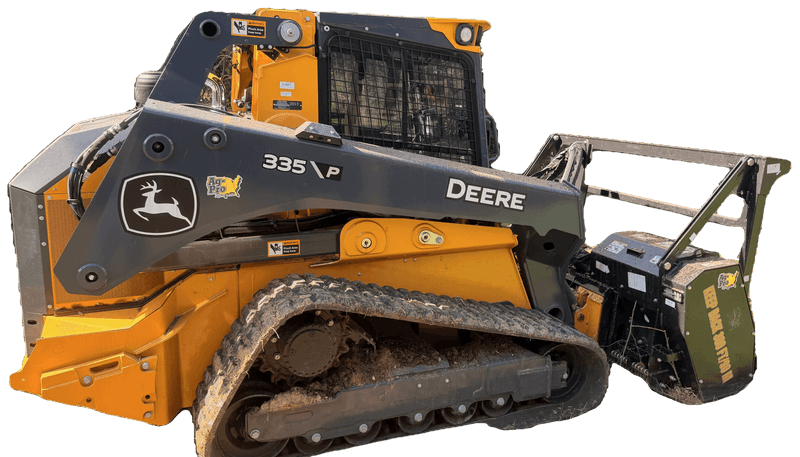
John Deere 335P
Compact track loader. A tracked carrier that swaps tools on its front.
Carries the head and powers it. It runs on rubber tracks, with a closed cab and a wire mesh guard over the cab glass.
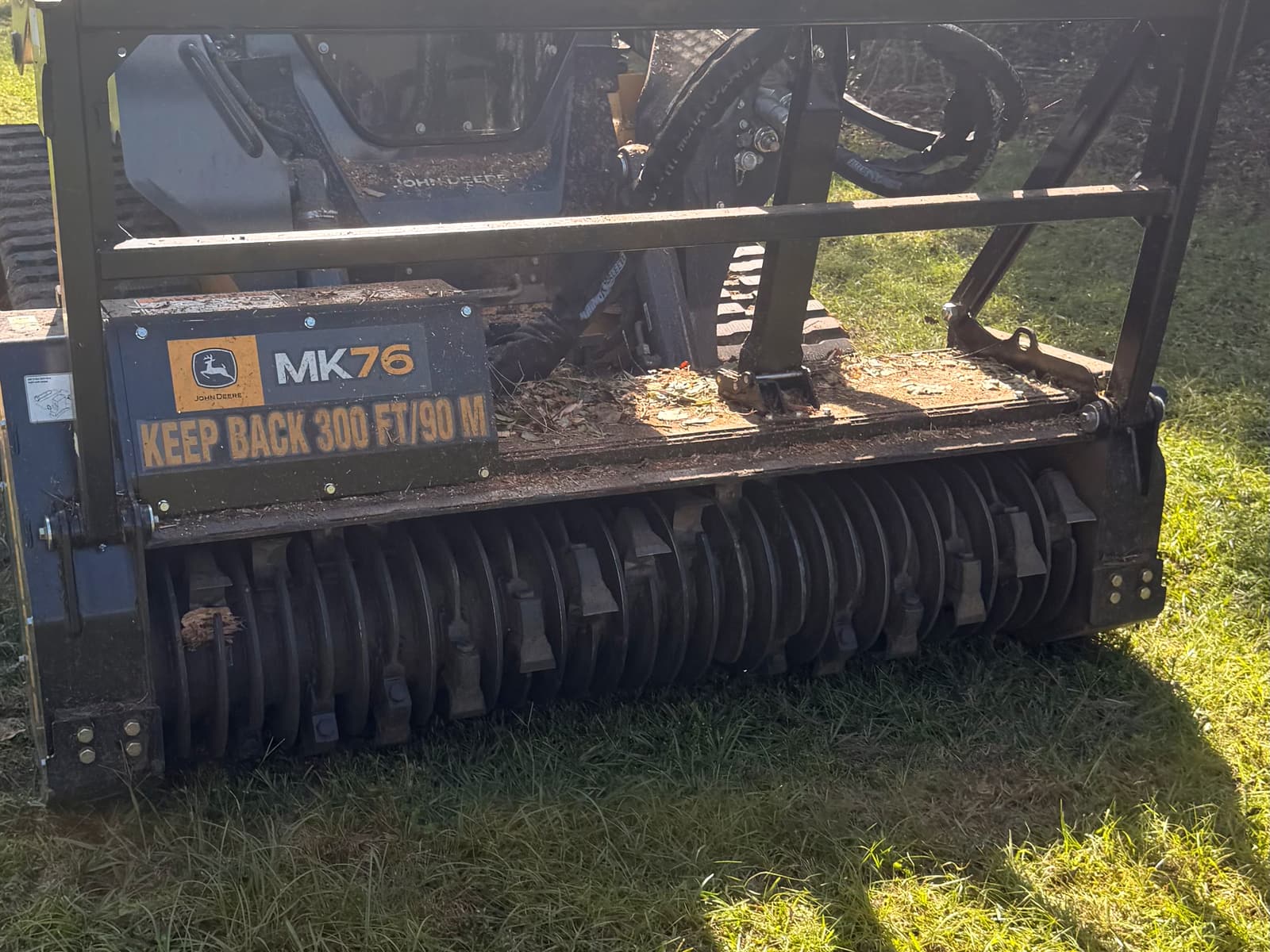
John Deere MK76 mulching head
Forestry mulching head. A steel drum of cutting teeth that mounts on the front of the 335P.
Does the cutting. A drum that cuts 76 inches wide, rated by John Deere for vegetation up to 8 inches thick.

Sources (23)
Rules change. Every link below was read between November 11 and November 12, 2026. Check with the office named before you act on it.
335 P-Tier Compact Track Loader, specification sheet MK335CAU (opens in a new tab). John Deere. Checked .
MK76 Mulching Head, Compact Equipment Attachment: benefits and specifications (opens in a new tab). John Deere. Checked .
Options for Clearing Land to Establish Pasture (publication 465-341) (opens in a new tab). Virginia Cooperative Extension. Checked .
Mastication Considerations for Forest Landowners (opens in a new tab). University of California Cooperative Extension. Checked .
Reducing Hazardous Fuels on Woodland Property: Mechanical Treatments (EC 1575) (opens in a new tab). Oregon State University Extension Service. Checked .
Dispelling Misperceptions About Trees (MG089) (opens in a new tab). University of Florida, IFAS Extension. Checked .
Conservation Subdivision, Construction Phase: Protecting Trees and Conserved Natural Areas (UW323) (opens in a new tab). University of Florida, IFAS Extension. Checked .
Protecting Trees During Construction (opens in a new tab). University of Florida, IFAS Gardening Solutions. Checked .
Gadsden County Land Development Code, Chapter 5, Subsection 5404: Tree and Native Vegetation Protection Standards (opens in a new tab). Gadsden County, Florida. Checked .
Tree Removal and Clearing Permit Application (opens in a new tab). Gadsden County, Florida, Planning Division. Checked .
Tree Permit (opens in a new tab). City of Tallahassee, Growth Management. Checked .
Controlling Invasive Plants in North Florida Forests (FR133) (opens in a new tab). University of Florida, IFAS Extension. Checked .
Biology and Control of Cogongrass (Imperata cylindrica) in Southern Forests (FR411) (opens in a new tab). University of Florida, IFAS Extension. Checked .
Land Management: Managing Forest Resources (opens in a new tab). Tall Timbers. Checked .
Know the Law: Land Clearing Debris Burns (opens in a new tab). Florida Department of Agriculture and Consumer Services, Florida Forest Service. Checked .
Burn Permits and Notifications (opens in a new tab). Georgia Forestry Commission. Checked .
Open Burning Rules for Georgia: Burn Types (opens in a new tab). Georgia Environmental Protection Division. Checked .
Summer Open Burning Ban (opens in a new tab). Georgia Environmental Protection Division. Checked .
Gopher Tortoise Permits (opens in a new tab). Florida Fish and Wildlife Conservation Commission. Checked .
Environmental Resource Permits (opens in a new tab). Northwest Florida Water Management District. Checked .
Dealing with Snakes in Florida's Residential Areas: Preventing Encounters (UW260) (opens in a new tab). University of Florida, IFAS Extension. Checked .
Preventing Lyme Disease (opens in a new tab). Centers for Disease Control and Prevention. Checked .